
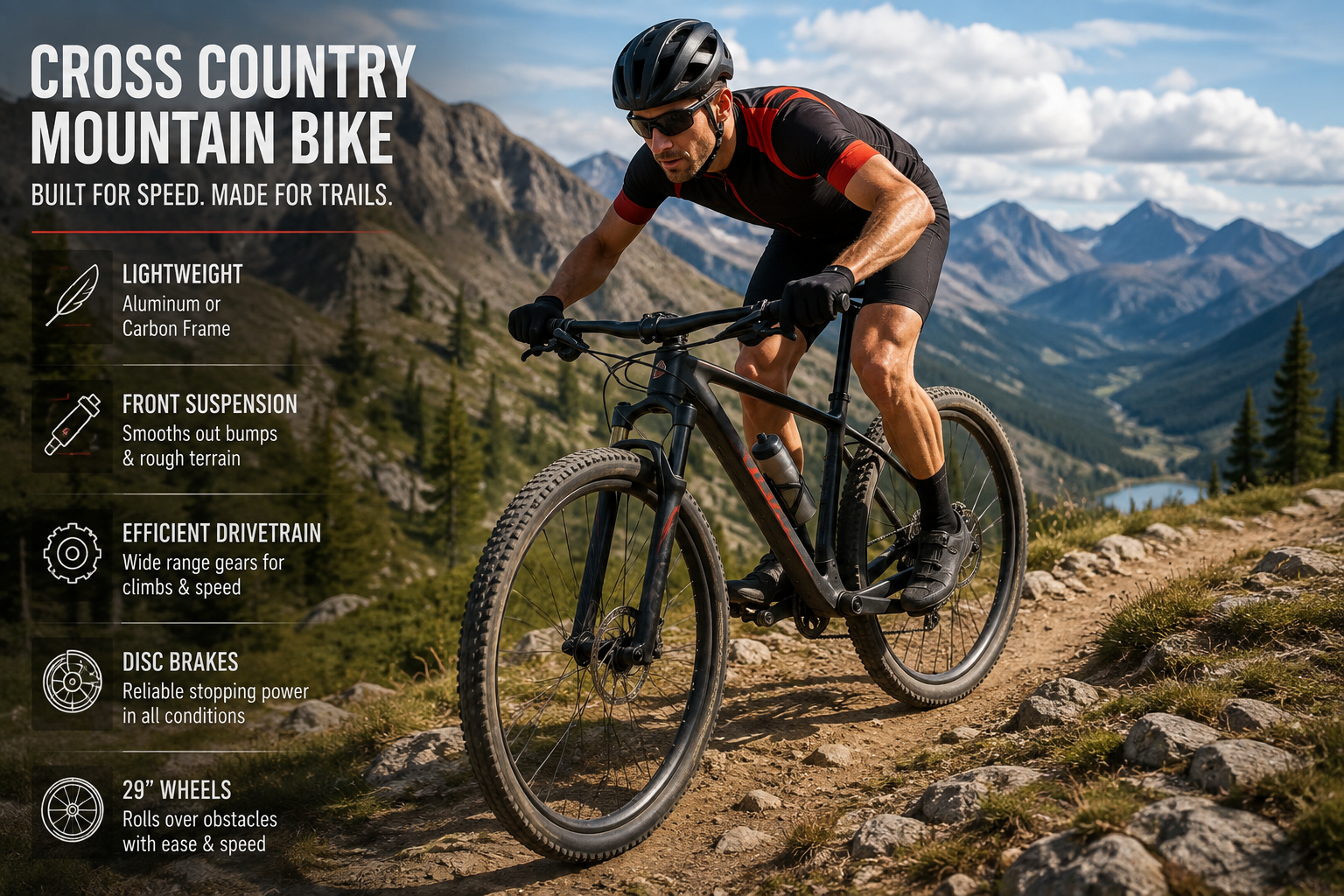
Introduction
Cross country mountain biking sits at an interesting crossroads in 2026.
On one side, you have the traditional image of the category: featherlight carbon bikes ridden at maximum effort by elite racers in lycra, battling wheel-to-wheel around tight, punishing circuits. On the other, you have an entirely new generation of XC bikes that are genuinely fun on singletrack, capable on technical descents, and ridden by regular cyclists who simply want to cover big distances quickly and efficiently.
Both of those things are now true at the same time — and that’s what makes the cross country mountain bike one of the most exciting and most misunderstood categories in cycling right now.
Whether you’re a first-time buyer trying to figure out whether an XC bike is right for you, a weekend trail rider looking to go faster, or someone planning their first XCO race, this guide gives you everything you need to make a great decision in 2026 — without the jargon or the brand bias.
What Is a Cross Country Mountain Bike?
The XC Discipline Explained
XC stands for cross-country — a discipline focused on endurance, efficiency, and fitness. XC bikes are lightweight and fast, optimized for smooth pedaling and climbing performance on rolling terrain or long-distance races. They’re built to go far and go fast, not necessarily to handle big jumps or rough descents.
The racing format that defines the category is XCO — Cross-Country Olympic. Cross-country is one of the most exciting disciplines within mountain biking. Races are often close, with elbow-to-elbow action right until the line, and the best cross-country mountain bikes combine everything we love about mountain biking — riding fast, uphill and downhill.
But you don’t need to race to want a cross country bike. Plenty of recreational riders choose XC bikes because they prioritize efficiency, fitness riding, and covering long distances on varied terrain.
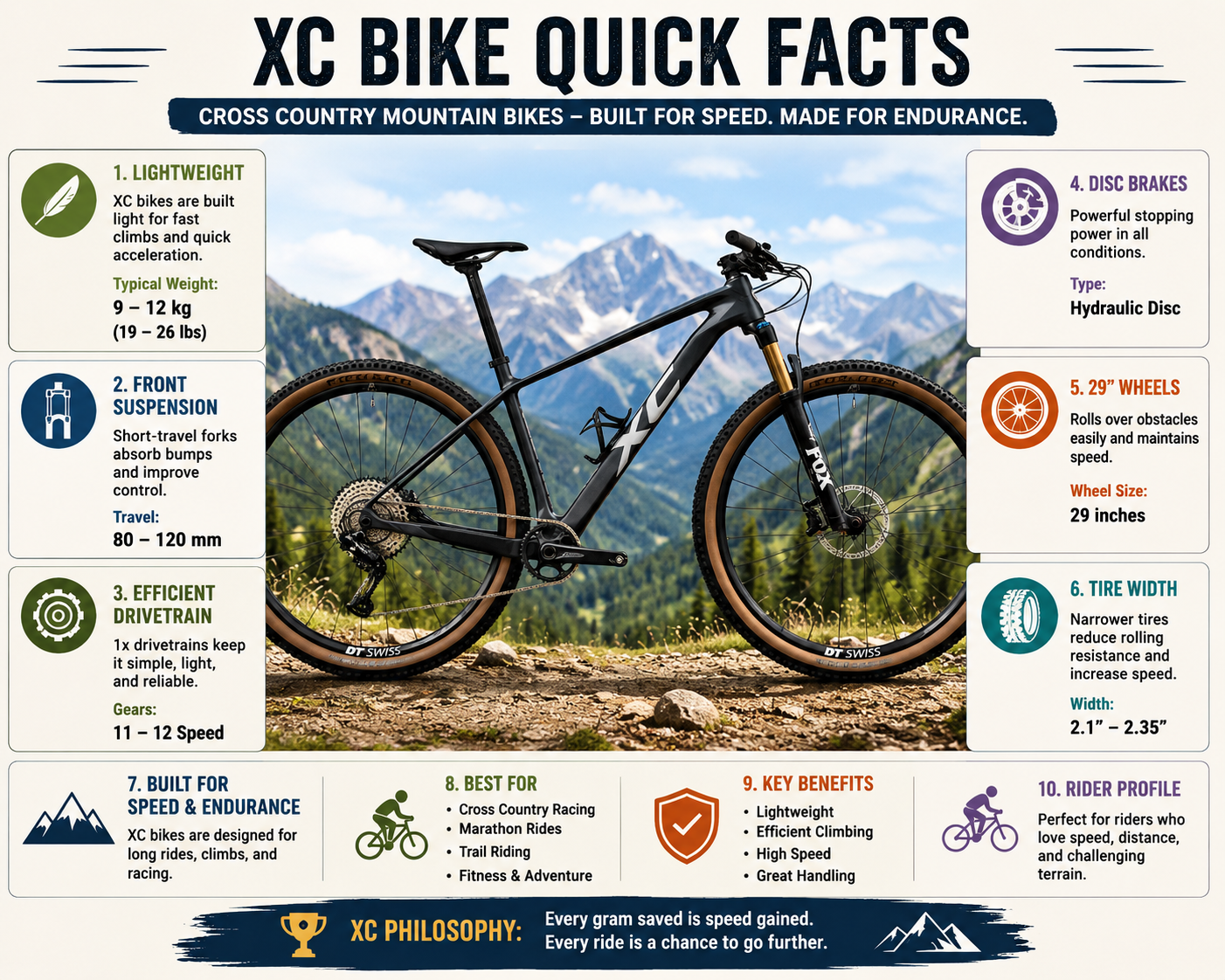
XC Bike Quick Facts (2026)
| Specification | Typical Range |
|---|---|
| Suspension Travel (FS) | 80–120mm |
| Suspension Travel (Hardtail) | 80–100mm (front only) |
| Weight (Carbon FS) | 9–12 kg |
| Wheel Size | 29″ (dominant) / 27.5″ (smaller riders) |
| Head Angle | 67–68.5 degrees |
| Seat Tube Angle | 74–78 degrees |
| Price Range | $1,500–$15,000+ |
| Best For | Racing, fitness riding, long-distance trail riding |
How XC Has Changed in 2026
Here is the thing that surprises most first-time XC bike shoppers: Cross-country bikes have come a long way from their weight-obsessed roots. Today’s short-travel XC bikes balance efficiency with real-trail capability, built to cover big distances without sacrificing confidence when the descents get rough. Whether you’re lining up for an XCO race or linking together backcountry ridges, cross-country bikes are light, fast, and surprisingly fun to ride.
The top cross-country racers in the world used to all ride hardtails for minimum weight, but tougher courses mean most of the best XC mountain bikes are now full-suspension models. The great news is that the shift has led to some really versatile high-velocity, short-travel machines that are as happy raving on your favourite singletrack as they are ripping up a race course.
Geometry has also evolved significantly. Head angles as slack as 67 degrees and reach figures once only seen on trail bikes are not uncommon on modern cross-country bikes. They will also have steeper seat angles of around 74 to 75 degrees, which puts a rider’s hips in a better position.
Types of Cross Country Mountain Bikes
XC Hardtail
Many cross-country mountain bikes are hardtails, meaning they have no rear suspension. A rigid back end makes your pedaling more efficient, as the bike doesn’t bob up and down. In addition to the efficiency, the lack of rear suspension components makes the bike lighter and simpler to maintain. The downside of riding a hardtail cross-country mountain bike is that it can be challenging to ride technical terrain. But you can compromise by riding a cross-country mountain bike with short-travel rear suspension.
Best for: Budget-conscious buyers, fitness-first riders, beginners learning technique, racers on tight budgets.
Example hardtails: Lapierre Prorace 3.0, Canyon Exceed CF, Trek X-Caliber
XC Full Suspension
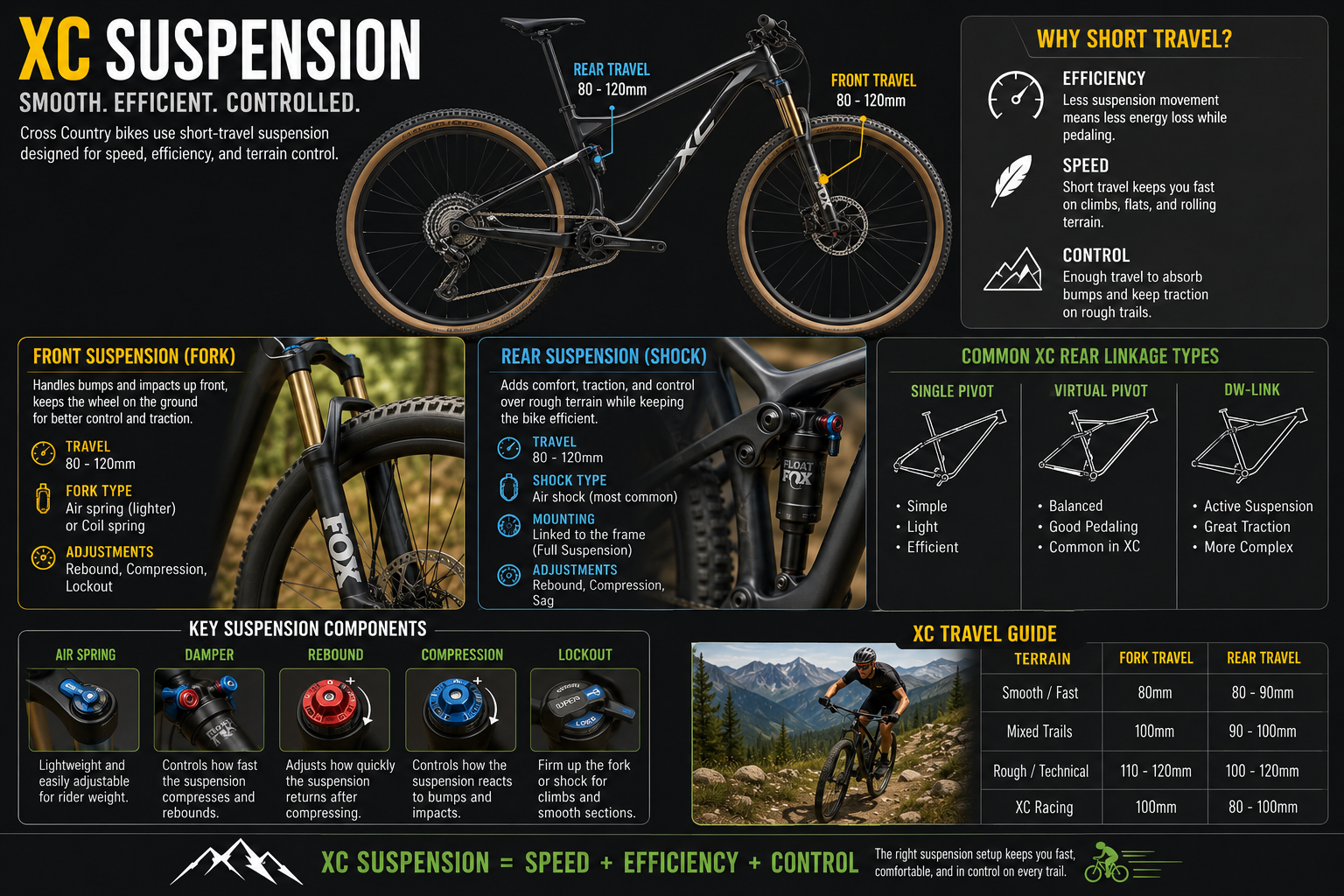
A full suspension cross-country mountain bike will have between 80mm and 120mm travel, which will help with its off-road prowess. Most of these suspension systems have a lockout to make riding uphill easier.
Full-suspension XC bikes dominate the top levels of racing and are the go-to for riders on more technical terrain. They are more expensive and heavier than hardtails but deliver noticeably better traction, control, and comfort.
Best for: Competitive racers, technical terrain riders, anyone regularly riding rougher trails.
Example full-sus XC bikes: Specialized Epic 9, Trek Supercaliber Gen 2, Giant Anthem, Canyon Lux CFR
Downcountry (The New Middle Ground)
A newer category, downcountry, bridges the gap between XC and trail. Bikeperfect divides this guide into XC race bikes, downcountry bikes, and fast trail bike options — these three categories span speed-orientated bikes.
Downcountry bikes typically feature 110–130mm of travel, slightly more relaxed geometry than pure XC, and are designed for riders who want XC efficiency but trail bike capability. Think of them as XC bikes with a confidence boost on descents.
Best for: Recreational riders who want speed AND fun, trail riders who want to go faster uphill, riders who can’t decide between XC and trail.
Example downcountry bikes: Rocky Mountain Element, Yeti ASR, Trek Top Fuel
XC Race Bike vs. XC Recreational Bike
| Feature | XC Race Bike | XC Recreational Bike |
|---|---|---|
| Frame | Ultralight carbon | Carbon or alloy |
| Components | Top-spec groupset | Mid-range groupset |
| Travel | 80–100mm | 100–120mm |
| Weight | 9–11 kg | 11–14 kg |
| Price | $5,000–$15,000+ | $1,500–$4,500 |
| Intended Use | UCI racing, podiums | Fitness rides, trail days, gran fondos |
Cross Country Mountain Bike Geometry — Explained
Geometry is one of the most important — and most confusing — topics in XC mountain biking. Here is what each number actually means for your ride.
Head Angle
The head angle controls how the front wheel steers. Head angles have largely stabilized into well-defined ranges for each category. Trail bikes have settled around 65–66.5 degrees, enduro bikes at 63–65 degrees, and cross-country bikes at 67–68.5 degrees.
A steeper head angle (67–68.5°) makes the bike faster to respond to steering inputs — great for climbing, cornering efficiently, and riding at XC race pace. The tradeoff is slightly less stability on very steep or technical descents compared to trail bikes.
Seat Tube Angle
If there’s one measurement that’s still actively evolving, it’s the seat tube angle. Modern trail and enduro bikes now commonly run effective seat angles of 77–78 degrees, up from 73–74 just five years ago. Some cross-country bikes push past 78 degrees.
A steep seat tube angle keeps your hips directly over the pedals on climbs, maximizing pedaling power. For XC riders covering big elevation on every ride, this matters enormously.
Reach & Stack
Reach is the horizontal distance from the bottom bracket to the head tube. Cross-country geometry is all about optimising speed and power by putting the rider in an aggressive pedalling position. XC bikes have comparatively steeper head angles (often 67 to 71 degrees) and shorter reach measurements, paired with long stems. This positions the rider’s weight over the front of the bike and allows for powerful pedalling.
Wheelbase & Chainstay Length
Uphill manoeuvrability takes priority over descending stability and XC bikes often have a considerably shorter wheelbase than their trail counterparts. Cross-country bike geometry is largely centred around creating a platform for optimal power delivery.
Key Components on an XC Bike
Suspension Travel & Forks
Stiff and brutally efficient, cross-country bikes are either hardtails, meaning they have no rear suspension, or they have about 100mm of rear suspension.
Most high-end XC full-suspension bikes use a lockout system — a lever that stiffens the suspension for climbing efficiency and releases it for technical descents. The Trek Supercaliber takes this further. The 2026 Trek Supercaliber Gen 2 is Trek’s ultimate XC race bike, featuring the innovative IsoStrut rear suspension system that integrates the shock into the top tube for a clean, efficient design. With 110mm of front travel and 80mm of rear travel via the RockShox SIDLuxe IsoStrut shock, the Supercaliber delivers just enough suspension compliance to maintain traction without sacrificing the razor-sharp efficiency that XC racers demand.
Drivetrain (Gearing for XC)
XC bikes use 1x (single-chainring) drivetrains almost universally at the mid-to-high price point. Shimano XT and XTR, SRAM GX and XX, and SRAM AXS wireless are the groupsets most commonly found on XC bikes.
A wide gear range matters enormously on XC bikes — you need very low gears for steep climbs and high gears for sprinting and flat sections. Most XC builds use 10–51t or 10–52t cassettes for maximum range.
Wheels & Tires
Most XC bikes use 29-inch wheels for speed and efficiency. XC tires have a smoother tread for less rolling resistance, while trail tires feature more aggressive patterns for better grip on rough terrain. XC bikes typically run higher tire pressures for speed, while trail bikes use lower pressures for better traction and comfort.
29-inch wheels dominate XC racing because they roll over obstacles more easily, maintain momentum better, and provide better traction across the wide variety of terrain typical of XC courses.
The big difference comes in the construction and tread, with XC tyres tending to be lighter, with smaller knobs to help them roll faster. Typical XC tires: Maxxis Rekon Race, Schwalbe Racing Ray/Ralph, Continental XKing.
Handlebars & Cockpit
XC bikes use narrower handlebars (typically 720–760mm) and shorter stems compared to trail or enduro bikes. This positions the rider more aggressively forward, improving climbing traction and aerodynamics. Many 2026 XC bikes feature integrated cockpits — combined stem and bar units that save weight but limit adjustability.
Brakes
Most XC bikes use 160mm rotors front and rear. Unlike enduro bikes with 200mm+ rotors, XC bikes prioritize weight savings over maximum stopping power. Shimano XT, SRAM Level, and SRAM Code are all common XC brake options.
Cross Country Mountain Bike vs. Trail Bike — Full Comparison
This is the single most searched question in the XC bike category. Here is the clearest breakdown available.
Geometry Differences
| Measurement | XC Bike | Trail Bike |
|---|---|---|
| Head Angle | 67–68.5° | 65–66.5° |
| Seat Angle | 74–78°+ | 76–78° |
| Wheelbase | Shorter | Longer |
| Reach | Moderate | Longer |
| Riding Position | Forward, aggressive | More upright, balanced |
Suspension Differences
Cross-country bikes typically run around 100 millimeters of rear travel and are built for efficiency on rolling terrain. Trail bikes sit in the 125–150mm range and handle almost anything. Enduro bikes push into the 150–170mm range for rougher, steeper riding. The more travel, generally the more downhill-focused the bike.
Weight Differences
A trail bike is more comfortable and forgiving on rough terrain, while a hardtail is usually cheaper, simpler, and easier to maintain. XC mountain bikes are lighter, more efficient, and better for climbing and racing.
A typical carbon XC full-suspension bike weighs 9.5–11.5 kg. A comparable trail bike weighs 12–14 kg. That 1.5–2.5 kg weight difference is significant when you’re climbing 1,000+ meters over a long day.
Which Rider Should Choose Which?
| Choose an XC Bike If You… | Choose a Trail Bike If You… |
|---|---|
| Prioritize climbing efficiency | Want confidence on technical descents |
| Ride long distances at high pace | Prefer a balanced, versatile bike |
| Are training for or racing XCO events | Ride rough, rooty, or rocky trails |
| Value low weight above all else | Want one bike for everything |
| Ride mostly rolling to moderate terrain | Ride steeper and more varied terrain |
Whether you choose a Cross Country MTB or a Trail Bike, the right option depends on your riding goals, terrain, and experience. XC bikes excel in speed and endurance, while trail bikes provide greater confidence on technical terrain.
XC Mountain Bike: Hardtail vs. Full Suspension
| Factor | Hardtail XC | Full Suspension XC |
|---|---|---|
| Weight | Lighter | Heavier |
| Price | Lower | Higher |
| Climbing Efficiency | Excellent | Very Good (with lockout) |
| Descending Capability | Limited | Good–Very Good |
| Maintenance | Simpler | More complex |
| Best For | Beginners, budget buyers, smooth trails | Racers, technical terrain, all-day riding |
Most XC bikes come with either hardtail or lightweight full-suspension systems. Hardtails are preferred for their simplicity and efficiency, while full-suspension models offer better control on rough terrain.
The honest recommendation: If you are new to XC riding or on a budget under $2,500, start with a hardtail. The technique you build on a hardtail will make you a better rider on any bike. If you are racing or riding consistently technical terrain and your budget allows, go full suspension.
Best Cross Country Mountain Bikes 2026 — Our Top Picks
Best Overall XC Bike — Specialized Epic 9
Specialized’s Epic 9 pushes the brand’s race platform deeper into pure XC territory with a lighter carbon frame, 120mm of suspension travel and updated kinematics aimed at saving energy over rough race courses. The S-Works frame comes in at a claimed 1589 grams, while the suspension system is designed with less friction for better sensitivity and efficiency under power.
The Epic 9 builds on a long legacy. The Specialized Epic has been a benchmark for cross-country bikes for a long while, with the latest generation setting the bar even higher. We were impressed by the bike’s ability on almost all trails, and found the handling and suspension feel similar to a trail bike.
| Spec | Detail |
|---|---|
| Travel | 120mm front / 120mm rear |
| Frame | FACT 12m Carbon |
| Drivetrain | SRAM XX SL AXS |
| Wheel Size | 29″ |
| Weight | ~9.5 kg (S-Works build) |
| Price | $7,499–$15,249 |
Best for: Serious recreational XC riders and racers who want the very best full-suspension platform
Best for Racing — Trek Supercaliber SLR Gen 2
The Trek Supercaliber SLR 9.9 XX AXS Gen 2 is a thoroughbred cross-country race bike, delivering razor-sharp handling and a direct feel under power. With its IsoStrut rear shock partially hidden in the top tube, the Supercaliber is intended to offer the efficiency of a hardtail with the comfort of rear suspension. Pair this with the updated and more capable geometry and you have a bike that balances efficiency and composure. A 67.5° head angle across all sizes provides predictable, confidence-inspiring handling at XC race speeds, while the 74.5° seat tube angle keeps riders in an efficient climbing position.
| Spec | Detail |
|---|---|
| Travel | 110mm front / 80mm rear (IsoStrut) |
| Frame | OCLV Carbon |
| Drivetrain | SRAM XX AXS |
| Wheel Size | 29″ |
| Weight | ~9.8 kg |
| Price | $7,999–$13,499 |
Best for: Dedicated XCO racers who want maximum efficiency and the race-hardened pedigree of a World Cup team bike
Best Value — Giant Anthem Advanced 2026
The 2026 Giant Anthem is the newest XC bike on the block. Highs: Lightweight frame & build kit, plush suspension elevates grip & control, loads of fun to ride on techy terrain, room for two bottles. If you’re racing an XC or multi-day event anywhere around Australia, there’s a strong chance you’ll be going bar-to-bar with a Giant Anthem. An incredibly popular choice with privateer racers, the Anthem has long been sought after for its low weight, efficient pedalling manners and top value for money. Giant went back to the drawing board to work on an entirely redesigned Anthem lineup for 2026. The latest version sees the shock flipped upwards to sit within the top tube, making room for two bottles inside the front triangle.
| Spec | Detail |
|---|---|
| Travel | 120mm front / 120mm rear |
| Frame | Advanced SL Carbon |
| Drivetrain | Shimano XT / XTR |
| Wheel Size | 29″ |
| Price | $5,600–$12,500 |
Best for: Privateer racers and serious recreational riders who want top-level performance without S-Works pricing
Best Downcountry — Rocky Mountain Element
A single flipchip extends the Element’s adaptability, letting riders fine-tune suspension feel and geometry through Rocky Mountain’s RIDE-4 system. With 120mm of travel at both ends and optional in-frame storage on carbon models, the bike bridges XC efficiency with trail stability. Designed for big-day endurance efforts as much as short-course sprints, it’s designed to be equally happy on race-tape or rugged backcountry routes.
| Spec | Detail |
|---|---|
| Travel | 120mm front / 120mm rear |
| Frame | Carbon or Alloy |
| Flipchip | (geometry tuning) |
| Wheel Size | 29″ |
| Price | $4,200–$9,800 |
Best for: Riders who want a fast XC platform that can handle genuinely rough trails without feeling compromised
Best Lightweight Rocket — Yeti ASR
Built to bring Yeti back to its cross-country racing roots, the ASR emphasizes low weight and maximum efficiency, yet still descends with near trail bike capability. The full-carbon frame with flex stays replaces traditional pivots to save grams and boost stiffness under power. With 115mm of rear travel paired to a 120mm fork, it carries two full-size bottles inside the front triangle, even on smaller frames. Available in C-series and premium TURQ carbon, the ASR keeps its lines sleek and its intentions pure speed.
| Spec | Detail |
|---|---|
| Travel | 120mm front / 115mm rear |
| Frame | TURQ or C-Series Carbon (flex stay) |
| Wheel Size | 29″ |
| Price | $6,500–$11,000 |
Best for: Weight-obsessed riders who want Yeti’s descending DNA packed into an XC platform
Best Premium Flagship — Canyon Lux World Cup CFR
The Canyon Lux World Cup CFR is the pure race expression of Canyon’s XC lineup — built for riders who want nothing between them and the podium. Direct-to-consumer pricing means you get more bike for your money than comparable branded builds.
| Spec | Detail |
|---|---|
| Travel | 100mm front / 100mm rear |
| Frame | CFR Carbon (ultra-premium) |
| Drivetrain | SRAM XX SL AXS |
| Wheel Size | 29″ |
| Price | $8,499–$11,499 |
Best for: Experienced XCO racers who demand World Cup-caliber equipment and value direct-to-consumer value
XC Mountain Bike Comparison Table (2026)
| Model | Travel | Weight | Best For | Price |
|---|---|---|---|---|
| Specialized Epic 9 | 120/120mm | ~9.5 kg | Best Overall | $7,499–$15,249 |
| Trek Supercaliber Gen 2 | 110/80mm | ~9.8 kg | Best Racer | $7,999–$13,499 |
| Giant Anthem Advanced | 120/120mm | ~10 kg | Best Value | $5,600–$12,500 |
| Rocky Mountain Element | 120/120mm | ~11 kg | Downcountry | $4,200–$9,800 |
| Yeti ASR | 120/115mm | ~9.9 kg | Lightweight | $6,500–$11,000 |
| Canyon Lux World Cup CFR | 100/100mm | ~9.5 kg | Race Flagship | $8,499–$11,499 |
What to Look for When Buying a Cross Country Mountain Bike
Suspension Travel — How Much Do You Need?
A full suspension cross-country mountain bike will have between 80mm and 120mm travel. Here is how to choose:
- 80–100mm: Pure racing, smooth XCO courses, maximum efficiency
- 100–120mm: Balanced all-rounder, recreational XC, technical trail days
- Hardtail (0mm rear): Budget-first, beginner, or fitness riding on moderate terrain
Frame Material — Carbon vs. Aluminum
| Factor | Carbon | Aluminum |
|---|---|---|
| Weight | Lighter (9–11 kg) | Heavier (11–13.5 kg) |
| Cost | Higher ($3,500+) | Lower ($1,500–$3,000) |
| Ride Feel | Stiffer, refined | Lively, direct |
| Durability | Excellent | Excellent |
| Repairability | Harder to repair | Easier to weld/repair |
Honest advice: Be realistic about what you can get at different price points. Premium bikes invest cost into high-performance components and lighter materials. Budget bikes deliver the basic mountain bike experience but will be heavier and may have components that wear faster or require more adjustment.
Wheel Size — 29″ vs. 27.5″
29-inch wheels dominate XC in 2026 and for good reason. Most XC bikes use 29-inch wheels for speed and efficiency. The larger wheel rolls over trail features more easily, holds speed better, and provides a larger contact patch for traction.
27.5-inch wheels may suit smaller riders (under 5’4″/163cm) for better standover and handling. Some bikes offer mixed-wheel options (MX: 29″ front / 27.5″ rear) for specific trail applications.
UCI 2026 Note: 32-inch wheels are real and will be UCI legal in 2026, but don’t expect them to be the norm on the bike shop floor next year.
Fit & Geometry
A bike that doesn’t fit will ruin your ride. Cross country geometry typically puts you in a more upright, efficient pedaling position compared to slack trail bikes. Use manufacturer size charts based on your height.
Budget Tiers Explained
| Budget | What You Get | Example |
|---|---|---|
| $1,500–$2,500 | Alloy hardtail, Shimano SLX/XT | Trek Marlin, Giant Talon |
| $2,500–$4,500 | Alloy or entry carbon FS, Shimano XT | Canyon Lux CF 7, Giant Anthem |
| $4,500–$7,500 | Premium carbon FS, SRAM GX/X0 AXS | Rocky Mountain Element, Yeti ASR |
| $7,500–$15,000+ | Top-spec carbon, SRAM XX/XX SL AXS | Trek Supercaliber SLR, Specialized S-Works Epic |
Cross Country Mountain Biking — Riding Skills & Tips
Climbing Technique on XC Bikes
XC riding is at least 50% about going uphill efficiently. These techniques make a real difference:
- Sit forward on the saddle to maintain traction on the rear wheel without unweighting the front
- Use a high cadence (85–95 RPM) rather than grinding big gears — it’s more efficient over long climbs
- Look ahead — choose your line early so you don’t lose momentum navigating around rocks mid-climb
- Lock out your suspension on smooth, sustained climbs (if your bike has lockout)
- Stay relaxed — tension in your upper body wastes energy over long climbs
Descending on an XC Bike
Folks interested in a true cross-country bike are likely thinking about racing and value weight and efficiency over fun, comfort, and practicality. That said, modern XC bikes descend far better than their reputation suggests.
- Open your suspension before technical descents — never descend locked out
- Drop your heels, weight your pedals, and keep your center of gravity low
- Trust the geometry — modern XC head angles are now slack enough to handle most trail features
- Scan ahead — with less travel than a trail bike, earlier line choice is more important
- Control speed with braking before corners, not during them
XC Race Training Tips for Beginners
- Start with local trail rides at a sustainable pace before entering a race
- Train both interval efforts (short, hard) and longer aerobic sessions
- Practice transition sections — the brief flat and technical segments between climbs and descents that decide races
- Dial your tire pressure before every race — PSI matters enormously on XC bikes
- Get comfortable with nutrition on the bike — XCO races last 60–90+ minutes
XC Mountain Bike Maintenance Essentials
bikes XC are precision instruments. Light weight means less material margin for error — so maintenance matters more than on a heavier trail bike.
Check tire pressure before every ride. XC tires operate at higher pressures and small drops make a big handling difference.
Lube your chain regularly. XC drivetrain components work hardest on long climbs. A dry chain loses watts and wears faster.
Inspect pivot bearings every 6–8 weeks. Full suspension XC bikes use smaller bearings than trail bikes — they wear faster and need checking more often.
Service your fork and shock annually (or every 50–80 hours of riding). Suspension service is non-negotiable on XC bikes used regularly.
Check your wheel tension after rough rides. XC wheels are lighter and more vulnerable to becoming out of true on rocky terrain.
Bleed your brakes once a year. Consistent modulation on XC bikes is critical — spongy brakes at speed cost lap times and confidence.
Clean your bike after every muddy ride. Grit in bearings, pivots, and drivetrain components is the fastest way to expensive repairs on a lightweight bike.
Is a Cross Country Mountain Bike Right for You?
A cross country mountain bike is ideal for you if:
- You love climbing and want a bike that rewards effort on ascents
- You ride long distances and value efficiency over plushness
- You are considering XCO racing, marathon events, or gran fondo-style mountain bike rides
- You ride trails that are rolling to moderately technical
- You want the lightest, fastest possible mountain bike
- Your rides are mostly on well-maintained singletrack, fire roads, and cross-country trail networks
Consider a trail bike instead if:
- Your local trails are steep, technical, and feature-heavy
- You want one bike that does everything without compromise
- You are a beginner who wants maximum confidence before skill development
- You regularly ride bike parks, enduro-style trails, or chunky terrain
Cross-country bikes are very much a niche category. If you are reading this, chances are most of these bikes probably aren’t for you. Folks interested in a true cross-country bike are likely thinking about racing and value weight and efficiency over fun, comfort, and practicality. That is the honest truth from independent testing — but “recreational XC rider who simply wants to go fast and far” is a completely valid use case that the market increasingly serves.
FAQ — Cross Country Mountain Bike
Q1. What is a cross country mountain bike?
XC stands for cross-country — a discipline focused on endurance, efficiency, and fitness. XC bikes are lightweight and fast, optimized for smooth pedaling and climbing performance on rolling terrain or long-distance races.
Q2. How much suspension travel does a cross country mountain bike have?
A full suspension cross-country mountain bike will have between 80mm and 120mm travel. XC hardtails have 80–100mm of front travel and no rear suspension at all.
Q3. What is the difference between an XC bike and a trail bike?
Cross-country (XC) and trail bikes may look similar, but their geometry, suspension, and riding styles are built for very different purposes. XC bikes are designed for speed and climbing efficiency across long distances, while trail bikes prioritize balance, traction, and control on technical descents.
Q4. Are cross country mountain bikes good for beginners?
A good XC bike prioritizes efficiency and light weight for climbing and covering long distances quickly. Beginners who are fitness-focused will enjoy XC bikes. However, those who want maximum confidence on rough terrain are often better served starting with a trail hardtail before transitioning to an XC-specific setup.
Q5. What wheel size do most XC mountain bikes use?
Most XC bikes use 29-inch wheels for speed and efficiency. 29-inch wheels are now dominant at all levels of XC racing and recreational riding.