
Introduction
You’re standing at the trailhead. The singletrack disappears into the trees ahead. The dirt smells like rain. Your heart rate is already climbing.
That moment — that feeling — starts with one decision: choosing the right mountain bike.
But walk into any bike shop or open any online store, and the options are immediately overwhelming. Hardtail or full suspension? 29-inch or 27.5-inch wheels? Carbon or aluminum? XC or trail or enduro?
Here’s the truth: there is no single “best” mountain bike. There is only the best mountain bike for you — for your terrain, your riding style, your body, and your budget.
This guide cuts through the noise. Whether you’re buying your first MTB bicycle or upgrading after years on the trails, everything you need is right here. No fluff. No filler. Just real, rider-tested advice that helps you make the right call.
Let’s get into it.
What Is a Mountain Bike (MTB Bicycle)?
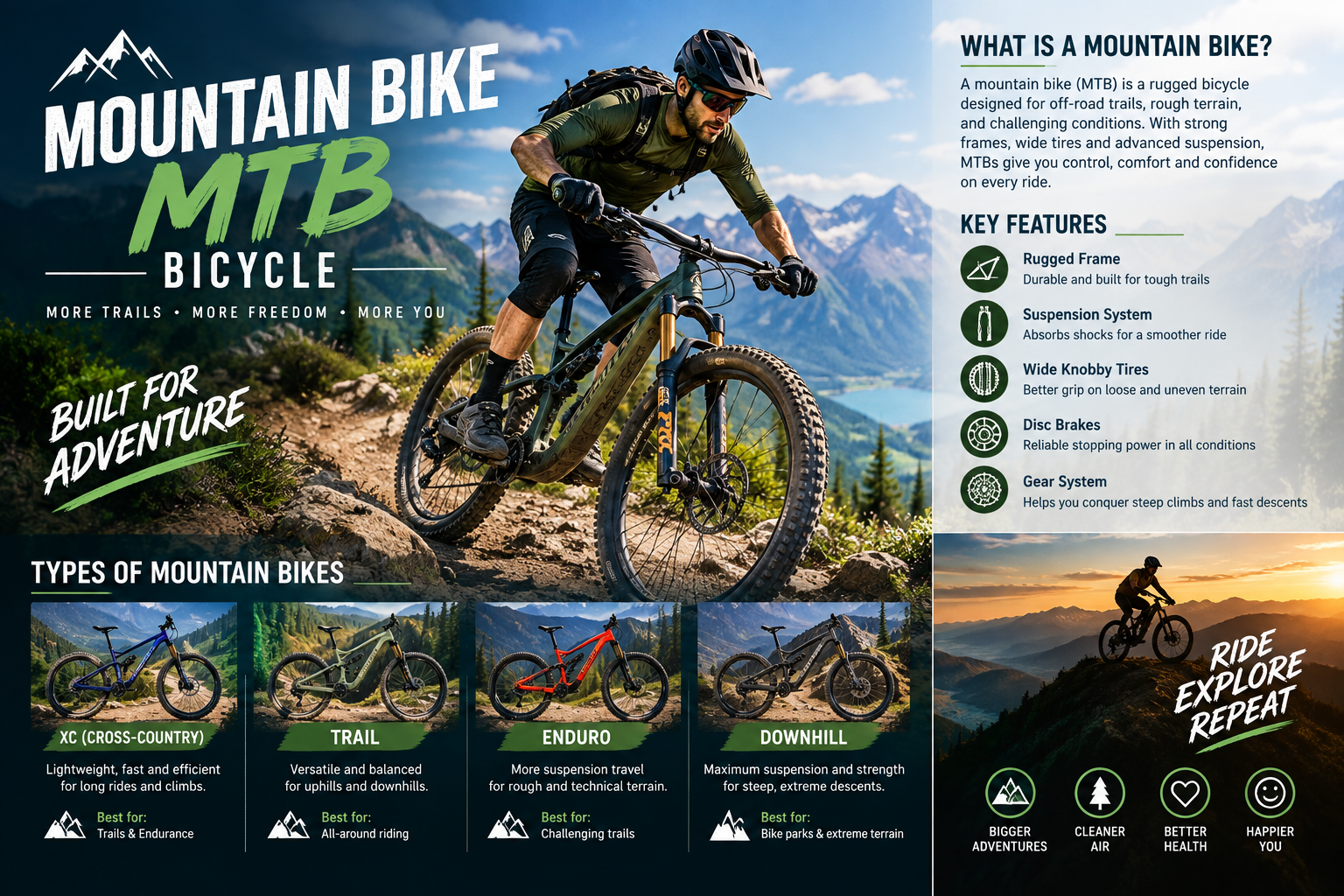
A mountain bike — often abbreviated as MTB — is a bicycle specifically engineered for off-road riding. Unlike road bikes or city commuters, mountain bikes are built to handle unpaved surfaces: rocky trails, root-laced singletracks, muddy forest paths, steep descents, and technical climbs.
They achieve this through a combination of purpose-built features that regular bicycles simply don’t have.
MTB vs. Regular Bicycle — Key Differences
| Feature | Mountain Bike (MTB) | Regular Bicycle |
|---|---|---|
| Tires | Wide, knobby (2.2″–2.6″+) | Narrow, smooth |
| Suspension | Front fork (or front + rear) | None (usually) |
| Brakes | Hydraulic disc brakes | Rim brakes / mechanical disc |
| Frame Geometry | Slack head angle, short stem | Upright or aggressive forward |
| Gearing | Wide-range 1x or 2x drivetrain | Narrower gearing range |
| Weight | Heavier (24–35 lbs typical) | Lighter |
| Terrain | Dirt, rocks, roots, mud | Pavement, paths |
The wide knobby tires dig into loose terrain for grip. The suspension absorbs impact from rocks and roots, keeping your hands comfortable and your wheels tracking the ground. The slack geometry keeps you stable at speed on descents. Every design choice has a purpose.Who Should Ride a Mountain Bike?
Mountain bikes are for anyone who wants to ride off-road — but they’re also increasingly used for gravel paths, fire roads, and even light commuting. You should consider a mountain bike if you:
- Want to explore trails, forests, or mountain terrain
- Enjoy adventure riding with unpredictable surfaces
- Prefer a more physically engaging, full-body ride
- Want the versatility to go places a road bike simply can’t
Even if you never hit a technical trail, a hardtail mountain bike makes an excellent gravel adventure bike or rugged commuter.
Types of Mountain Bikes Explained
This is where most new buyers get confused — and where making the wrong choice costs you. Every MTB category exists for a specific type of riding. Match the bike to your trails, not the other way around.
Cross-Country (XC) Mountain Bikes
Best for: Speed, efficiency, racing, long-distance trail riding Suspension travel: 80–120mm
XC bikes are the thoroughbreds of the mountain bike world. They’re built light, roll fast, and climb exceptionally well. Competitive XC riders chase every gram of weight savings, and modern XC bikes feature aggressive geometry, short-travel suspension, and high-end components like Shimano XTR or SRAM XX.
If you ride smooth trails, participate in XC races, or prioritize covering big miles efficiently, an XC mountain bike is your weapon of choice.
Top XC picks to consider: Trek Procaliber, Specialized Epic, Canyon Lux
Trail Mountain Bikes
Best for: All-around riding, the majority of recreational riders Suspension travel: 120–140mm (hardtail) or 120–150mm (full suspension)
Trail bikes are the Swiss Army knives of the MTB world. They climb well, descend with confidence, and handle the kind of varied terrain that most riders encounter on a typical day out. If you’re not sure what type of riding you’ll be doing most, start here.
The geometry is relaxed enough for comfort on longer rides but aggressive enough to inspire confidence on technical descents. Most quality trail bikes in 2026 ship with 29-inch wheels, a 1x drivetrain, and hydraulic disc brakes as standard.
Top trail picks to consider: Specialized Stumpjumper, Trek Fuel EX, Santa Cruz Tallboy
Enduro Mountain Bikes
Best for: Technical descents, aggressive riders, bike park laps Suspension travel: 150–170mm
Enduro bikes blur the line between trail and downhill. They’re designed to descend fast and hard on the most technical terrain, while still being pedal-able on climbs. If you spend more time focused on descending than climbing — and you want the bike to feel planted on gnarly, high-speed terrain — enduro is your category.
These bikes are heavier than trail bikes but far more capable on aggressive terrain.
Top enduro picks to consider: Specialized Enduro, Trek Slash, Ibis Ripmo V3
Downhill Mountain Bikes
Best for: Lift-accessed bike parks, racing downhill, maximum descent capability Suspension travel: 180–210mm
Downhill (DH) bikes are purpose-built descenders. They do one thing and do it incredibly well: go down, fast, with control. They are NOT designed to pedal uphill (though you technically can). You ride a DH bike at a bike park where you take a chairlift or shuttle to the top.
If you’re not spending dedicated time at a lift-access park, a DH bike is not practical for everyday riding.
Electric Mountain Bikes (eMTB)
Best for: Longer rides, mixed ability groups, older riders, riders returning from injury Motor assistance: Pedal-assist up to 20 mph (Class 1)
Electric mountain bikes have grown up. The motors are smoother, the batteries last longer, and the ride quality of modern eMTBs is genuinely excellent. You still pedal — the motor only assists your effort, it doesn’t replace it. This means eMTBs still provide a real workout, just with a boost when you need it most: on long climbs.
Trail access for Class 1 eMTBs is expanding rapidly. In 2026, many trail systems that previously prohibited eMTBs have opened up, making them more practical than ever.
Hardtail vs. Full-Suspension MTB — Which Should You Choose?
This is the single most important decision for most buyers.
Hardtail Mountain Bikes:
- Suspension fork only (front)
- Rigid rear triangle
- Lighter weight
- Lower cost
- Less maintenance
- Better for smoother trails, XC, and climbing
- Forces better technique — you feel the trail more
Full-Suspension Mountain Bikes:
- Suspension fork (front) + rear shock (rear)
- More comfort on rough terrain
- Better traction on descents and technical features
- Higher cost
- More maintenance (shock service required annually)
- Ideal for technical trail, enduro, and aggressive riding
Our recommendation: Start on a quality hardtail unless you already know your riding is primarily technical, rocky, or aggressive. The money you save on a hardtail can be put into better components, protective gear, or trail fees. Once your skills develop, upgrading to full suspension is a natural next step.
Key Components of a Mountain Bike
Understanding what you’re actually buying helps you compare bikes fairly — and avoid getting fooled by a shiny frame with bargain-bin components.
Frame Material — Aluminum vs. Carbon Fiber
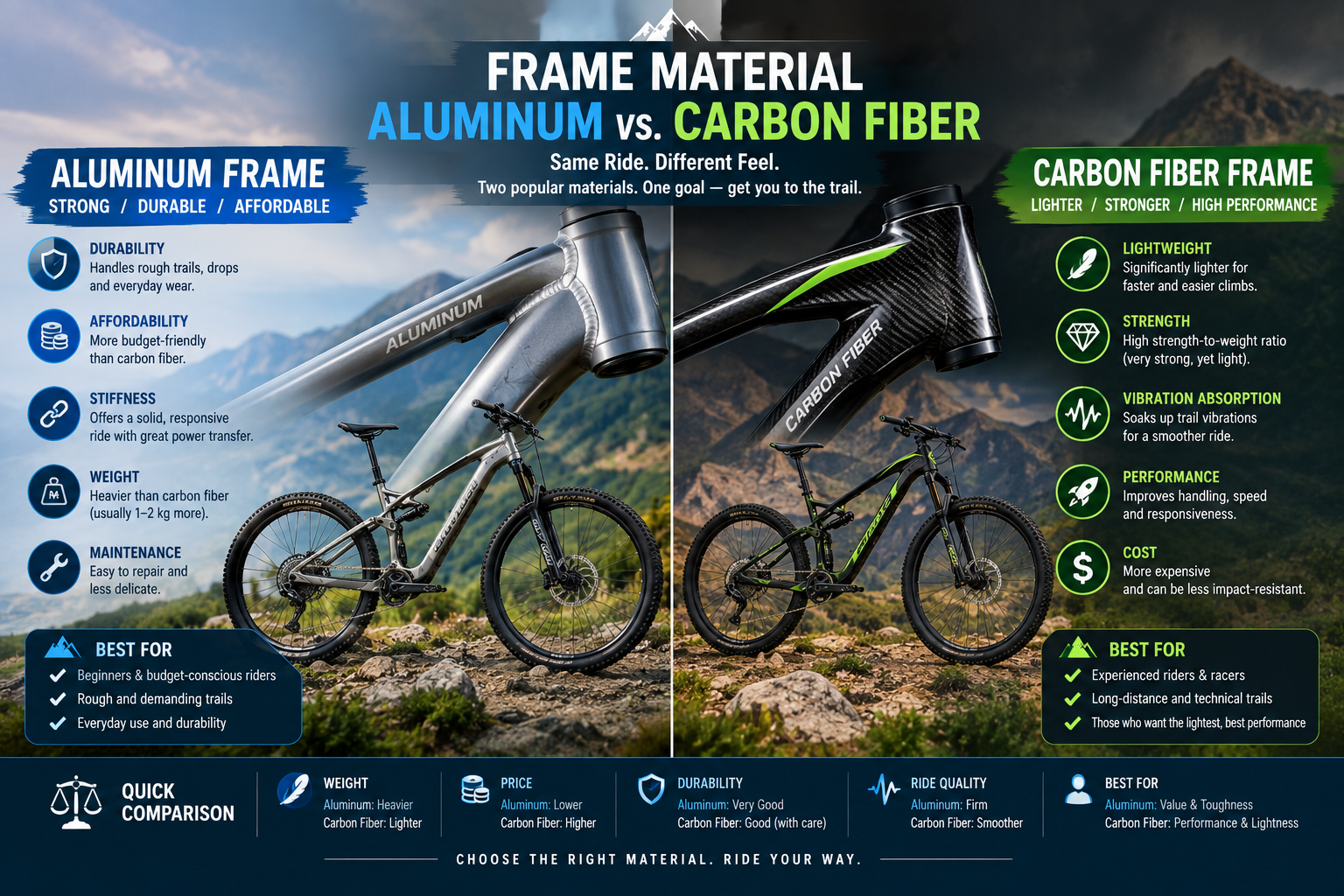
Aluminum (Alloy):
- More affordable
- Durable and repairable
- Slightly heavier
- Excellent choice up to ~$3,000
Carbon Fiber:
- Lighter (significant for climbing)
- Can be tuned for specific stiffness/compliance profiles
- More expensive
- Harder to repair if cracked
- Ideal for performance-focused riders and budgets above $3,000
For most recreational riders, a quality aluminum frame is the smarter buy. Save the carbon upgrade for when your skills justify the investment.
Suspension Systems & Travel Explained
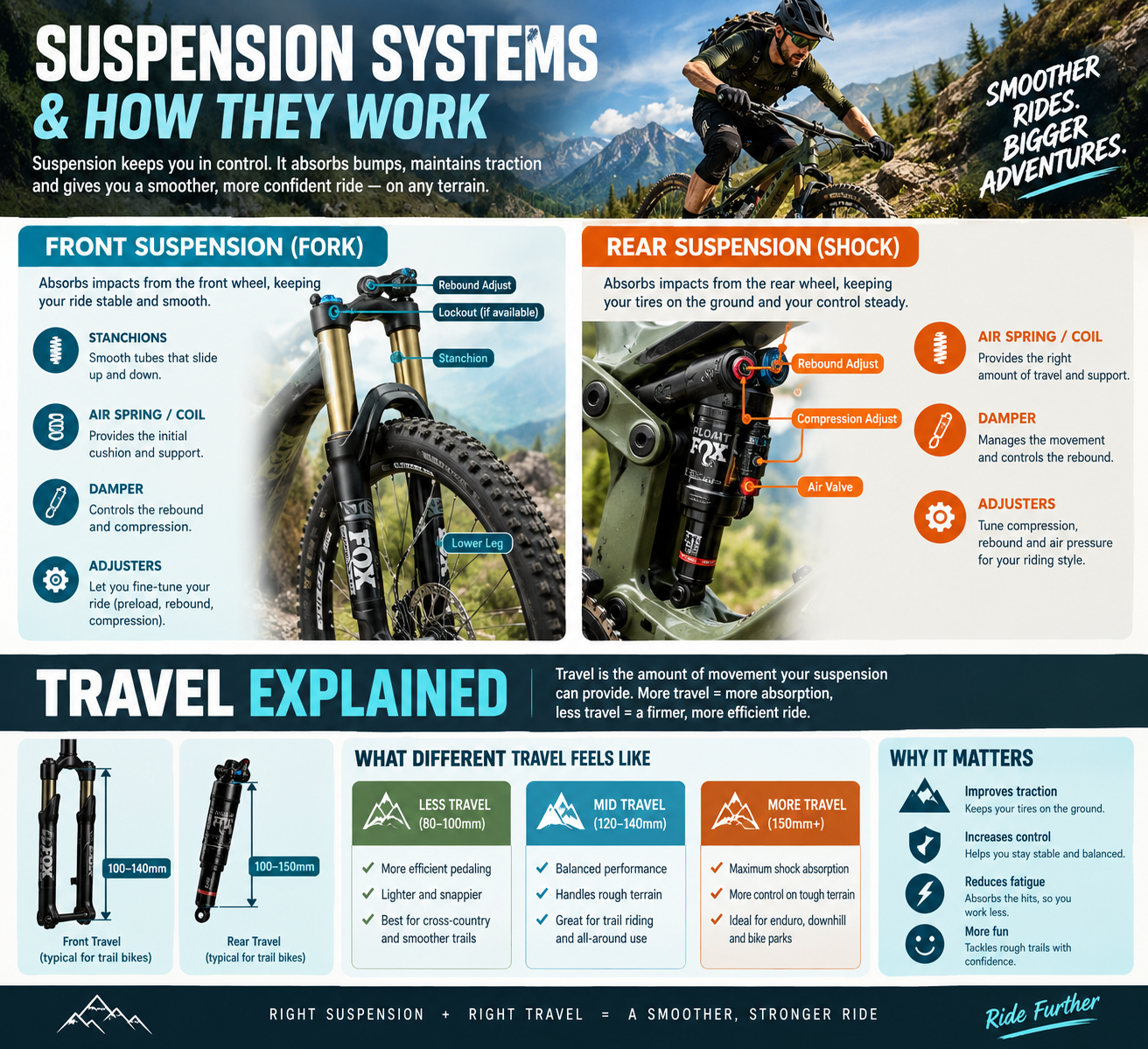
Suspension travel refers to how far the fork or shock can compress. More travel = more capability on rough terrain, but also more weight and energy loss on climbs.
| Travel | Category | Best For |
|---|---|---|
| 80–100mm | XC | Smooth trails, racing, climbing |
| 120–140mm | Trail | All-around riding |
| 150–170mm | Enduro | Technical descents |
| 180mm+ | Downhill | Bike park, DH racing |
Top fork brands: RockShox and Fox Racing Shox dominate the market. Look for these names on any serious MTB.
Wheel Sizes — 26″, 27.5″, and 29″
The 26-inch wheel is largely obsolete on modern mountain bikes. Today’s choice is between:
27.5″ (650b):
- More nimble and playful handling
- Better for smaller riders (under 5’6″)
- Preferred for aggressive enduro and technical terrain
29″ (29er):
- Rolls over obstacles more easily
- Faster rolling speed
- More traction and stability
- Preferred for XC, trail, and taller riders
- The current industry standard for most trail bikes
Most new riders should default to 29-inch wheels unless they’re on the shorter side or prioritize agility over speed.
Drivetrain & Gearing — 1x vs. 2x
Modern mountain bikes have largely adopted 1x (single chainring) drivetrains. Here’s why:
- 1x systems (e.g., SRAM Eagle 12-speed, Shimano Deore 12-speed): Simpler, lighter, no front derailleur to manage, wide-range cassettes cover almost all terrain
- 2x systems: Two chainrings up front, slightly more range, but more complexity
For 2026, a 1×12 drivetrain (12-speed cassette) from SRAM or Shimano is the sweet spot for trail and enduro riders.
Brakes — Hydraulic vs. Mechanical Disc
Both types use disc rotors at the hub — the difference is how they’re actuated.
Hydraulic Disc Brakes:
- Use fluid (mineral oil or DOT fluid) to transfer force
- More powerful, more modulation, self-adjusting
- Low hand effort = less fatigue
- Strongly recommended for all MTBs
Mechanical Disc Brakes:
- Use a cable like traditional brakes
- Less powerful, require manual pad adjustment
- Found on entry-level bikes
- Acceptable on flat, easy terrain; limiting on technical descents
If your budget allows it, always upgrade to hydraulic disc brakes. Brands to trust: Shimano (XT, SLX, Deore) and SRAM (Code, Maven, Level).
How to Choose the Right Mountain Bike
Step 1 — Assess Your Riding Style
Before you look at a single price tag, answer these questions honestly:
- Where will you ride? (Groomed trails, rocky singletrack, bike park, gravel fire roads?)
- How often will you ride? (Weekly warrior or occasional weekend?)
- Are you more interested in climbing, descending, or both equally?
- Are you racing or recreational riding?
- Will you be riding alone or keeping up with a group?
Your answers point directly to your bike category (XC, Trail, Enduro, eMTB).
MTB Frame Sizing Guide
Getting the right frame size is critical for comfort, control, and injury prevention. Use this as your starting reference — always verify with the brand’s specific sizing chart.
| Rider Height | MTB Frame Size |
|---|---|
| Under 5’2″ (157cm) | XS (Extra Small) |
| 5’2″ – 5’6″ (157–168cm) | S (Small) |
| 5’6″ – 5’10” (168–178cm) | M (Medium) |
| 5’10” – 6’1″ (178–185cm) | L (Large) |
| 6’1″ – 6’4″ (185–193cm) | XL (Extra Large) |
| 6’4″+ (193cm+) | XXL (if available) |
Pro tip: If you’re between sizes, go up for trail/enduro riding (more reach = more control at speed) or down for XC (more agility and lighter feel).
Beyond frame size, pay attention to reach and stack numbers — these give you a more precise fit than frame size labels alone.
Budget Breakdown — What to Expect at Every Price Point
| Budget | What You Get |
|---|---|
| Under $500 | Department store quality — avoid for trail riding |
| $500 – $800 | Entry hardtail, mechanical disc brakes, basic suspension fork — suitable for beginners on easy trails |
| $800 – $1,500 | Quality hardtail, hydraulic disc brakes, better suspension — solid choice for intermediate riders |
| $1,500 – $3,000 | Full-suspension trail bike or premium hardtail, quality groupsets (Shimano SLX/XT or SRAM GX), significantly better ride quality |
| $3,000 – $6,000 | Performance trail/enduro bikes, carbon options, Fox/RockShox suspension, 12-speed drivetrains |
| $6,000+ | Top-tier builds, team-level components, carbon everything, pro-level performance |
Best value zone in 2026: The $1,500–$2,500 range has never been better. Component trickle-down means bikes at this price ride the way $4,000 bikes did just a few years ago.
New vs. Used Mountain Bikes
Buying New:
- Full warranty coverage
- Latest geometry and components
- Easier financing options
- No hidden damage or wear
Buying Used:
- Can access significantly higher-spec bikes for the same budget
- Risk of hidden damage (especially to suspension and frame)
- No warranty
- Inspect thoroughly before buying — check for cracks around welds, suspension sag, and brake feel
If buying used: Always request a test ride. Inspect the suspension, check for creaks, and verify the frame hasn’t been crashed. A pre-purchase inspection at your local bike shop (~$30–$50) is well worth the cost.
Top Mountain Bike Brands in 2026
Trek Mountain Bikes
Trek is one of the most trusted names in cycling. Their Marlin series offers excellent entry-level hardtails, while the Fuel EX and Slash deliver world-class trail and enduro performance. Trek bikes are available through a wide dealer network, making service and support easy to access.
Specialized Mountain Bikes
Specialized consistently pushes MTB technology forward. The Stumpjumper is arguably the most iconic trail bike ever made. Their Epic series dominates XC racing, and the Enduro is a benchmark in aggressive trail riding. The Specialized Stumpjumper 15 in 2026 is widely regarded as one of the best value trail bikes on the market.
Giant Mountain Bikes
Giant offers exceptional value across all price points. As the world’s largest bike manufacturer, they control their own manufacturing, which lets them deliver higher-spec components at lower prices than many competitors. The Trance and Reign models are highly respected in the trail and enduro categories.
Santa Cruz & Ibis for Enthusiasts
If budget is no object and you want bikes that inspire devotion, Santa Cruz and Ibis are cult favorites among serious riders. The Santa Cruz Nomad and Ibis Ripmo V3 are standout performers in 2026, favored by experienced riders who know exactly what they want from a trail or enduro machine.
Best Mountain Bikes by Category in 2026
Best MTB for Beginners
Recommended: Trek Marlin 7 or Specialized Rockhopper Comp
- Aluminum frame
- Hydraulic disc brakes
- Quality suspension fork
- 29″ wheels
- 1x drivetrain
- Price range: $800–$1,200
Best MTB Under $1,000
Recommended: Giant Talon 29 1 or Trek Marlin 5
- Solid components for the price
- Hydraulic disc brakes (on select models)
- 29″ or 27.5″ wheels
- Enough capability to grow with you as a rider
Best Full-Suspension MTB
Recommended: Specialized Stumpjumper 15, Trek Fuel EX 7, Giant Trance 29
- Price range: $2,500–$4,500
- 130–140mm travel
- 1×12 drivetrains
- Fox or RockShox suspension
Best Electric Mountain Bike (eMTB)
Recommended: Specialized Turbo Levo SL, Trek Rail, Giant Trance X E+
- Class 1 pedal-assist
- 500–750Wh batteries
- Shimano EP8 or Brose/Bosch motors
- Price range: $4,000–$10,000+
Mountain Bike Maintenance & Care Tips
A well-maintained mountain bike lasts longer, rides better, and costs less in the long run.
How to Clean Your MTB
After every muddy ride:
- Rinse the drivetrain and frame with low-pressure water
- Use a soft brush and bike-specific degreaser on the chain and cassette
- Wipe dry with a clean rag
- Apply chain lube (wet lube for wet conditions, dry lube for dry/dusty)
- Never use a high-pressure washer — it forces water into bearings
Chain Lubrication & Drivetrain Care
Your chain is the most frequently replaced component on any mountain bike. Replace it when it reaches 0.75% wear (use a chain wear indicator tool — they cost less than $10). Running a worn chain damages your cassette and chainring, turning a $20 repair into a $150+ replacement.
- Lube your chain after every wet ride
- Wipe off excess lube before riding (dirty lube = more wear)
- Degrease and re-lube every 5–10 rides in dry conditions
Suspension Setup & Tuning
Your suspension should be set up to match your body weight. Follow these basics:
Sag (most critical setting):
- Trail fork: 15–20% sag
- Enduro fork: 20–25% sag
- Rear shock: 25–30% sag
Measure sag by sitting on the bike in your riding position (with gear) and measuring how much the fork/shock has compressed. Use the o-ring on the stanchion as your measurement point.
Get a professional suspension service once a year — dirty oil inside your fork or shock dramatically degrades performance and accelerates wear.
How Long Does a Mountain Bike Last?
With proper care:
- Frame: 10–20 years (aluminum), 8–15 years (carbon)
- Fork/shock: Service annually, replace every 5–10 years
- Chain: Every 1,000–2,000 miles
- Cassette: Every 2–3 chains
- Brake pads: Every 500–1,500 miles (terrain-dependent)
- Tires: Every 1–3 years depending on use and compound
Mountain Biking Safety & Essential Gear
Helmet Types for MTB Riding
Half-shell / trail helmet: Lightweight, ventilated, covers the back of the skull. Best for trail and XC riding. Brands: Giro, Bell, Troy Lee Designs.
Full-face helmet: Covers your chin and jaw. Essential for downhill and bike park riding. Adds weight but provides critical protection on high-speed, technical terrain.
MIPS technology: Look for MIPS (Multi-directional Impact Protection System) in any helmet you buy — it significantly reduces rotational forces in a crash.
Protective Pads, Gloves & Eyewear
Knee pads: Non-negotiable on technical terrain. Fox Defend, Leatt DBX, and G-Form are well-regarded options.
Gloves: Protect your palms and improve grip. Full-finger gloves for trails, short-finger for XC.
Eyewear: Goggles for bike park/downhill riding. Sunglasses or clear lens for trail riding.
Body armor: Back protectors and chest guards for enduro and DH riding. Optional for trail riding, recommended if you’re still learning.
Trail Etiquette & Safety Rules
- Ride in control at all times
- Yield to hikers and equestrians on multi-use trails
- Call out when passing other riders
- Respect trail closures (especially wet/muddy conditions — you damage the trail)
- Carry a tube, pump, multi-tool, and phone on every ride
- Tell someone where you’re riding and when to expect you back
Frequently Asked Questions
Q: What is the difference between a mountain bike and a regular bicycle? A: A mountain bike (MTB) is specifically designed for off-road riding. It features suspension, wide knobby tires, hydraulic disc brakes, and geometry built for technical terrain. A regular bicycle is optimized for pavement — thinner tires, no suspension, and road-focused geometry.
Q: Is a hardtail or full-suspension mountain bike better for beginners? A: A hardtail is the better starting point for most beginners. It’s lighter, cheaper, easier to maintain, and teaches better riding technique. Once your skills develop, a full-suspension upgrade makes a huge difference on technical terrain.
Q: What wheel size should I choose — 27.5″ or 29″? A: 29-inch wheels are faster, roll over obstacles more easily, and offer more traction — making them the default choice for most trail riders. 27.5-inch wheels are more nimble and better suited to smaller riders or aggressive enduro/DH terrain.
Q: How much should I spend on a mountain bike? A: For a genuinely capable trail bike, budget at least $1,000–$1,500 for a quality hardtail, or $2,500+ for a solid full-suspension MTB. Anything under $500 from a department store will frustrate you on real trails.
Q: What is the difference between XC, Trail, Enduro, and Downhill bikes? A: XC = fast and efficient climbing. Trail = all-around riding. Enduro = aggressive descents with climb capability. Downhill = maximum descent performance, not designed for pedaling uphill.
Q: Are electric mountain bikes (eMTBs) worth it in 2026? A: Yes, for the right rider. eMTBs are excellent for covering more terrain, riding with faster friends, or returning to the sport after an injury. Trail access is expanding rapidly in 2026. The main trade-offs are weight and higher maintenance costs.
Q: How do I size a mountain bike frame? A: Use your height as a starting guide (see sizing chart above), then verify using the brand’s specific sizing chart. Pay attention to “reach” numbers for the most accurate fit, especially if you’re between sizes.
Q: How long does a mountain bike last? A: A quality MTB frame can last 10–20 years with proper care. Components wear faster — chains every 1,000–2,000 miles, cassettes every 2–3 chains, tires every 1–3 years. Annual suspension service keeps your fork and shock performing like new.
Final Verdict — Which Mountain Bike Should You Choose?
Here’s your cheat sheet:
| You are… | Choose this |
|---|---|
| A first-time buyer on a budget | Hardtail trail bike, $800–$1,200, 29″ wheels, hydraulic disc |
| A recreational weekend trail rider | Full-suspension trail bike, $2,500–$4,000 |
| An aggressive rider who loves descents | Enduro full-suspension, $4,000–$6,000 |
| A fitness rider who loves long climbs | XC hardtail or lightweight full-suspension |
| A bike park / lift-access rider | Downhill or enduro MTB |
| An older or less fit rider, or returning from injury | Class 1 eMTB |
| Undecided on riding style | Trail hardtail — develop your skills, then upgrade |
The mountain bike market in 2026 is exceptional. Component quality has trickled down to every price point, frame geometry has matured, and there are genuinely great options at every budget level.
The worst decision you can make is no decision. Pick a category, set a budget, get on a trail — and refine from there.