
Table of Contents
- What Is the Honda CB1000GT?
- Honda CB1000GT 2026 Price & Availability
- Honda CB1000GT Full Specifications
- Key Features — What You Get as Standard
- Colour Options & Accessory Packs
- Real-World Performance — How It Rides
- Pros and Cons
- Honda CB1000GT vs Competitors
- Common Concerns & Known Issues
- Is the Honda CB1000GT Worth Buying?
- Frequently Asked Questions
- Final Verdict & Conclusion
Introduction
Some motorcycles arrive quietly. The Honda CB1000GT did not.
When Honda pulled the covers off this bike in late 2025, the sport-touring world sat up sharply. A liter-class inline-four engine derived from the CBR1000RR Fireblade. Full electronic suspension as standard. Panniers, heated grips, cruise control, and a quickshifter — all included. And a price of £11,999.
That last number is the one that changed everything.
BMW might have started this wailing four-cylinder ‘Adventure-Sports’ category 11 years ago with their S1000XR, but Honda has just blown the whole sector wide open with a bike that makes riders smile at a fraction of the competition’s price.
This is the complete guide to the Honda CB1000GT. We cover every spec, every feature, every rival, and every question you might have — so you can make an informed decision before stepping into a dealership.
1. What Is the Honda CB1000GT?
The Hornet Gets Touring Legs — How the CB1000GT Was Born
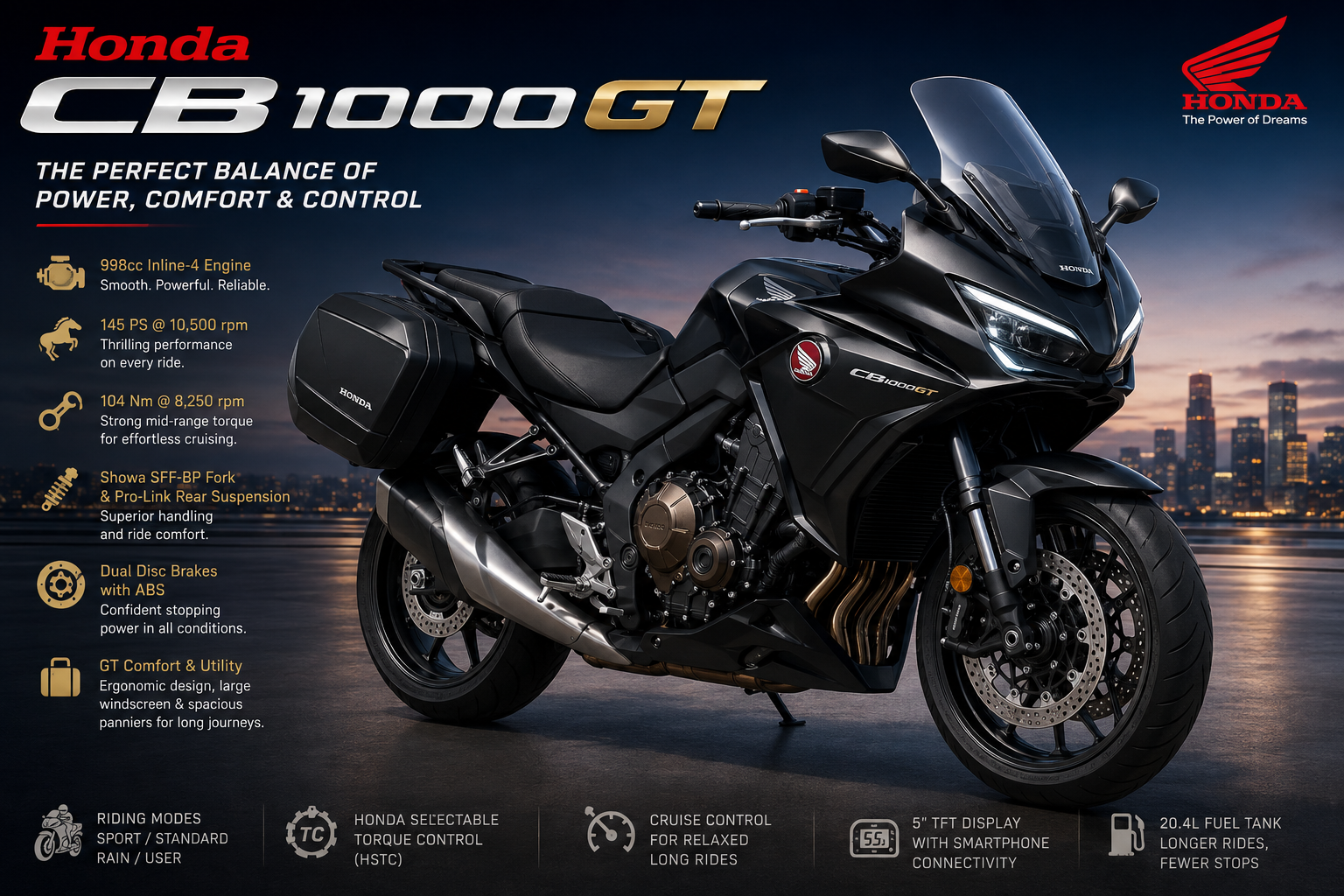
The CB1000GT takes the CB1000 Hornet as its base, adds touring legs, and turns up the spec sheet to eleven. Power comes from a retuned 1,000cc inline-four, which can trace its DNA back to the CBR1000RR Fireblade.
It is not Honda’s first sport-tourer — the brand has form here, from the ST1100 Pan European to the CBF1000. But it is arguably Honda’s most aggressively positioned one yet.
The Honda CB1000GT takes all the best features from its naked sibling, but uses them for the long road. The “GT” designation here is earned, not just a marketing badge.
Who Is the CB1000GT Built For?
This is an ideal fit for experienced riders who want one bike to do it all: weekday commuting, spirited back-road runs, and multi-day tours. Its liter-class output and 229 kg kerb weight make it less suited to first-time riders, but its IMU-based safety net, cornering ABS, and riding modes will appeal to those stepping up from middleweights.
If you’ve outgrown your 650cc parallel-twin, spend weekends exploring back roads but need to commute Monday through Friday, and refuse to buy two bikes to cover both roles — the CB1000GT was designed with you in mind.
2. Honda CB1000GT 2026 Price & Availability
UK & European Pricing
The 2026 Honda CB1000GT is currently listed on the maker’s European configurator at an MSRP of £11,999, around $15,795 at today’s exchange rates. Pricing is competitive for the specification: £11,999 (OTR) in the UK, €13,999 in France, and €14,429 in Germany (including delivery).
To put that pricing in context: Suzuki has reduced the price of its GSX-S1000GX by £2k to £12,999 in response, Yamaha’s middle-of-the-range Tracer 9 GT (similar spec to the Honda) is £14k and BMW’s base-model S1000XR starts at £16,790.
Honda is on a mission to make great motorcycles affordable and the CB1000GT underlines that with its £11,999 price tag.
When Does It Hit Showrooms?
It’ll be landing in European and UK dealerships in February 2026 and will be priced at £11,999.
US Availability — What We Know
Regional availability includes Europe, Japan, and Asia & Oceania (announced), with US availability not announced as of 2025-11-23.
However, given Honda’s global track record, a US launch appears to be a matter of when rather than if. Estimated US pricing, when announced, is expected to be highly competitive.
Finance Options
A PCP finance example (from November 2025) comes in at £139 per month for 36 months, with a deposit of £2,596.06, an APR of 8.9%, and maximum annual mileage of 4,000. An optional final payment to keep the bike is then £6,507.46.
3. Honda CB1000GT Full Specifications
Engine & Performance

At its core, the 2026 Honda CB1000GT has a 1,000cc four-stroke liquid-cooled four-cylinder engine managed by a port fuel injection system. In GT trim, it’s producing 147.6 bhp at 11,000 rpm and 75 lb ft of torque at 8,750 rpm. According to Honda insiders, the ride-by-wire GT’s version of the motor has all the power of the Hornet, though delivered in a smoother manner befitting a sport-touring motorcycle.
The engine’s lineage matters. The 2026 Honda CB1000GT gets the Hornet engine with some retuning. The powerplant is based on the 2017 CBR1000RR superbike motor, and that means plenty of power and reliability.
Chassis, Frame & Suspension
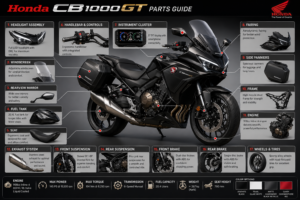
The bike borrows the diamond-style steel frame from the Hornet and ties it to an extended subframe. It relies on suspension components, including an EERA inverted telescopic fork at the front with a manual preload adjuster and 130 mm of stroke, and an electronically controlled EERA suspension at the rear with an electronic preload adjuster and 140 mm of travel. Adding some tech to the chassis is Showa’s electronically controlled suspension (Showa-EERA), which comes as standard. The system constantly adjusts the damping to suit conditions and rider input.
Braking System
The motorcycle is equipped with 17-inch 10-spoke alloy wheels, fitted with braking components including two 310 mm discs at the front, clamped by four-piston Nissin calipers, and a 240 mm disc at the rear, clamped by a single-piston Nissin caliper.
Cornering ABS is managed through a 6-axis IMU system — bringing superbike-grade safety tech to the touring segment.
Dimensions, Weight & Ergonomics
| Specification | Detail |
|---|---|
| Seat Height | 825 mm (32.48 in) |
| Kerb Weight | 229 kg (505 lb) |
| Fully Loaded Weight | 241.5 kg (532 lb) |
| Front Tyre | 120/70-17 |
| Rear Tyre | 180/55-17 |
| Fuel Tank | 21 litres |
The Honda CB1000GT seat height is 825 mm. That is actually 20 mm lower than the Yamaha Tracer 9 GT — a meaningful advantage for shorter riders.
Fuel Tank & Consumption
The Honda CB1000GT should have the advantage on tank range because its listed fuel capacity is 21 L versus 19 L for the Suzuki GSX-S1000GX. Average fuel consumption is estimated at 6 l/100 km according to the WMTC cycle. That gives a theoretical range of around 350 km per tank — excellent for touring.
4. Honda CB1000GT Key Features — What You Get as Standard
This is where the CB1000GT story gets compelling. At £11,999, you are not paying for a stripped-out base model.
The Honda comes with removable panniers, cruise control, quick shifter, electronic suspension, centre stand and heated grips as standard.
Showa EERA Electronic Suspension
The biggest change for the GT over the Hornet comes in the form of Showa EERA, the Japanese firm’s tested and trusted semi-active and electronically adjusted suspension system. And it’s big for a couple of reasons. Firstly, at this price point, it’s an absolute steal. If you wanted semi-active suspension from Honda’s compatriot, Yamaha, you’d be eyeing up either the £13,954 Tracer 9 GT or the top-spec £16,604 Tracer 9 GT+. This is the first time Honda has fitted the EERA system to anything with an inline four-cylinder engine or anything as sporty as this.
Riding Modes & Electronics Suite
There are five riding modes to choose from: Sport, Rain, Tour, Standard and User, with the IMU-managed Cornering ABS keeping everything in check when things get interesting.
Each mode adjusts throttle response, power delivery, and suspension behaviour — allowing the bike to transform from a relaxed cruiser on motorways to a focused sporting machine on back roads.
Touring Equipment — Panniers, Heated Grips & Centre Stand
The level of standard touring kit is extraordinary for this price bracket. The integrated side panniers are removable for weekend blasts when you don’t need the luggage. The centre stand makes loading easier and chain maintenance straightforward. Heated grips are standard — no need to budget for the accessory.
Connectivity — Honda RoadSync & USB-C
Honda also gives it serious touring equipment: Showa EERA electronic damping, cornering ABS, cruise control, quickshifter, heated grips, center stand, panniers, Honda RoadSync, USB-C and a 5-position windscreen.
Honda RoadSync allows Bluetooth pairing with your smartphone for navigation display and music control directly through the TFT instrument cluster.
Windscreen
It features side-mounted rear hard panniers, heated grips, handguards, and a five-position adjustable windscreen. The standard screen has been noted to be less effective at higher speeds, but the optional taller screen (available in the Comfort Pack) resolves this.
5. Colour Options & Accessory Packs
Available Colours
Three colours will be available at launch: Grand Prix Red with extended Graphite Black livery, Pearl Deep Mud Grey, and Graphite Black.
The Grand Prix Red is the standout choice — a nod to Honda’s racing heritage that looks exceptional in real-world lighting conditions.
Accessory Packs
Honda has structured the accessories into three focused packs:
The Comfort Pack adds a taller screen, fog lights and plush seats. The Sports Pack sharpens things visually with a belly pan, decals and wheel stripes. And for commuters or tourers, the Urban Pack includes a 50-litre top box, rear carrier and pads. All accessories can be bought separately if you want to mix and match.
Recommendation: For pure touring use, start with the Comfort Pack + Urban Pack. For weekend performance focus, the Sports Pack transforms the bike’s visual presence.
6. Real-World Performance — How It Rides
Engine Character & Power Delivery
The CB1000GT’s engine is not just fast — it is characterful. The retuning for GT duty means power is delivered progressively rather than explosively, making it manageable in city traffic and deeply satisfying on open roads.
If you value a smooth inline-four, electronic suspension, and true touring equipment straight from the showroom, the CB1000GT sits right in the sweet spot.
At motorway speeds, the engine is relaxed, refined, and entirely unstressed. Crack the throttle open on a fast A-road and it transforms into something genuinely exciting — exactly what the “GT” designation promises.
Handling & Suspension Feel
The 2026 Honda CB1000GT looks like a natural evolution of the Hornet platform, bridging the gap between full-fat tourers and sporty nakeds.
The EERA suspension in Tour mode provides a plush, compliant ride over broken surfaces. Switch to Sport and the damping tightens considerably, giving the bike a confidence-inspiring, planted feel through fast corners. The IMU-managed cornering ABS adds a genuine safety net without feeling intrusive.
Touring Comfort on Long Rides
The ergonomics are upright enough to avoid wrist fatigue over multi-day tours, while the seat position keeps you engaged rather than merely along for the ride. The adjustable windscreen offers meaningful protection at motorway speeds in positions 3–5. The heated grips extend the bike’s usable season into autumn and early spring.
One honest caveat: the standard seat could be more comfortable and the standard screen is less effective at higher speeds. Both are addressable through the accessory catalogue.
7. Honda CB1000GT Pros and Cons
Pros
- Exceptional value — flagship technology at mid-range pricing
- Full Showa EERA electronic suspension as standard — first for this segment at this price
- Panniers, heated grips, cruise control, quickshifter all included
- 147.6 bhp from a CBR1000RR-derived inline-four
- Honda RoadSync connectivity and USB-C charging
- Five riding modes including User-customisable setting
- 21-litre fuel tank for extended touring range
- IMU-managed cornering ABS and multiple riding modes
- 825 mm seat height — lower than most rivals
- Honda build quality and global service network
Cons
- Standard seat comfort needs improvement on long days
- Standard windscreen underperforms at sustained motorway speeds
- Handguards are relatively small for serious winter use
- Not yet available in the US market
- Oil consumption on Hornet engine under investigation (see concerns section)
- 229 kg kerb weight demands respect from less experienced riders
8. Honda CB1000GT vs Competitors
CB1000GT vs Yamaha Tracer 9 GT
If straight-line speed is your priority, the CB1000GT takes the lead. With 31 HP more than the Tracer 9 GT, it offers a more spirited ride that will be noticeable on highway overtakes or track days. Its seat height is 20 mm lower than the Tracer 9 GT, making it much easier to flat-foot at stoplights and increasing confidence during stops.
| Feature | CB1000GT | Yamaha Tracer 9 GT |
|---|---|---|
| Engine | 1,000cc inline-four | 890cc inline-three |
| Power | 148 hp | 117 hp |
| Price (UK) | £11,999 | ~£14,000 |
| Seat Height | 825 mm | 845 mm |
| Fuel Tank | 21 litres | 18 litres |
| Electronic Suspension | Standard (EERA) | Standard |
Verdict: The CB1000GT is more powerful, lower, bigger-tanked, and cheaper. The Tracer 9 GT’s triple engine character is different — more mid-range grunt — but on paper, the Honda wins comprehensively.
CB1000GT vs Suzuki GSX-S1000GX
The Honda CB1000GT and Suzuki GSX-S1000GX are aimed at the same rider: someone who wants superbike-derived inline-four performance without giving up upright ergonomics, luggage capability and electronic touring comfort. They are close on displacement, weight and purpose, but the feel is different. The short version: the CB1000GT is the lower, lighter and more touring-equipped sport tourer; the GSX-S1000GX is the taller, slightly stronger and more suspension-focused sport crossover. Pick the Honda for seat height, fuel capacity and standard touring kit. Pick the Suzuki for adaptive suspension, crossover posture and sport-road electronics.
| Feature | CB1000GT | Suzuki GSX-S1000GX |
|---|---|---|
| Power | 148 hp | 152 hp |
| Price (UK) | £11,999 | £12,999 |
| Seat Height | 825 mm | 845 mm |
| Fuel Tank | 21 litres | 19 litres |
| Weight | 229 kg | 232 kg |
Verdict: The Honda is cheaper, lighter, lower, and has a bigger tank. Suzuki narrowly wins on peak power. The Honda wins on value and practicality.
CB1000GT vs BMW S1000XR
The CB1000GT is a rival to the Suzuki GSX-S1000GX on paper. But in typical Honda fashion, the bikemaker has priced it so aggressively that it has ended up rivaling bikes from a segment below, such as the Yamaha Tracer 9 GT and Triumph Tiger Sport 800.
| Feature | CB1000GT | BMW S1000XR |
|---|---|---|
| Power | 148 hp | 210 hp |
| Price (UK) | £11,999 | £16,790 |
| Electronic Suspension | Standard | Standard |
| Weight | 229 kg | 226 kg |
Verdict: The BMW S1000XR is a more powerful, more premium machine — at a £4,791 premium. For most real-world touring riders, the Honda is the smarter buy. The BMW is the choice if absolute performance and prestige matter more than value.
CB1000GT vs Kawasaki Ninja 1100SX
The Kawasaki Ninja 1100SX is a direct competitor in the sport-tourer segment. The CB1000GT edges it on electronics standardisation and value-per-pound, while the Kawasaki counters with its own distinct engine character and established reliability record.
9. Common Concerns & Known Issues
There is one topic prospective buyers should be aware of: engine oil consumption.
The arrival of the CB1000GT in showrooms was delayed following concerns about excessive oil consumption in the 2025-model CB1000 Hornet. Some publications who had bikes on long-term tests reported consumption to be as high as 400 ml per 1,000 miles. Honda quotes an upper level of 3,500 ml and lower level of 3,000 ml, so even before they fixed it you could check the oil level every 1,000 miles and at those levels of consumption you wouldn’t be below the recommended levels. Honda are aware of this and it is being investigated. The delayed showroom arrival of the CB1000GT was partly attributed to this — suggesting Honda took the issue seriously before launching the GT variant.
Practical advice: Check your oil level every 1,000 miles, especially during the first service period. Keep a 500 ml top-up bottle in your panniers on long tours. This is manageable with basic awareness.
10. Is the Honda CB1000GT Worth Buying in 2026?
The 2026 Honda CB1000GT brings a cohesive sport-touring package: a refined 1,000 cm³ inline-four with 110.1 kW on tap, Showa EERA suspension, cornering ABS, and real touring hardware including heated grips, a center stand, and panniers. Judged on the core of what matters to sport-touring riders — engine character, stability, electronics, comfort, and price — the 2026 Honda CB1000GT specs make it a compelling, well-rounded choice.
The honest answer: yes, unreservedly — for the right rider.
If you want the most technology per pound sterling of any sport-tourer currently available, the CB1000GT has no equal at £11,999. If you want the most powerful or the most prestige-laden machine on the market, look at the BMW S1000XR and accept the price difference.
As a new model we won’t know too many details regarding running costs, however when comparing the spec to its closest rivals, the CB1000GT does seem to offer exceptional value for money.
11. Frequently Asked Questions (FAQ)
Q1: What is the price of the Honda CB1000GT in the UK? A: The Honda CB1000GT is officially priced at £11,999 in the UK for 2026.
Q2: What engine does the Honda CB1000GT use? A: It uses a 1,000cc four-stroke liquid-cooled inline-four cylinder engine producing 147.6 bhp at 11,000 rpm and 75 lb ft of torque at 8,750 rpm, derived from the CBR1000RR Fireblade.
Q3: Does the Honda CB1000GT come with panniers? A: Yes. Removable side panniers are included as standard, along with heated grips, cruise control, a quickshifter, electronic suspension, and a centre stand.
Q4: Does the Honda CB1000GT have electronic suspension? A: Yes. It comes standard with Showa EERA semi-active electronic suspension — adjusting damping automatically based on riding conditions and rider input.
Q5: Is the Honda CB1000GT available in the US? A: Not yet, as of mid-2026. It is currently available in the UK, Europe, Japan, and parts of Asia and Oceania. A US launch is widely anticipated.
Q6: What is the seat height of the CB1000GT? A: 825 mm (32.48 inches) — 20 mm lower than the Yamaha Tracer 9 GT, which aids accessibility for shorter riders.
Q7: How does the CB1000GT compare to the Yamaha Tracer 9 GT? A: The CB1000GT has 31 hp more, a lower seat height, a bigger fuel tank, and a lower price. The Tracer 9 GT offers a distinctive three-cylinder engine character. On most measurable criteria, the Honda wins.
Q8: What colours does the CB1000GT come in? A: Three colours: Grand Prix Red with Graphite Black livery, Pearl Deep Mud Grey, and Graphite Black.
Q9: What accessory packs are available for the CB1000GT? A: The Comfort Pack (taller screen, fog lights, comfort seats), Sports Pack (belly pan, decals, wheel stripes), and Urban Pack (50-litre top box, rear carrier, pads). All items can also be bought individually.
Q10: What is the top speed of the Honda CB1000GT? A: Approximately 200 km/h (124 mph).
12. Final Verdict & Conclusion
A high-speed, high-comfort sports tourer aimed squarely at riders who want one bike to do it all. That was Honda’s brief. They delivered.
The Honda CB1000GT is not just a competitive sport-tourer. It’s a benchmark-setter. By packaging flagship-grade electronics — semi-active suspension, cornering ABS, five riding modes, cruise control, a quickshifter, and real touring hardware — into a £11,999 package, Honda has forced every rival manufacturer to reconsider their value propositions overnight.
No other bike offers electronic suspension as standard in this space, which is another big plus for the Honda.
The oil consumption concern is real but manageable. The standard seat and windscreen are the obvious upgrade targets. But none of that changes the fundamental reality: if you’re in the market for a sport-touring motorcycle in 2026, this is the bike you compare everything else against.
It is, genuinely, one of the most exciting motorcycle launches in years.