
Introduction
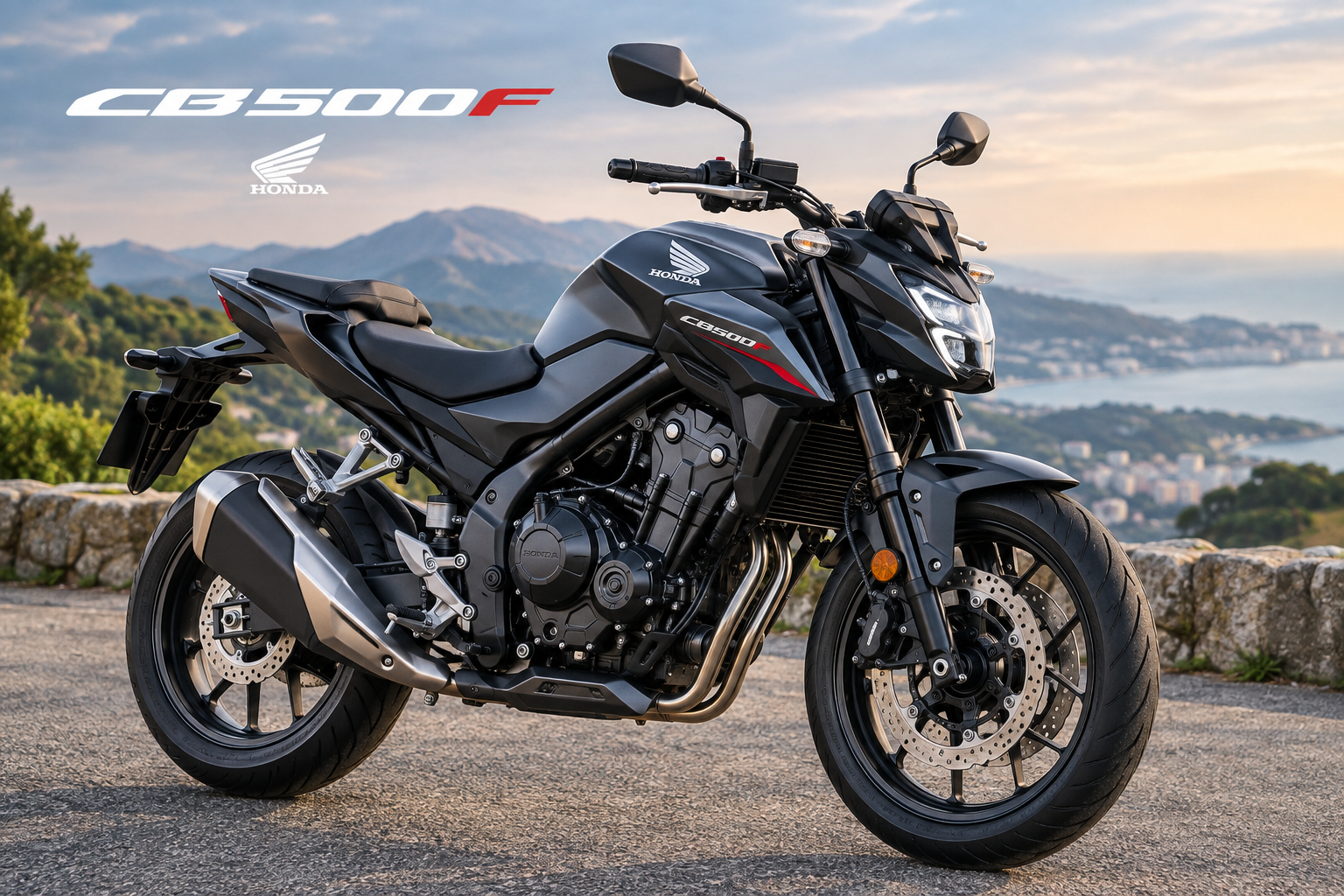
The Honda CB500F doesn’t shout. It doesn’t wheelie down the main street or demand attention through a blaring aftermarket exhaust. It doesn’t need to.
What it does — quietly, reliably, and with characteristic Honda precision — is make you a better, more confident rider. And then it keeps doing exactly that, mile after mile, year after year, without drama and without excuses.
The value-conscious and sporty Honda CB500F is a perfect example of why the universal Japanese motorcycle has been so popular for so long. It threads the needle between approachable and genuinely exciting, between city commuter and weekend canyon carver, between beginner machine and bike you’ll never actually feel the need to replace.
In this complete Honda CB500F review and buyer’s guide, we’ll walk you through every spec, every significant model year upgrade, how it compares to the competition, and — most importantly — whether it’s the right motorcycle for you.
Let’s get into it.
What Is the Honda CB500F?
The Honda CB500F is a middleweight naked motorcycle — also called a streetfighter or standard — produced by Honda since 2013. Unlike full-fairing sportbikes, naked bikes leave the engine and frame exposed, resulting in an aggressive, muscular visual identity paired with a comfortable, upright riding position.
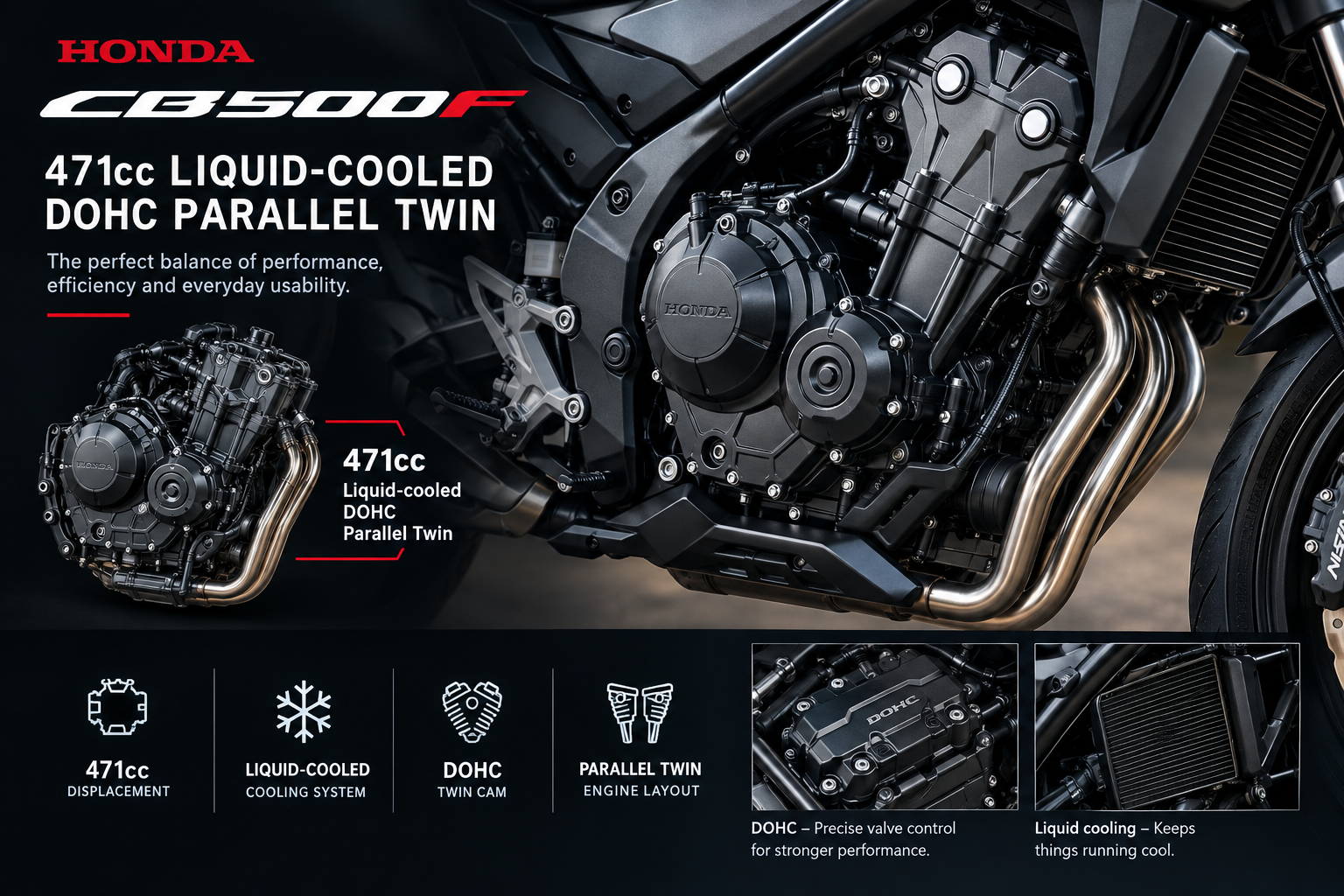
With subtle-yet-aerodynamic styling, the CB500F is a capable, reliable machine that delivers an enjoyable riding experience for all comers. Its 471cc parallel-twin engine is shared across Honda’s entire 500 lineup — including the CBR500R (sport), the CB500X (adventure), and the NX500 (off-road adventure) — making parts availability and mechanic familiarity a genuine ownership advantage.
The CB500 Hornet Naming Confusion — Explained
If you’ve been researching the CB500F internationally and stumbled across something called the “CB500 Hornet,” you’re not alone in the confusion.
For 2024, Honda redesigned the CB500F with bolder, more aggressive styling and rebranded it as the CB500 Hornet for European, Asian, and other global markets — aligning it with the CB750 Hornet and CB1000R Hornet family. In the United States, however, Honda continues to sell the exact same motorcycle under the original CB500F nameplate.
The bottom line: CB500F and CB500 Hornet are mechanically identical. If you’re in the US shopping for a 2024 or 2025 model, look for CB500F. If you’re in Europe, look for CB500 Hornet.
A Brief History of the CB500F (2013–2025)
- 2013: Original CB500F launches as Honda’s answer to the growing A2 license market in Europe and the beginner bike demand globally.
- 2016: Minor refresh — updated styling, slightly revised ergonomics.
- 2019: Major mechanical update — slipper/assist clutch added, clutch pull reduced by 45%.
- 2022: The biggest upgrade in CB500F history — Showa SFF-BP inverted forks replace conventional units, dual front brake discs replace the single disc, and an all-new frame improves rigidity.
- 2024: Bold new Hornet-inspired styling globally, Honda Selectable Torque Control (HSTC) added, new 5-inch TFT display, LED lighting throughout.
- 2025: Carries forward all 2024 updates with no mechanical changes.
2025 Honda CB500F Specs — Full Breakdown
Engine & Performance Specs
| Spec | Detail |
|---|---|
| Engine Type | 471cc liquid-cooled, DOHC, parallel-twin |
| Bore x Stroke | 67mm x 66.8mm |
| Compression Ratio | 10.7:1 |
| Horsepower | ~46.9 hp @ 8,600 RPM |
| Torque | ~31.8 lb-ft @ 6,500 RPM |
| Fuel System | Honda PGM-FI fuel injection |
| Transmission | 6-speed with slipper/assist clutch |
| Final Drive | Chain |
| Top Speed | ~112–115 mph (180–185 km/h) |
Chassis, Dimensions & Weight
| Spec | Detail |
|---|---|
| Frame | Diamond steel frame |
| Seat Height | 31.1 in (790mm) |
| Wheelbase | 55.5 in (1,410mm) |
| Wet Weight | 414 lbs (188 kg) |
| Fuel Capacity | 3.7 US gal (14.1L) |
| Front Tyre | 120/70-17 |
| Rear Tyre | 160/60-17 |
Electronics & Technology
| Feature | Detail |
|---|---|
| ABS | Standard, dual-channel |
| Traction Control | Honda HSTC (standard, 2024+) |
| Display | 5-inch full-color TFT (2024+) |
| Connectivity | Honda RoadSync (Bluetooth) |
| Lighting | Full LED |
MSRP (2025): $6,899 base / $7,499 total (including destination)
How Does the Honda CB500F Engine Actually Feel to Ride?
Specs are one thing. What the CB500F actually feels like under your right hand is another conversation entirely.
The ignition timing and air/fuel ratio have been optimized to create more powerful acceleration feel from low RPM, with linear power delivery and throttle feel. That sentence from Honda’s engineers perfectly describes what you experience in the real world: smoothness and accessibility at every point in the rev range.
Low-End & Mid-Range Power Delivery
Crack the throttle at 2,000 RPM in third gear and the CB500F doesn’t lurch, cough, or hesitate. It pulls. Cleanly, predictably, confidently.
This is where the 471cc twin shines most brightly. The torque curve is so broad and forgiving that beginners can barely make a mistake with the throttle. At the same time, experienced riders will appreciate that you’re never hunting for a narrow powerband — the engine is simply always ready between 3,000 and 8,000 RPM.
Crack it past 7,000 RPM and things get genuinely exciting. The exhaust muffler features dual exit pipes, giving a sporting edge to each pulse, as well as a rasping high-RPM howl — a sound character that adds real character to the riding experience.
Honda CB500F Top Speed & Highway Performance
Real-world top speed sits comfortably between 112 and 115 mph (180–185 km/h), depending on rider weight, wind conditions, and whether you’ve tucked behind the small fly screen.
0–60 mph takes approximately 4.5–5 seconds — genuinely quick enough to leave most cars behind off a stoplight.
Freeway cruising at 75–80 mph keeps the engine humming at a relaxed 6,000 RPM — well within its comfort zone and well away from the stressful top of the rev range. Wind blast becomes noticeable above 85 mph without a windshield, but nothing that makes the bike genuinely uncomfortable.
Handling, Suspension & Braking
41mm Showa SFF-BP Forks — A Game Changer
The 2022 suspension upgrade transformed this motorcycle. Before 2022, the CB500F was a competent city bike with somewhat soft, imprecise conventional front forks. After 2022, it became a proper canyon carver.
A top-notch 41mm inverted Showa Separate Function Fork—Big Piston (SFF-BP) front end provides the rigidity needed for precise steering and feedback.
In practical terms, this means the front end communicates clearly what the tyre is doing on every surface — from smooth tarmac to mid-corner road imperfections. Confidence comes naturally and quickly. Turn-in is sharp without being nervous, and the chassis holds its line mid-corner with genuine authority.
At 414 lbs, the CB500F isn’t the lightest bike in its class, but the weight is carried low in the frame, making it feel significantly lighter than the numbers suggest. Lane changes at highway speed feel effortless. U-turns in parking lots are stress-free.
Braking Power & ABS
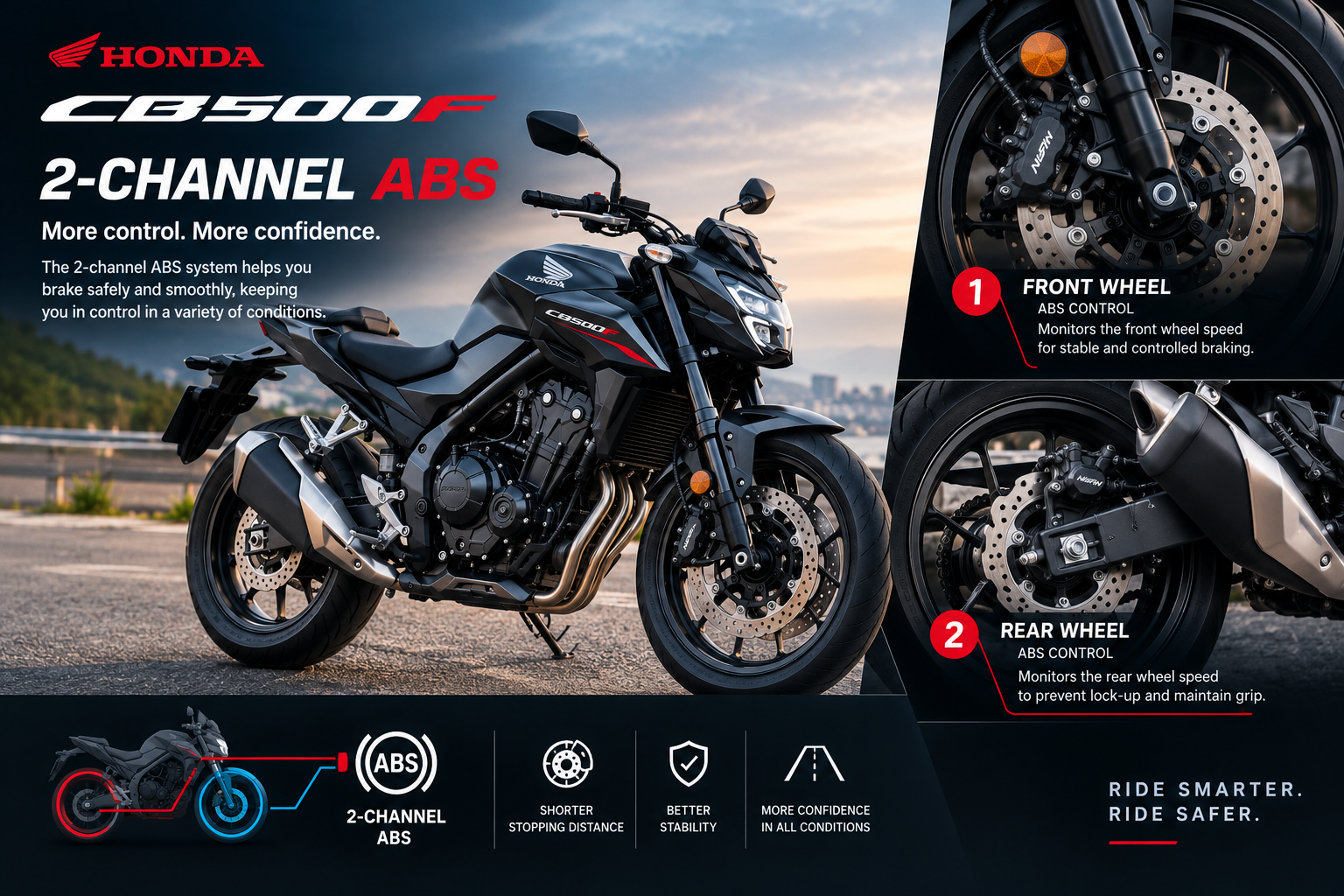
The Anti-Lock Braking System is standard, providing confident stopping power and added assurance in challenging conditions, such as wet roads or loose gravel.
The dual 296mm front discs (introduced in 2022) grabbed by Nissin four-piston calipers provide exceptional bite. Modulation is excellent — you can trail-brake into corners with confidence, and panic stops from highway speeds feel controlled and progressive rather than dramatic.
Is the Honda CB500F a Good Beginner Bike?
Yes. Emphatically, enthusiastically, unconditionally: yes.
But let’s get beyond the simple answer and explain exactly why — because not all beginner bikes are created equal, and the CB500F earns its recommendation for specific, measurable reasons.
Seat Height & Rider Accessibility
At 31.1 inches (790mm), the CB500F is accessible to a wide range of rider heights. Importantly, the seat is narrow toward the front — so even shorter riders around 5’4″ can get both feet down flat or near-flat at stoplights. This is not a small thing. Confidence at low speed and while stationary is one of the biggest anxieties for new riders, and the CB500F’s seat shape addresses it directly.
The upright handlebar position keeps your back neutral, your wrists relaxed, and your sightlines forward — exactly where they need to be as a new rider developing spatial awareness.
Weight & Low-Speed Maneuverability
Yes, 414 lbs sounds heavy on paper. But the low centre of gravity means the bike practically wants to balance itself. Slow-speed U-turns, parking lot manoeuvres, and filtering through traffic are all significantly less stressful than on heavier, taller alternatives.
The slipper clutch improves power delivery, reduces clutch-lever pull effort by 45 percent, and helps prevent rear-wheel hop during hard deceleration — a detail that becomes incredibly important for newer riders spending lots of time in city traffic. Lighter clutch pull means less hand fatigue and more relaxed riding.
Will You Outgrow It?
This is the question every experienced motorcyclist asks beginner friends, and it’s the right question to ask. The honest answer with the CB500F: most riders won’t outgrow it nearly as quickly as they think.
The 471cc parallel-twin engine delivers enough performance to keep intermediate riders genuinely engaged — especially when you start leaning into corners on twisty roads. It’s not a 600cc supersport, and it doesn’t need to be. What it is is a motorcycle that rewards smooth, skilled riding — and that’s exactly what a beginner needs to develop.
Honda CB500F Fuel Economy & Commuter Capability
If there’s one area where the CB500F quietly outperforms almost every other motorcycle in its class, it’s at the pump.
Real-World MPG
Thanks to Honda’s PGM-FI (Programmed Fuel Injection) system and the efficient parallel-twin architecture, real-world fuel economy consistently lands between 60 and 70 MPG — regardless of whether you’re commuting through city traffic or cruising a motorway.
Aggressive riding (high-RPM canyon runs, repeated hard acceleration) will push you toward the lower end of that range. Relaxed highway cruising will push you to the top.
Range Per Tank
With a 3.7-gallon (14.1L) fuel tank, you’re looking at approximately 220–260 miles of range per fill-up under normal mixed-riding conditions. For a daily commuter, that often means stopping at the pump once a week at most.
For context: a typical commuter car achieving 30 MPG would cost more than twice as much per mile to run.
Honda CB500F Technology & Electronics (2024+ Updates)
The 2024 model year represented the CB500F’s most significant technological leap since the 2022 suspension upgrade.
Honda Selectable Torque Control (HSTC)
For 2024, the CB500F welcomed the addition of Honda Selectable Torque Control (HSTC). The system compares front and rear wheel speeds to monitor rear slip, and when it’s detected, the fuel injection is controlled to smoothly reduce torque, offering enhanced control, especially in slippery conditions. 1 HSTC can be turned off completely with the new four-way toggle switch on the left side of the handlebar.
This is a significant safety net for newer riders who may encounter unexpected wet or slippery road surfaces mid-corner.
5-Inch TFT Display & Honda RoadSync
Honda’s CB500F continues into 2025 with the updates introduced in 2024, including new styling, traction control, and a 5-inch TFT display.
The full-color TFT display integrates with the Honda RoadSync app via Bluetooth, giving you turn-by-turn navigation, call/music controls, and ride information — all visible at a glance. The display is sharp, legible in bright sunlight, and genuinely useful for daily commuting.
Honda CB500F Model Year Differences — Which Year to Buy?
If you’re shopping used, this section could save you thousands. Not all CB500Fs are created equal.
Pre-2022 vs. 2022+ (The Biggest Divide)
| Feature | Pre-2022 | 2022+ |
|---|---|---|
| Front Forks | Conventional telescopic | Showa SFF-BP inverted |
| Front Brakes | Single 296mm disc | Dual 296mm discs |
| Slipper Clutch | From 2019 | ✅ |
| Frame | Older design | Revised, improved rigidity |
Verdict: If budget allows, aim for 2022 or newer. The difference in front-end feel and braking confidence is immediately noticeable.
2024+ Updates Explained
- New Hornet-inspired fairing design (shared globally with CB500 Hornet)
- Honda HSTC traction control added
- 5-inch full-color TFT display
- Full LED lighting (front and rear)
- New 4-way toggle switch on left handlebar
If you’re buying new, the 2024–2025 CB500F represents the most complete and well-equipped version of this motorcycle Honda has ever produced.
Honda CB500F vs. The Competition
Honda CB500F vs. Kawasaki Z500
The new Kawasaki Z500 (451cc parallel-twin, ~45 hp) is the CB500F’s closest direct competitor. It’s marginally lighter and has a slightly more angular, aggressive design language. However, the CB500F pulls ahead in suspension quality (the Showa SFF-BP forks are a class above), electronics sophistication (HSTC, TFT display), and the sheer depth of Honda’s reliability heritage.
Winner for beginners: CB500F. Winner for those who want edgier style: Z500.
Honda CB500F vs. Yamaha MT-03
The Yamaha MT-03 (321cc parallel-twin, ~42 hp) is often recommended as an entry-level naked. It’s lighter and more nimble in tight urban environments. However, it runs out of steam on the highway at higher speeds and will genuinely be outgrown within 12–18 months by most riders.
The CB500F costs a little more, weighs a little more, and rewards you with significantly more long-term capability.
Winner: CB500F — for anyone who plans to ride beyond city limits.
Honda CB500F vs. Royal Enfield Hunter 350
The Hunter 350 undercuts the CB500F significantly on price and offers genuine retro charm. But its 349cc single-cylinder engine, lack of ABS on some variants, and decidedly more relaxed performance make it a very different machine.
Winner: CB500F — for modern technology, performance, and reliability. Hunter 350 — for those who want character and budget value above all else.
Common Honda CB500F Problems & Long-Term Reliability
Let’s be completely transparent here: there are no widespread, catastrophic mechanical problems associated with the Honda CB500F.
The 471cc parallel-twin is genuinely one of the most bulletproof motorcycle engines produced in the last decade. Across forums, owner communities, and professional mechanic testimony, the CB500F consistently earns a reputation for starting every time, needing nothing but routine maintenance, and running hard well past 50,000 miles when properly serviced.
Routine Maintenance Schedule:
- Oil & filter change: Every 8,000 miles
- Coolant flush: Every 2 years
- Brake fluid: Every 2 years
- Spark plugs: Every 16,000 miles
- Valve clearance check: Every 16,000 miles
Minor Complaints from Owners (Pre-2022):
- Soft front forks that felt vague at the limit (fixed entirely in 2022)
- Single front brake disc that felt average under hard braking (fixed entirely in 2022)
Minor Complaints (2022+):
- Wind blast at sustained highway speeds above 85 mph (no fairing)
- Stock mirrors have modest vibration above 7,000 RPM
- The stock exhaust sounds relatively subdued — easily solved with aftermarket options
Honda CB500F Aftermarket Parts & Popular Modifications
The CB500F has a passionate ownership community, and aftermarket support reflects that.
Best Exhaust Upgrades
The stock exhaust is functional but quiet. Popular upgrades include:
- Yoshimura R-77 Slip-On: One of the most popular choices — great sound, minimal weight gain
- Akrapovic Slip-On: Premium option with titanium construction
- Two Brothers Racing: A mid-range option that offers a genuine bark at higher RPM
Tail Tidy & Aesthetic Mods
The stock rear end has a somewhat bulky look. A tail tidy/fender eliminator is the single most popular cosmetic modification, dramatically cleaning up the rear profile. Multiple manufacturers produce plug-and-play kits for the CB500F.
Other Popular Mods:
- Bar-end mirrors (cleaner aesthetic, reduced vibration)
- Puig windscreen (immediate highway comfort improvement)
- Rear seat cowl (for solo riders wanting a cleaner tail)
- Heated grips (essential for year-round commuters)
Honda CB500F Insurance Cost — What to Expect
The CB500F’s modest engine displacement, low theft-rate profile, and beginner-friendly reputation all contribute to extremely reasonable insurance premiums.
Estimated Annual Premiums (US — will vary by state, age, and history):
- New riders, age 25+: $500–$900/year
- Experienced riders, clean record: $300–$600/year
- Comprehensive coverage with low deductible: Add 20–30%
Compare this to a 600cc supersport, which can run $1,500–$2,500+ for a newer rider — and the CB500F’s financial case becomes even more compelling.
Tip: Always get at least three quotes. Progressive, Markel, and Dairyland are among the most competitive insurers for motorcycle policies in the US.
Honda CB500F FAQs
What is the top speed of the Honda CB500F? The Honda CB500F tops out at approximately 112–115 mph (180–185 km/h). It cruises comfortably at 75–80 mph highway speeds without working the engine hard.
Is the Honda CB500F a good beginner bike? Yes — arguably the best in its class. The CB500F combines a forgiving power delivery, ABS as standard, a manageable seat height of 31.1 inches, a 45% lighter clutch pull (thanks to the slipper clutch), and Honda’s near-legendary reliability. It checks every beginner box without being boring.
What is the difference between the CB500F and the CB500 Hornet? Mechanically identical. The CB500 Hornet is simply the 2024+ European market rebrand of the CB500F with new Hornet-family styling. In the US, it remains sold as the CB500F.
How much does the 2025 Honda CB500F cost? The 2025 CB500F has a base MSRP of $6,899 with a $600 destination charge, for a total of $7,499.
Does the Honda CB500F have traction control? Yes, from 2024 onwards. Honda Selectable Torque Control (HSTC) compares front and rear wheel speeds and smoothly reduces torque when rear wheel slip is detected. It can be switched off for track or spirited riding.
Does the CB500F have ABS? Yes. Dual-channel ABS is standard on all CB500F models sold in the US.
What year CB500F should I buy used? 2022 or newer if possible — that’s when Honda upgraded to the Showa SFF-BP inverted forks and dual front disc brakes, fundamentally improving how the bike handles and stops. If budget pushes you pre-2022, the 2019+ models at least have the improved slipper clutch.
How fuel-efficient is the CB500F? Extremely. Riders consistently report 60–70 MPG depending on riding style, giving approximately 220–260 miles of range per 3.7-gallon tank.
Final Verdict — Should You Buy the Honda CB500F?
Here’s the truth without the marketing language: the Honda CB500F is one of the most intelligently engineered motorcycles at any price point.
It won’t embarrass a supersport off the line, and it won’t win any Instagram contests against a hand-built Italian café racer. What it will do is start every single morning without drama, carry you smoothly through rush-hour traffic, surprise you with genuine canyon-road fun on the weekend, and still be running perfectly when you’ve long since paid it off.
The CB500F is a capable, reliable machine that delivers an enjoyable riding experience for all comers — and that sentence, coming from a source with no financial stake in your purchase, says everything.
Buy it if:
- You’re a new rider wanting a bike you won’t outgrow in one season
- You’re an experienced rider wanting a low-cost, low-stress daily commuter
- You want Honda reliability without Honda Gold Wing pricing
- You’re an A2-license restricted rider in Europe needing a sub-47hp machine
- You value modern electronics (HSTC, TFT, ABS) at an attainable price
Look elsewhere if:
- You need triple-digit horsepower for track days
- You want a pure retro or cruiser aesthetic
- You’re set on the absolute lightest, most nimble option in the sub-500cc naked class
The Honda CB500F doesn’t beg for your attention. It earns it — and then keeps earning it, mile after mile after mile.