
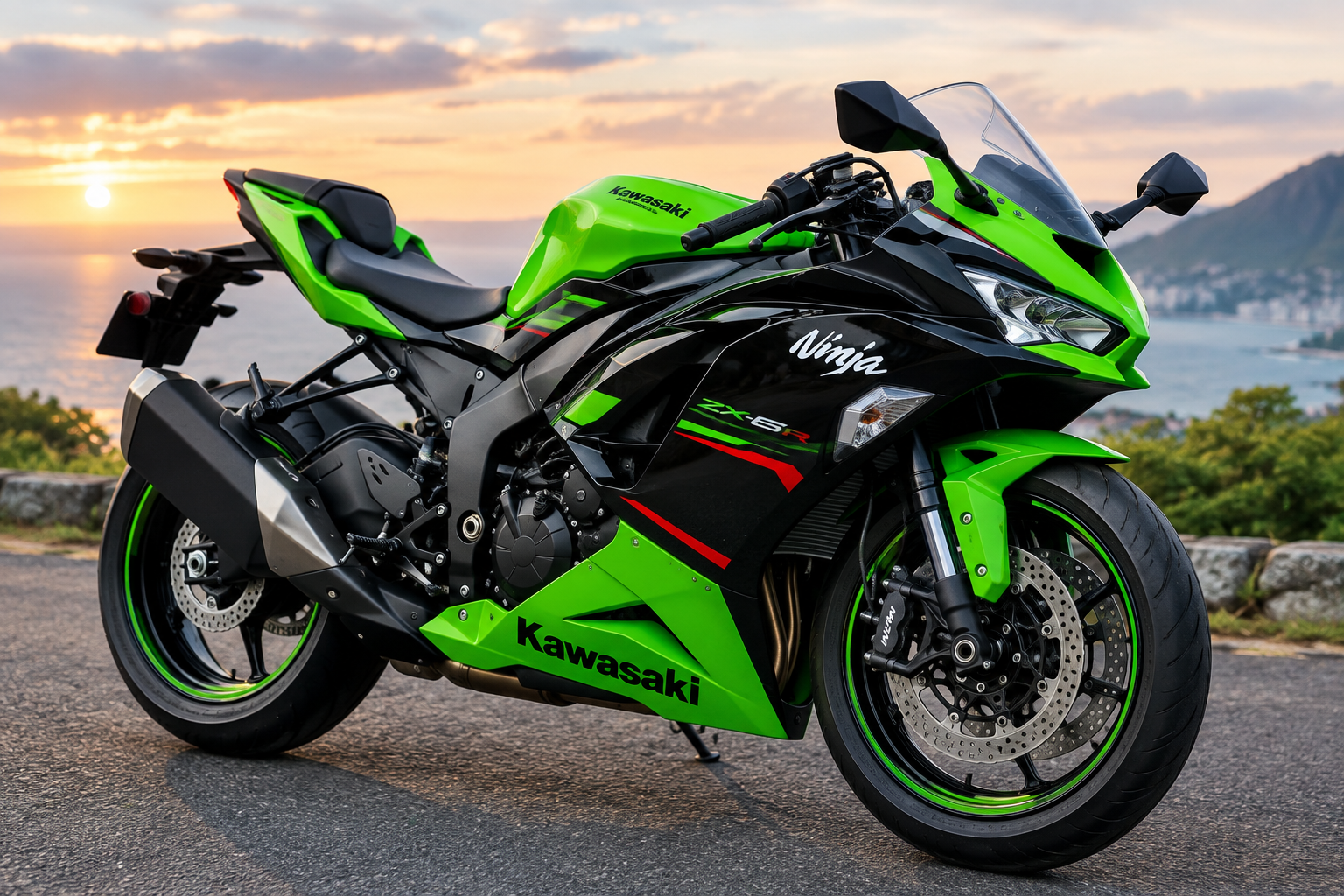
Introduction
Few names in motorcycling carry as much weight as Ninja.
It’s the name that launched a generation of sportbike riders in 1984 when the original Kawasaki GPZ900R rewrote the rules of production motorcycle performance. It’s the name that has since grown into one of the most diverse, respected, and commercially successful lineups in the entire two-wheeled world.
In 2026, the Kawasaki Ninja family is healthier than ever. Nine models, spanning from a beginner-friendly 296cc parallel twin to a supercharged 998cc rocket ship, each built to capture a specific rider, a specific skill level, and a specific thrill.
The question isn’t whether a Kawasaki Ninja is the right motorcycle. For most sport-focused riders, the question is simply: which one?
That’s what this guide answers. We’ll walk you through every 2026 Ninja model — specs, price, riding character, ideal rider profile — and give you a clear, honest recommendation based on who you are as a rider right now.
Let’s go.
What Is the Kawasaki Ninja Lineup?
A Brief History of the Kawasaki Ninja Name
The Ninja name has meant performance since 1984. The original GPZ900R was a machine that shocked the motorcycle world — liquid-cooled, 16-valve, and faster than anything that had come before it from a Japanese manufacturer. It set the template for what a sportbike could be.
From that foundation, Kawasaki built an empire. The ZX series became the benchmark for supersport and superbike performance. The smaller displacement Ninjas — the 250, 300, and later 500 — became the default answer to the question every new rider asked: “What should my first bike be?”
Today, the Ninja name covers more ground than ever, spanning six displacement classes and multiple riding styles — from commuter-friendly middleweight twins to WorldSBK-inspired open-class weapons.
How Kawasaki Structures the Ninja Family in 2026
The 2026 Kawasaki Ninja lineup offers clear progression paths, allowing riders to select the exact displacement, technology tier, and price point matching their riding experience.
Think of it as a ladder:
| Tier | Models | Rider Profile |
|---|---|---|
| Entry | Ninja 300, Ninja 500 | New riders, A2 licence |
| Mid | Ninja 650, ZX-4R/4RR | Intermediate, growing riders |
| Supersport | ZX-6R | Experienced, track-capable |
| Superbike | ZX-10R | Advanced, performance-focused |
| Sport Touring | Ninja 1100SX | Long-distance, comfort-sport |
| Extreme | Ninja H2 SX | Supercharged pinnacle |
Each tier is intentionally designed to be a stepping stone to the next — keeping Kawasaki riders in the family as they grow.
What’s New Across the Ninja Lineup for 2026
For two-wheel adrenaline seekers, Kawasaki’s 2026 sport and supersport motorcycle lineup welcomes the return of the Ninja 500, Ninja 650, Ninja ZX-4R and Ninja ZX-6R.
Key updates across the 2026 Ninja family include:
- The Ninja 650 gets a 4.3-inch TFT screen, twin LED headlights, and the Kawasaki traction control system for 2026.
- The 2026 Kawasaki Ninja ZX-10R adopts winglets as part of its model-year refresh, with new bodywork side-mounted winglets, a repositioned ram-air intake, and a 5-inch full-color TFT display.
- Kawasaki proudly announces the return of the iconic Ninja 300 ABS motorcycle for 2026, bringing back one of the most popular entry-level sportbikes to its lineup.
- The sport-touring Ninja 1100SX has a 1,099cc 4-stroke in-line-four engine, an advanced electronics package, and a relaxed riding position, with a cockpit featuring a 4.3-inch all-digital TFT color instrumentation with multiple display modes and smartphone connectivity.
Every 2026 Kawasaki Ninja Model — Full Overview
Kawasaki Ninja 300 — The Iconic Entry-Level Sportbike
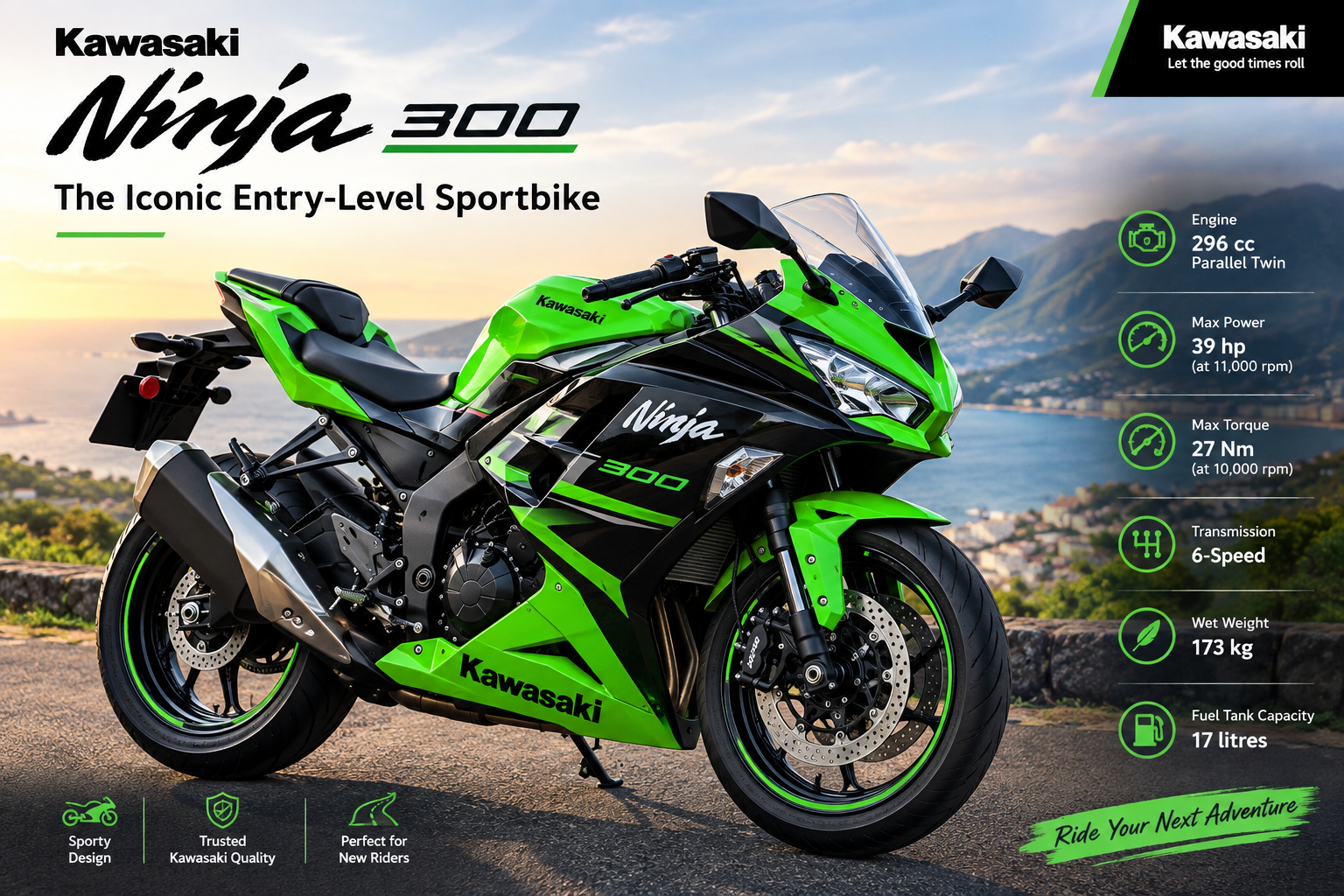
The Ninja 300 is where millions of riders started their sportbike journey, and for 2026, it’s back.
From its powerful 296cc parallel-twin engine and superb-handling chassis to its impressive large-body Ninja styling, everything about the Ninja 300 was designed to offer riders performance, ride quality and comfort beyond its class. Kawasaki proudly announces the return of the iconic Ninja 300 ABS motorcycle for 2026. True to the Ninja name, the Ninja 300 boasts a 296cc liquid-cooled, parallel-twin engine, chassis stability inspired by Kawasaki’s supersport machines, and Assist & Slipper Clutch technology for smooth, confident riding. Visually, the 2026 Ninja 300 ABS makes a bold statement with large-volume bodywork and sharp lines that echo its bigger Ninja siblings. Aggressive dual headlights, a sleek tail cowl, and premium fit-and-finish details give it a commanding presence.
Ninja 300 — Quick Specs:
| Spec | Detail |
|---|---|
| Engine | 296cc liquid-cooled parallel-twin |
| Clutch | Assist & Slipper |
| Frame | Rigid Diamond steel-tube |
| Brakes | ABS standard |
| Best For | True beginners, A2 licence |
Ideal Rider: First-time sportbike rider or anyone returning to motorcycling after time away. Smooth power delivery, forgiving character, and authentic Ninja DNA at the most accessible entry price.
Kawasaki Ninja 500 — The Best Beginner Sportbike of 2026
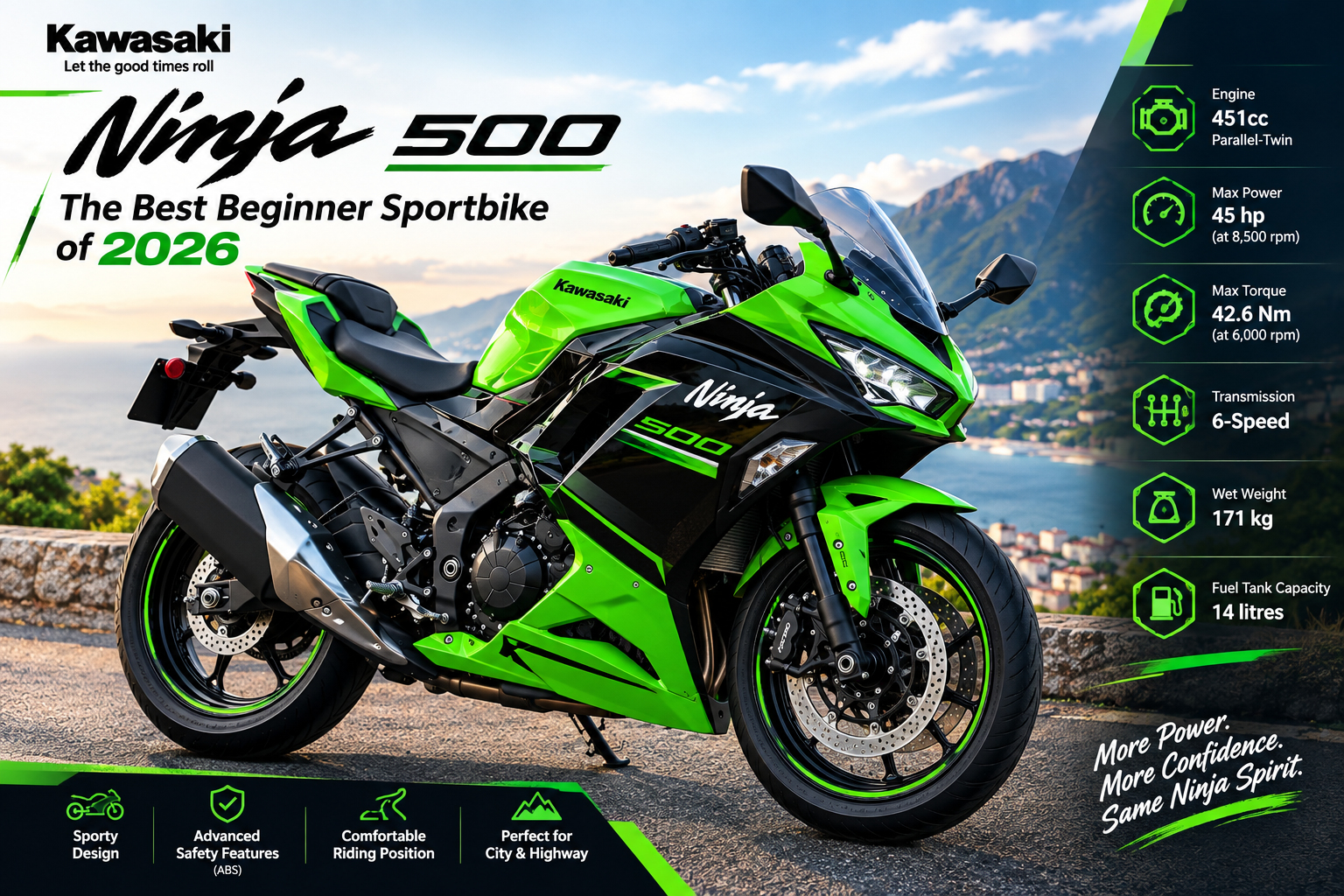
The Ninja 500 is one of the best bikes the brand makes for city riding. Designers created the Ninja 500 to turn heads in the dynamic lightweight sport segment. It boasts a powerful and rider-friendly 451cc parallel-twin engine. The motorcycle features an assist and slipper clutch and lightweight chassis. This design strikes a perfect balance between agility and stability. The current Ninja 500, which debuted in its modern form for 2024 with a completely new 451cc parallel-twin engine, carries forward the same philosophy of making performance accessible. For 2026, Kawasaki has refined the package and continues to offer what is arguably the best value proposition in the entry-level sportbike segment. What makes the Ninja 500 special isn’t any single headline feature — it’s the way everything works together. The engine delivers its power smoothly and predictably. The chassis feels planted but nimble. The ergonomics strike a balance between sporty and comfortable that most bikes in this class can’t quite match. And the price tag makes it all feel like you’re getting away with something.
Independent press validation is strong: Cycle World, RideApart, and Motorcycle.com all flagged the Ninja 500 as their “easiest recommendation” for a first sportbike in 2025-2026 buyer’s guides.
Ninja 500 — Quick Specs:
| Spec | Detail |
|---|---|
| Engine | 451cc parallel-twin |
| Connectivity | RIDEOLOGY App |
| Front Brake | 310mm disc |
| Clutch | Assist & Slipper |
| Starting MSRP | $5,499 |
| Best For | Beginners, commuters |
At $5,499 base / $5,899 ABS, the Ninja 500 is consistently called the best price-to-capability deal in the entry-level sportbike segment, especially after Honda’s CBR500R climbed to $7,199 ABS for 2026.
Ideal Rider: Any new rider — especially one coming off the MSF course who wants a bike that keeps up with skill development without outgrowing them in the first year.
Kawasaki Ninja 650 — The Everyday Sport-Tourer
The Ninja 650 is where Kawasaki bridges the gap between pure beginner bike and serious performance machine.
The Ninja 650 is offered with or without ABS, both versions packing a 649cc parallel-twin engine. For 2026, the bikes get a 4.3-inch TFT screen, twin LED headlights, and the Kawasaki traction control system.
The 650’s 649cc engine produces smooth, usable power across the entire rev range — it doesn’t demand revving to the redline to feel fast. With its upright-ish seating position, wide handlebars, and compliant suspension, it’s comfortable enough for all-day riding while still being entertaining on a back road.
Premium features include 4.3-inch TFT color instrumentation with smartphone connectivity. Integrated riding modes link KTRC and power modes.
Ninja 650 — Quick Specs:
| Spec | Detail |
|---|---|
| Engine | 649cc parallel-twin |
| Display | 4.3-inch TFT, smartphone connected |
| Traction Control | KTRC standard |
| Starting MSRP | $7,599 (standard) |
| Best For | Intermediate riders, commuters, weekend tourers |
Ideal Rider: Riders who have outgrown the 500 or are starting with some prior riding experience. Also outstanding as a do-everything daily motorcycle.
Kawasaki Ninja ZX-4R and ZX-4RR — The Mini Superbike
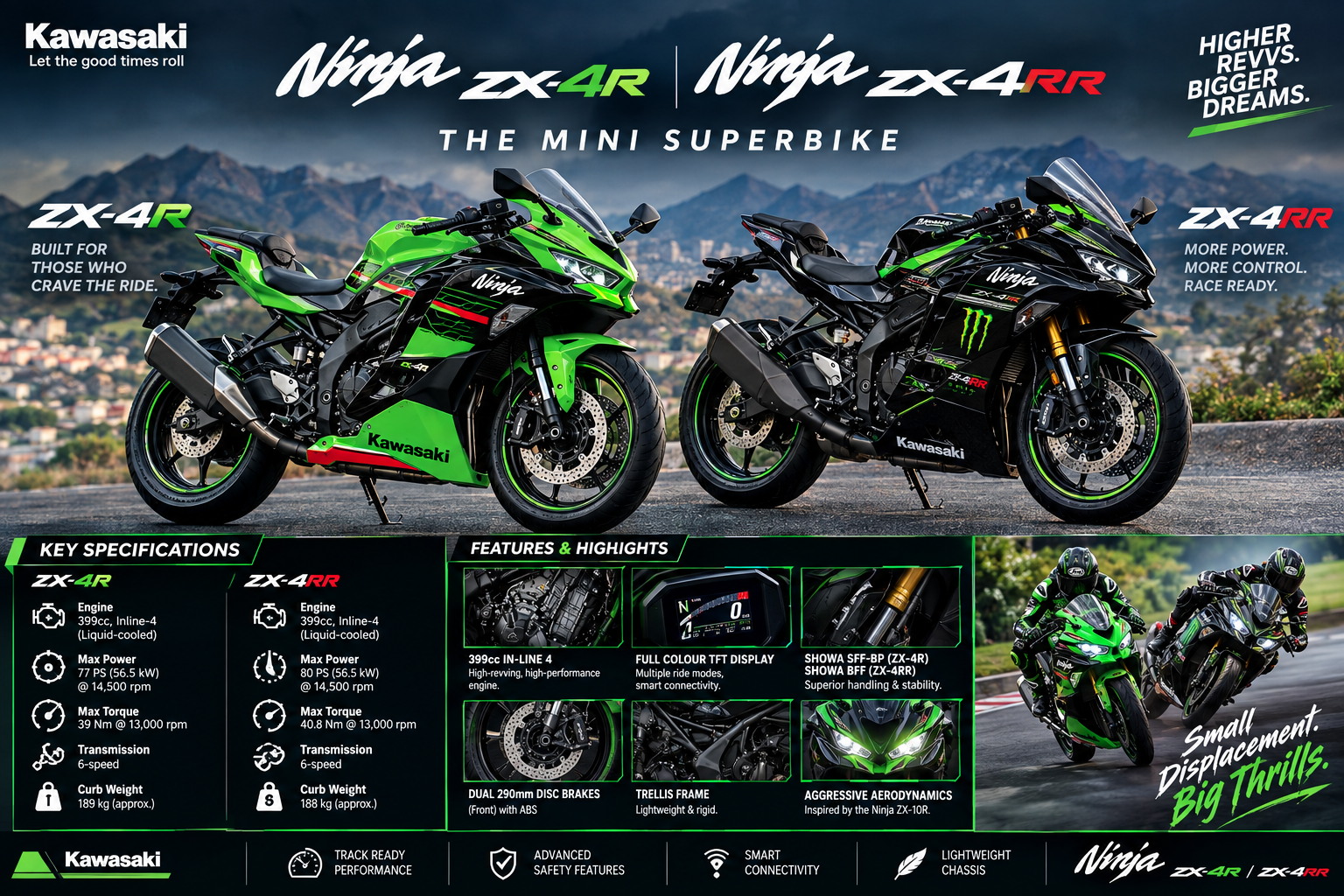
The ZX-4R is unlike anything else in the Kawasaki lineup — or the market. It brings a four-cylinder engine to the sub-400cc class, delivering a riding experience that has no direct equivalent at its price point.
The trellis frames of these bikes hold a 399cc in-line four-cylinder engine bred to make them circuit-focused bikes. The duo is propped on a 37mm Showa SFF-BP fork at the front and a horizontal backlink at the rear. Dual front disc brakes at the front ensure stopping power. Just like the other Ninjas, these are equipped with a 4.3-inch TFT screen with smartphone connectivity and traction control.
The ZX-4RR takes it further still: The Ninja ZX-4RR ABS takes performance even further with the addition of dual-direction Kawasaki Quick Shifter (KQS), a higher-grade Showa front fork with adjustable spring preload, and a Showa BFRC Lite rear shock.
ZX-4R vs ZX-4RR — Price Comparison:
| Model | MSRP |
|---|---|
| Ninja ZX-4R ABS | $9,299 |
| Ninja ZX-4RR ABS | From $9,999 |
Ideal Rider: The intermediate rider who wants genuine four-cylinder excitement without crossing into full supersport territory. Also excellent for track day enthusiasts on a budget.
Kawasaki Ninja ZX-6R — The Middleweight Supersport King
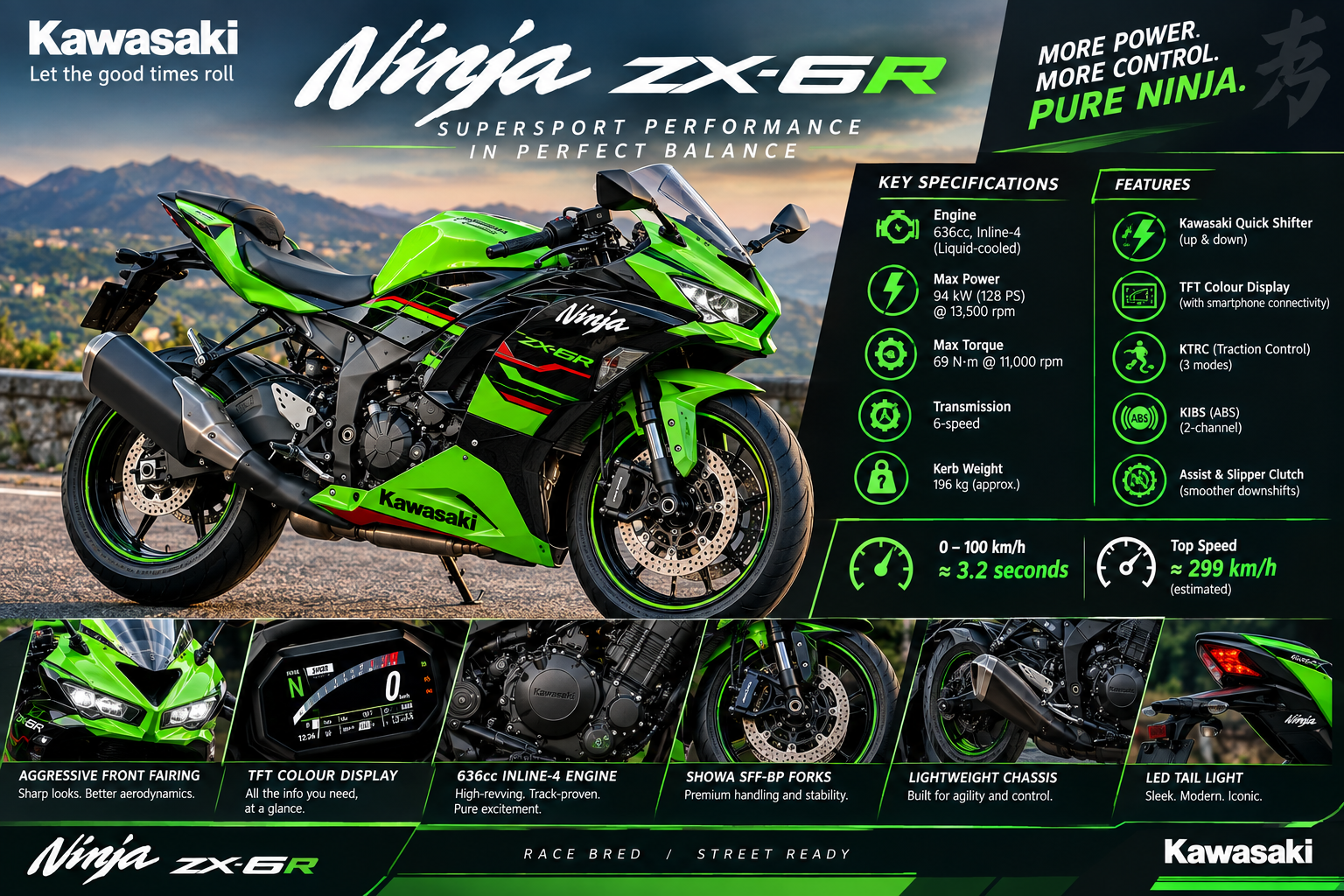
The Ninja ZX-6R is highly competitive in its class, going up against bikes like the Honda CBR600RR, but providing more displacement and power. The ZX-6R uses a 636cc inline four-cylinder engine that produces a screaming 127 hp and 52.1 lb-ft. The Kawasaki ZX-6R has a top speed of approximately 164 mph — making it the fastest bike in the current middleweight sport class; twin-cylinder rivals like the Yamaha R7 top out around 139 mph. Independent testing puts the ZX-6R at roughly 3.2 seconds from 0-60 mph, with a quarter mile in the high 10-second range — supercar-level acceleration for under $12,000. Out of all the Kawasaki sport bikes, the Ninja ZX-6R offers the highest value. The base price is set at $11,599, which positions it $4,000 more than the Ninja 650 while being $5,000 less than the updated Ninja ZX-10R. That’s a nice sweet spot in the lineup, without being too much in your face or too vanilla — and you get a proper four-cylinder engine with decent power and equipment for the middleweight sport segment.
The ZX-6R is not for beginners. Around 124 hp, race-derived geometry, and an aggressive riding position make it a poor first motorcycle. But for the experienced rider who wants track-capable performance at a price that doesn’t require selling organs — the ZX-6R remains one of the best value propositions in all of motorcycling.
Ninja ZX-6R — Quick Specs:
| Spec | Detail |
|---|---|
| Engine | 636cc inline-four |
| Horsepower | ~124 hp (127 hp with ram air) |
| Top Speed | ~164 mph |
| 0-60 mph | ~3.2 seconds |
| Starting MSRP | $11,599 |
| Best For | Experienced sport riders, track enthusiasts |
Kawasaki Ninja ZX-10R — The WorldSBK-Derived Superbike
This is it. The pinnacle of what road-legal Kawasaki Ninja technology looks like.
The 2026 Kawasaki Ninja ZX-10R is the latest to adopt winglets as part of its model-year refresh. The 998cc inline-4, aluminum twin-spar frame, and swingarm largely carry over intact, though with a few notable geometry tweaks. The bodywork’s side-mounted winglets, a repositioned ram-air intake, and 5-inch full-color TFT display are new. Value has become one of the 2026 Kawasaki Ninja ZX-10R’s strongest selling points. At $16,999 for the non-ABS model, the ZX-10R undercuts nearly all its liter-bike rivals, save for the base-model Suzuki GSX-R1000. What you’re getting is a seriously potent package with its eminently capable chassis and stout engine. The Ninja ZX-10R runs a 998cc inline-four producing 190+ horsepower and starts at $16,999 MSRP. Even in stock trim, the latest ZX-10R offers high-revving inline-4 thrills for a price that most of the competition can’t begin to beat.
Ninja ZX-10R — Quick Specs:
| Spec | Detail |
|---|---|
| Engine | 998cc inline-four |
| Horsepower | 190+ hp |
| Display | 5-inch full-color TFT |
| Aerodynamics | Side-mounted winglets (new 2026) |
| Starting MSRP | $16,999 (non-ABS) / $17,999 (ABS) |
| Best For | Advanced riders, superbike enthusiasts, track use |
Kawasaki Ninja 1100SX — The Sport-Touring Premium
The sport-touring Ninja 1100SX has a 1,099cc 4-stroke in-line-four engine, an advanced electronics package, and a relaxed riding position, with a cockpit featuring a 4.3-inch all-digital TFT color instrumentation with multiple display modes and smartphone connectivity. The special edition 1100SX SE offers Brembo M4.32 front brake calipers, Brembo master cylinder and brake discs, steel-braided lines, an Öhlins S46 rear shock, grip heaters, and more. The Ninja 1100SX starts at $13,999, while the special edition MSRP is $15,799.
Ideal Rider: Experienced riders who want effortless long-distance capability with genuine sport performance on-demand — especially those touring two-up or across multiple time zones on weekends.
Kawasaki Ninja H2 SX — The Supercharged Sport Tourer
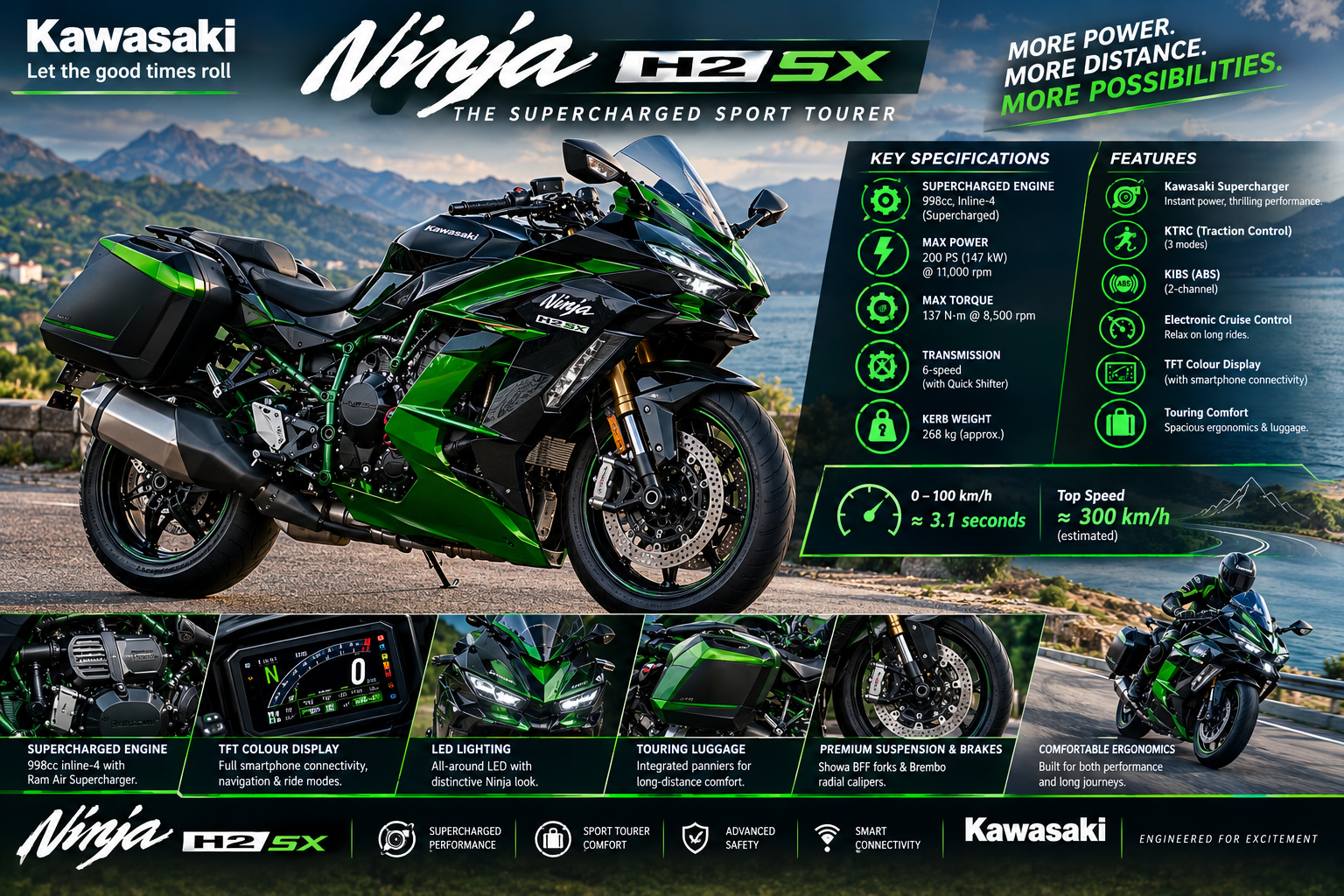
At the extreme top end of the Ninja family sits a motorcycle unlike anything else: supercharged, mind-bending, and still somehow street legal. The Ninja H2 SX takes Kawasaki’s supercharger technology — originally developed for the track-only H2R — and wraps it in a sport-touring package with luggage capacity and pillion comfort.
The 2026 Kawasaki Ninja H2 SX SE ABS is available in Metallic Brilliant Golden Black / Metallic Diablo Black. It is the most technologically complex road-going motorcycle in the current Kawasaki lineup — and one of the most extraordinary production machines in the world.
Ideal Rider: The seasoned, experienced rider who has ridden everything and wants the next level of performance in a package that can still eat up touring miles in comfort.
2026 Kawasaki Ninja Full Specs Comparison Table
| Model | Engine | Power | Starting MSRP | Best For |
|---|---|---|---|---|
| Ninja 300 | 296cc parallel-twin | ~39 hp | TBC | True beginners |
| Ninja 500 | 451cc parallel-twin | ~51 hp | $5,499 | Beginners, commuters |
| Ninja 650 | 649cc parallel-twin | ~67 hp | $7,599 | Intermediate, touring |
| Ninja ZX-4R | 399cc inline-four | ~77 hp | $9,299 | Intermediate, track |
| Ninja ZX-4RR | 399cc inline-four | ~77 hp | $9,999 | Performance-focused intermediate |
| Ninja ZX-6R | 636cc inline-four | ~124 hp | $11,599 | Experienced riders, track |
| Ninja ZX-10R | 998cc inline-four | 190+ hp | $16,999 | Advanced, superbike |
| Ninja 1100SX | 1,099cc inline-four | ~147 hp | $13,999 | Sport touring |
| Ninja H2 SX | 998cc supercharged inline-four | 197+ hp | $21,999+ | Experienced, extreme performance |
How to Choose the Right Kawasaki Ninja for You
Best Kawasaki Ninja for Beginners
Kawasaki Ninja 500 (primary) or Ninja 300 (budget)
The Ninja 500 offers rider-centric features including a relaxed riding position, LED headlights that illuminate the road ahead, and seamless smartphone connectivity via RIDEOLOGY THE APP MOTORCYCLE. The standard 2026 Ninja 500 without ABS starts as low as $6,049 including destination. Add ABS for $400 more — strongly recommended for new riders.
The Ninja 300 is the more accessible option if budget is the primary constraint — the Ninja 300’s rigid diamond frame is complemented by carefully tuned suspension and a wide rear tire to achieve racetrack-level chassis performance. Low vibrations thanks to a partially rubber-mounted engine and excellent heat management contribute to the high-quality ride feel.
Verdict: If budget allows, choose the Ninja 500. If you need the lowest possible entry price, the Ninja 300 ABS is a proud and capable choice.
Best Kawasaki Ninja for Intermediate Riders
Kawasaki Ninja 650 or ZX-4R/4RR
The Ninja 650 is the smarter long-term choice for most intermediate riders — more torque, better highway manners, and now more electronics than ever for 2026. If you crave the four-cylinder sound and rev-happy character of a sport engine, the ZX-4R delivers that experience in a manageable, mid-priced package.
Best Kawasaki Ninja for Experienced Riders
Kawasaki Ninja ZX-6R or ZX-10R depending on use
Out of all the Kawasaki sport bikes, the Ninja ZX-6R offers the highest value for the experienced rider who wants track-capable performance at a sub-$12,000 price.
If you’re going full superbike, value has become one of the 2026 Ninja ZX-10R’s strongest selling points — at $16,999, it undercuts nearly all its liter-bike rivals.
Best Kawasaki Ninja for Daily Commuting
Kawasaki Ninja 500 or Ninja 650
Both bikes offer upright-ish ergonomics, ABS options, smartphone connectivity, and enough performance for real-world traffic. The 500 is lighter and more city-suited. The 650 adds highway confidence and is the better choice for mixed urban/suburban commuting with occasional longer runs.
Best Kawasaki Ninja for Track Days
Kawasaki Ninja ZX-4RR or ZX-6R
For track day enthusiasts who need a road-legal machine: 3the Ninja ZX-4RR takes performance further with the addition of dual-direction Kawasaki Quick Shifter, a higher-grade Showa front fork with adjustable spring preload, and a Showa BFRC Lite rear shock — all essential tools for circuit use at a sub-$10,000 price point.
The ZX-6R is the step up for riders ready for more power on circuit.
Best Kawasaki Ninja for Long-Distance Touring
Kawasaki Ninja 1100SX SE
The special edition 1100SX SE offers Brembo M4.32 front brake calipers, steel-braided lines, an Öhlins S46 rear shock, and grip heaters — everything you need for serious long-haul comfort and performance combined.
2026 Kawasaki Ninja Price Guide — Every Model MSRP
Kawasaki released nine returning Ninja models for the 2026 model year, with only two priced over $10,000.
| Model | MSRP (Standard) | MSRP (ABS/SE) |
|---|---|---|
| Ninja 300 ABS | TBC | Included |
| Ninja 500 | $5,499 | $5,899 (ABS) |
| Ninja 500 SE ABS | — | $7,149 |
| Ninja 650 | $7,599 | — |
| Ninja ZX-4R ABS | $9,299 | — |
| Ninja ZX-4RR ABS | $9,999 | — |
| Ninja ZX-6R | $11,599 | $12,599 (ABS) |
| Ninja 1100SX | $13,999 | $15,799 (SE) |
| Ninja ZX-10R | $16,999 | $17,999 (ABS) |
Budget Planning Note: Add $400–$650 destination charges and your state’s applicable sales tax to all MSRP figures for accurate out-the-door pricing.
Kawasaki Ninja vs. The Competition
Kawasaki Ninja 500 vs. Honda CBR500R
At $5,499 base / $5,899 ABS, the Ninja 500 is consistently called the best price-to-capability deal in the entry-level sportbike segment — especially after Honda’s CBR500R climbed to $7,199 ABS for 2026.
| Spec | Ninja 500 | Honda CBR500R |
|---|---|---|
| Engine | 451cc twin | 471cc twin |
| Power | ~51 hp | ~46 hp |
| Starting MSRP | $5,499 | $7,199 (ABS) |
| TFT Display | Yes | No (base) |
| Traction Control | No (base) | No |
Verdict: The Ninja 500 wins on value, power, and technology at a significantly lower price. The CBR500R remains a quality machine, but the Ninja 500 is the better deal in 2026.
Kawasaki Ninja ZX-6R vs. Honda CBR600RR
The Ninja ZX-6R is highly competitive in its class, going up against bikes like the Honda CBR600RR, but providing more displacement and power — a 636cc inline-four producing a screaming 127 hp and 52.1 lb-ft.
The ZX-6R’s extra displacement (636cc vs. 599cc in traditional supersport machines) gives it a noticeable midrange advantage, making it more usable on the road while losing nothing on the track.
Verdict: The ZX-6R’s additional displacement, strong electronics package, and more accessible price position it as the better real-world choice between the two.
Kawasaki Ninja ZX-10R vs. Yamaha YZF-R1
Value has become one of the 2026 Kawasaki Ninja ZX-10R’s strongest selling points — at $16,999, it undercuts nearly all its liter-bike rivals.
The R1 typically commands a $2,000–$4,000 premium over the ZX-10R at equivalent spec levels. The Yamaha leads on electronics sophistication with its IMU-driven suite; the ZX-10R responds with its WorldSBK racing lineage, offering high-revving inline-4 thrills for a price that most of the competition can’t begin to beat.
Verdict: Value-conscious buyers choose the ZX-10R. Electronics-obsessed riders may prefer the R1. Both are extraordinary machines.
Kawasaki Ninja Technology Explained
KTRC — Kawasaki Traction Riding Control
KTRC is Kawasaki’s traction control system, available across the 2026 Ninja lineup from the 650 upward. It monitors rear wheel slip via sensors and adjusts ignition timing and fuel delivery to prevent loss of traction. It operates transparently at the edge of grip, intervening only when needed. Multiple settings allow riders to tune sensitivity to road conditions.
KQS — Kawasaki Quick Shifter
The ZX-4RR version comes standard with an upgraded quickshifter that makes it a bit more enjoyable to ride on the track or on the street.
KQS is a dual-direction quickshifter (up and down on performance models) that enables clutchless gear changes at speed. On the track, it eliminates the shift delay that comes from pulling the clutch lever — keeping power flowing through every upshift. On the road, it reduces fatigue during frequent gear changes in traffic.
KIBS — Kawasaki Intelligent Anti-lock Brake System
KIBS is a more sophisticated evolution of standard ABS, standard on the ZX-6R and ZX-10R. It uses a high-speed processor (nearly 100-times faster than conventional ABS systems) to modulate brake pressure with more precision and at lower thresholds. This allows harder initial brake application before ABS intervention — a genuine performance advantage on both road and track.
TFT Display & RIDEOLOGY App
Seamless smartphone connectivity works via RIDEOLOGY THE APP MOTORCYCLE, available across most 2026 Ninja models with TFT displays. The app connects via Bluetooth, displaying call notifications, music controls, and riding data directly on your instrument panel. It also logs ride data — GPS tracks, speed, distance — for review after your ride. The 2026 ZX-10R gains a new 5-inch full-color TFT display — the largest in the Ninja lineup, with multiple display layouts and configurable widgets.
Winglet Aerodynamics (ZX-10R)
The 2026 Kawasaki Ninja ZX-10R adopts winglets as part of its model-year refresh.
Winglets generate downforce at speed, pressing the front end of the motorcycle into the road and improving stability during braking, acceleration, and high-speed cornering. Originally developed for MotoGP machinery, the technology has now cascaded down to road-legal production superbikes. On the ZX-10R, this translates to more confidence at the extreme limits of performance — exactly where WorldSBK-derived technology is meant to operate.
Kawasaki Ninja Maintenance & Reliability
Service Intervals by Model
| Service Task | Ninja 300/500 | Ninja 650 | ZX-6R | ZX-10R |
|---|---|---|---|---|
| Oil change | Every 4,000 mi | Every 7,500 mi | Every 7,500 mi | Every 7,500 mi |
| Air filter | 7,500 mi | 7,500 mi | 15,000 mi | 15,000 mi |
| Spark plugs | 15,000 mi | 15,000 mi | 15,000 mi | 15,000 mi |
| Valve clearance | 15,000 mi | 15,000 mi | 26,500 mi | 26,500 mi |
| Chain lube | Every 500–600 mi | Every 600 mi | Every 500 mi | Every 500 mi |
| Brake fluid | Every 2 years | Every 2 years | Every 2 years | Every 2 years |
Always refer to your specific model’s owner’s manual. Intervals above are general guidelines.
Common Issues & Long-Term Ownership
The Ninja lineup has a strong reputation for reliability. Common owner-reported considerations by model:
Ninja 500/300:
- Chain wear acceleration if not lubed frequently — this is the most common maintenance skip
- Tire wear on the rear (standard tires are adequate but not premium — Michelin Pilot Street is a popular upgrade)
- Battery drain during winter storage — use a battery tender
Ninja 650:
- Generally reported as one of the most reliable motorcycles in the segment
- Occasional wind noise from the screen at highway speeds (aftermarket screen popular fix)
- Comfortable enough for long days with no major ergonomic complaints
ZX-6R:
- Aggressive riding position causes discomfort on longer road rides — handlebar risers are a popular upgrade
- Higher-revving nature means more frequent oil changes than twin-cylinder bikes
- Rear tire wear is faster with spirited use — budget accordingly
ZX-10R:
- Requires more rigorous maintenance than the smaller Ninjas — especially valve clearance checks
- Aggressive stock mapping can cause occasional throttle abruptness — ECU flash is a common performance upgrade
- At sustained track use, brake fluid changes become more frequent than the 2-year recommendation
How Long Does a Kawasaki Ninja Last?
With proper maintenance, Kawasaki Ninja motorcycles are built to last. Realistic longevity expectations:
| Model Type | Expected Frame Life | High-Mileage Reports |
|---|---|---|
| Twin-cylinder (300, 500, 650) | 15–25+ years | 60,000–100,000+ miles with care |
| Inline-four (ZX-4R, ZX-6R) | 10–20 years | 40,000–70,000+ miles (more maintenance intensive) |
| Superbike (ZX-10R) | 10–15 years road use | 30,000–50,000+ miles without rebuild |
Kawasaki’s manufacturing quality is among the best in the Japanese Big Four. Ninja owners who change their oil on schedule and keep the chain lubed routinely report few if any mechanical issues for the life of their ownership.
Best Kawasaki Ninja Accessories & Upgrades
Performance Upgrades
| Upgrade | Applicable Models | Cost Estimate |
|---|---|---|
| Slip-on exhaust (Yoshimura, Two Brothers, Akrapovic) | All | $300–$800 |
| ECU flash / remap | ZX-6R, ZX-10R | $200–$400 |
| Dual-direction quickshifter upgrade | Ninja 500, 650 | $200–$400 |
| High-performance brake pads | All | $40–$120 |
| Steel-braided brake lines | All | $80–$200 |
| Power commander / fuel tuner | ZX series | $200–$350 |
Comfort & Touring Accessories
| Upgrade | Purpose | Cost Estimate |
|---|---|---|
| Tall screen / windshield | Highway wind protection | $80–$200 |
| Gel seat or comfort pad | Long-distance comfort | $50–$150 |
| Handlebar risers | Upright ergonomics | $40–$100 |
| Soft panniers / tank bag | Storage for touring | $100–$300 |
| Heated grip kit | Cold weather riding | $80–$200 |
| Phone/GPS mount | Navigation | $30–$100 |
Style & Protection
| Upgrade | Purpose | Cost Estimate |
|---|---|---|
| Crash bars / frame sliders | Tip-over protection | $80–$200 |
| Rim tape / wheel stickers | Visual customization | $20–$60 |
| Custom decal kit | Brand/race replica | $50–$150 |
| Flush mount indicators | Clean tail tidy | $40–$80 |
| Radiator guard | Off-circuit protection | $40–$100 |
Essential Gear for Kawasaki Ninja Riders
The Ninja’s performance demands proper protection. Never skimp on gear regardless of which Ninja you ride.
| Gear Item | Ninja 300/500/650 Budget | ZX-4R/ZX-6R/ZX-10R Budget |
|---|---|---|
| Helmet (full-face, ECE 22.06 / DOT-Snell) | $150–$400 | $400–$1,000+ |
| Jacket with CE Level 2 armor | $200–$400 | $400–$800 |
| Leather or textile pants | $150–$300 | $300–$600 |
| Riding gloves (short or full gauntlet) | $50–$100 | $100–$250 |
| Motorcycle boots (ankle protection) | $100–$200 | $200–$400 |
| Back protector (CE Level 2) | $50–$150 | $150–$300 |
| Total gear budget | $700–$1,550 | $1,550–$3,350 |
Pro Tip for ZX-6R and ZX-10R riders: At these performance levels, invest in a full-leather suit for any track use. Even for road riding, increase your protection budget proportionally to the bike’s capability. The gear that saves you at 50 mph is meaningfully different from the gear that saves you at 100+ mph.
Frequently Asked Questions
Q: Which Kawasaki Ninja is best for beginners? A: The Kawasaki Ninja 500 is the definitive answer in 2026. Its 451cc parallel-twin delivers smooth, confidence-building power, it starts at $5,499, and press coverage from Cycle World, RideApart, and Motorcycle.com unanimously endorses it as the easiest recommendation for a first sportbike. The Ninja 300 is the more budget-conscious alternative.
Q: What is the cheapest Kawasaki Ninja in 2026? A: The most affordable 2026 Ninja is the Ninja 500, starting at $5,399–$5,499. The returning Ninja 300 ABS also provides an entry-level price point for budget-focused beginners.
Q: What is the difference between the Ninja 500 and Ninja 650? A: The Ninja 500 (451cc) is a pure beginner/entry sportbike. The Ninja 650 (649cc) gains more torque, better highway capability, a TFT display, and Kawasaki’s KTRC traction control for 2026. The 650 is the smarter long-term investment; the 500 is the best-value first bike.
Q: How fast is the Kawasaki Ninja ZX-6R? A: The 2026 ZX-6R has a top speed of approximately 164 mph — the fastest in the current middleweight sport class. It runs 0-60 mph in approximately 3.2 seconds.
Q: Is the Kawasaki Ninja ZX-6R good for beginners? A: No. Its 124 hp, race-derived geometry, and aggressive riding position make it inappropriate for new riders. Beginners wanting four-cylinder character should consider the ZX-4R instead.
Q: What is the price of the 2026 Kawasaki Ninja ZX-10R? A: The 2026 ZX-10R starts at $16,999 (non-ABS) and $17,999 (ABS). It undercuts most liter-bike rivals at these prices.
Q: What Kawasaki Ninja technology is standard in 2026? A: Across the lineup: KTRC traction control (650 and up), KQS quickshifter (ZX-4RR and up), KIBS intelligent ABS (ZX-6R and up), 4.3-inch TFT displays (most models), and RIDEOLOGY app smartphone connectivity.
Final Verdict — Which Kawasaki Ninja Should You Buy in 2026?
Here’s your complete cheat sheet. Pick the row that describes you and your riding life — that’s your Ninja.
| You are… | Your Ninja is… | Starting Price |
|---|---|---|
| A first-time rider | Ninja 300 ABS | Budget-entry |
| A beginner who wants the best value | Ninja 500 ⭐ | $5,499 |
| An intermediate who rides daily | Ninja 650 | $7,599 |
| An intermediate chasing four-cylinder thrills | ZX-4RR | $9,999 |
| An experienced rider wanting track performance | ZX-6R | $11,599 |
| An advanced rider wanting the best superbike value | ZX-10R ⭐ | $16,999 |
| A long-haul sport tourer | Ninja 1100SX SE | $15,799 |
| A rider who wants the absolute pinnacle | Ninja H2 SX | $21,999+ |
The 2026 Kawasaki Ninja lineup offers clear progression paths, allowing riders to select the exact displacement, technology tier, and price point matching their riding experience. That’s not marketing copy — it’s the literal truth. From the accessible Ninja 500 all the way to the supercharged H2 SX, every step up the Ninja ladder is a logical, satisfying progression.
There is a Kawasaki Ninja for every rider at every stage. The only wrong answer is the one you never buy.