
Introduction
There’s a moment every new rider remembers — the first time they stall at a red light, traffic piling up behind them, hands sweating inside their gloves, heart racing faster than the engine ever will.
That exact moment is what Honda designed the Rebel 300 to eliminate.
For nearly a decade, the Honda Rebel 300 has been the answer to the question: “What motorcycle should I buy first?” It’s low to the ground, forgiving on throttle, light enough to feel manageable, and styled well enough that you’re actually proud to ride it.
And for 2026, Honda raised the stakes. The Rebel 300 now features E-Clutch technology as standard for the 2026 model year — a system that handles clutch engagement automatically while keeping the full engagement of a manual gearbox.
Is this the best beginner motorcycle available right now? Almost certainly. But let’s go through everything — specs, ride quality, comparisons, pricing, and real rider feedback — so you can decide with confidence.
What Is the Honda Rebel 300?
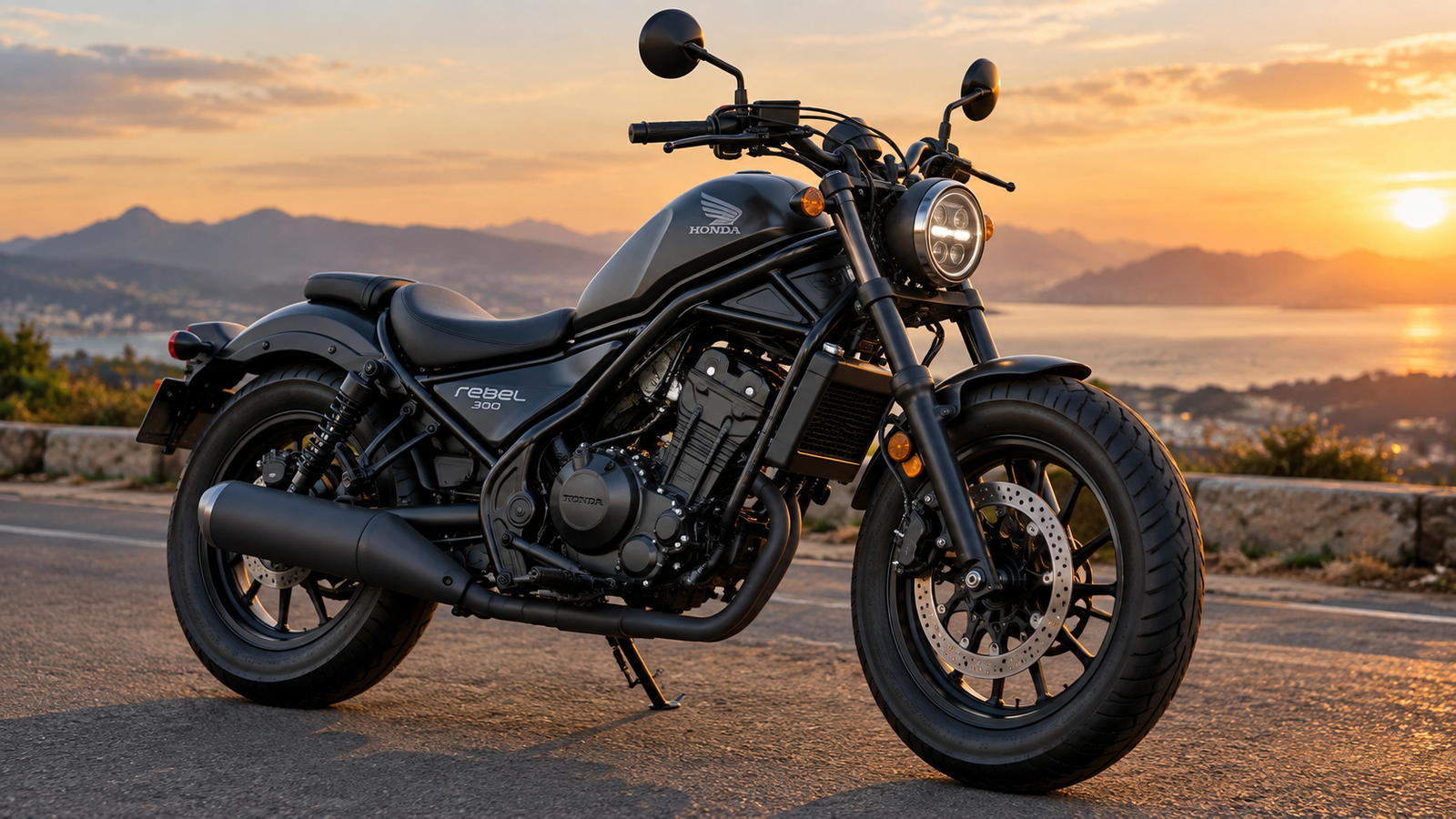
The Honda Rebel 300 is a small-displacement cruiser motorcycle built specifically for new and newer riders. It wears a stripped-down, bobber-inspired design — blacked-out engine, low slung profile, minimalist bodywork — that punches well above its entry-level price tag in terms of style.
Unlike regular commuters in Honda’s lineup, the Rebel 300 is more of a lifestyle cruiser aimed at those who want the look of a custom bike right out of the factory.
It sits at the base of Honda’s Rebel family — a lineup that now spans from the entry-level 300 all the way to the powerful Rebel 1100. After enticing you with the 300 E-Clutch, you’re able to stay in the family when you start with a Rebel 300 and work your way through the 500, up to the 1100, taking you from E-Clutch to DCT.
A Brief History of the Rebel Lineup
The current generation of Rebels debuted nine years ago with the 300 and 500. The bikes have evolved over the years, with the Rebel 1100 added in 2021, a model available with Honda’s fully automatic Dual Clutch Transmission (DCT). Although the redesign is no longer news, even since the first major revamp for the 2017 model year, Honda has made additional refinements to the next-gen Rebel 300. In 2020, it received a host of upgrades: better suspension, assist/slipper clutch, modern-looking LCD display, LED lighting, and a more comfortable saddle. This package stayed largely undisturbed through the 2025 model year, and then Honda did what everyone probably saw coming for 2026 and added the E-Clutch.
What’s New for 2026 — The E-Clutch Update
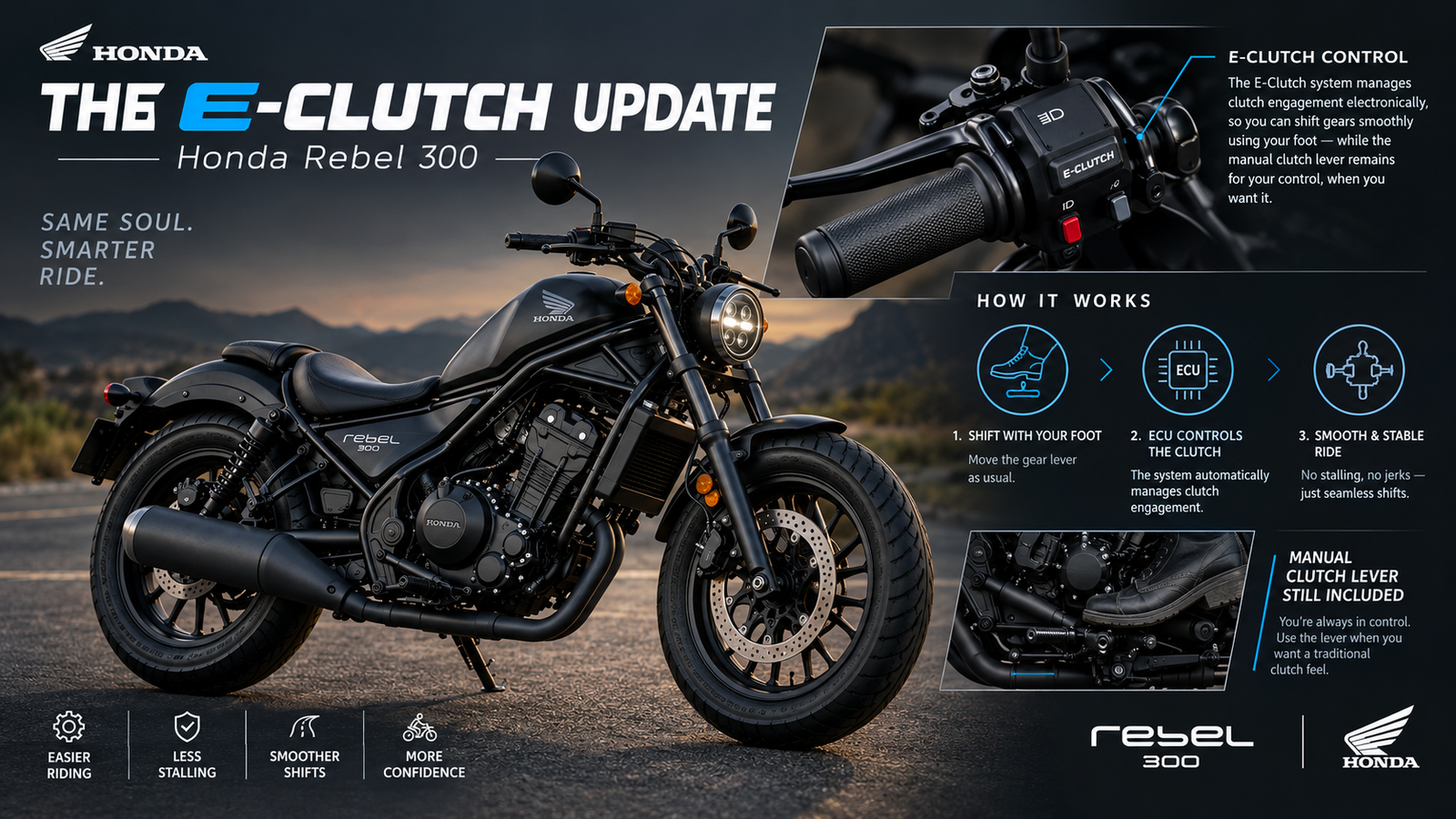
The biggest news for the 2026 Rebel 300 is the introduction of Honda’s E-Clutch as standard equipment on the new variant. For 2026, the beginner-friendly Rebel 300 becomes even more appealing to novices with the addition of the new E-Clutch model — a design that features a manual-shift transmission with an electronically controlled automatic clutch that can also be used manually, making it the perfect learning tool for a new rider.
This is not just a gimmick. For riders who fear stalling, grinding gears, or rolling back on hills, the E-Clutch removes those anxieties almost entirely.
2026 Honda Rebel 300 Full Specifications
Engine & Performance Specs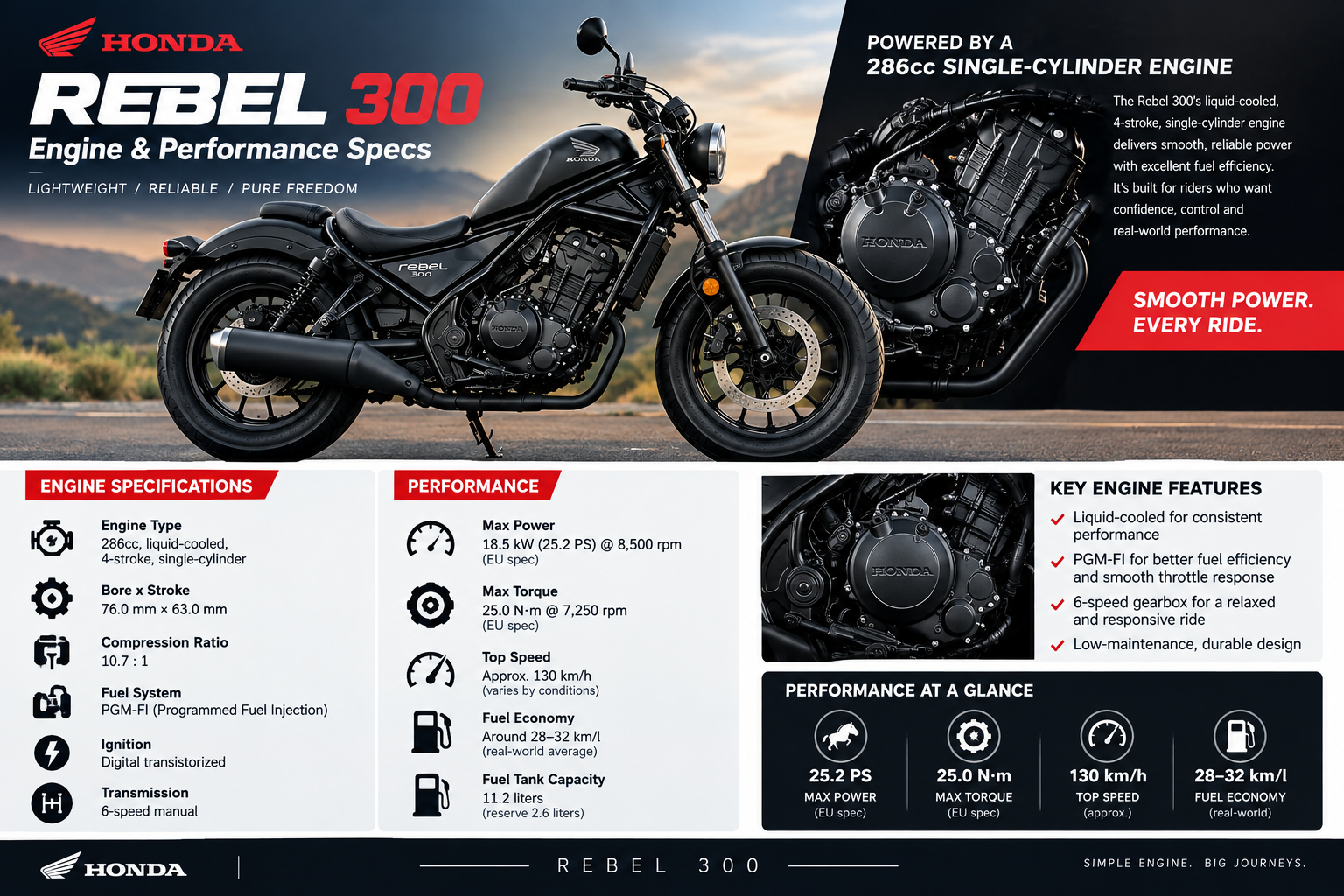
The Honda Rebel 300 2026 has a 286cc liquid-cooled single-cylinder four-stroke engine, with a 76mm x 63mm bore and stroke, 10.7:1 compression ratio, and 6-speed transmission.
| Spec | Detail |
|---|---|
| Engine Type | 286cc liquid-cooled, DOHC single-cylinder |
| Bore x Stroke | 76mm x 63mm |
| Compression Ratio | 10.7:1 |
| Horsepower | ~27 hp |
| Torque | ~19 lb-ft |
| Transmission | 6-speed manual |
| Fuel System | Fuel injection (PGM-FI) |
| Fuel Tank | 2.87 gallons |
The compact single-cylinder engine features fuel injection, dual cams, and counterbalancing — perfectly designed to fit your journey with its lightweight build and torque-rich power delivery.
Chassis, Suspension & Brakes
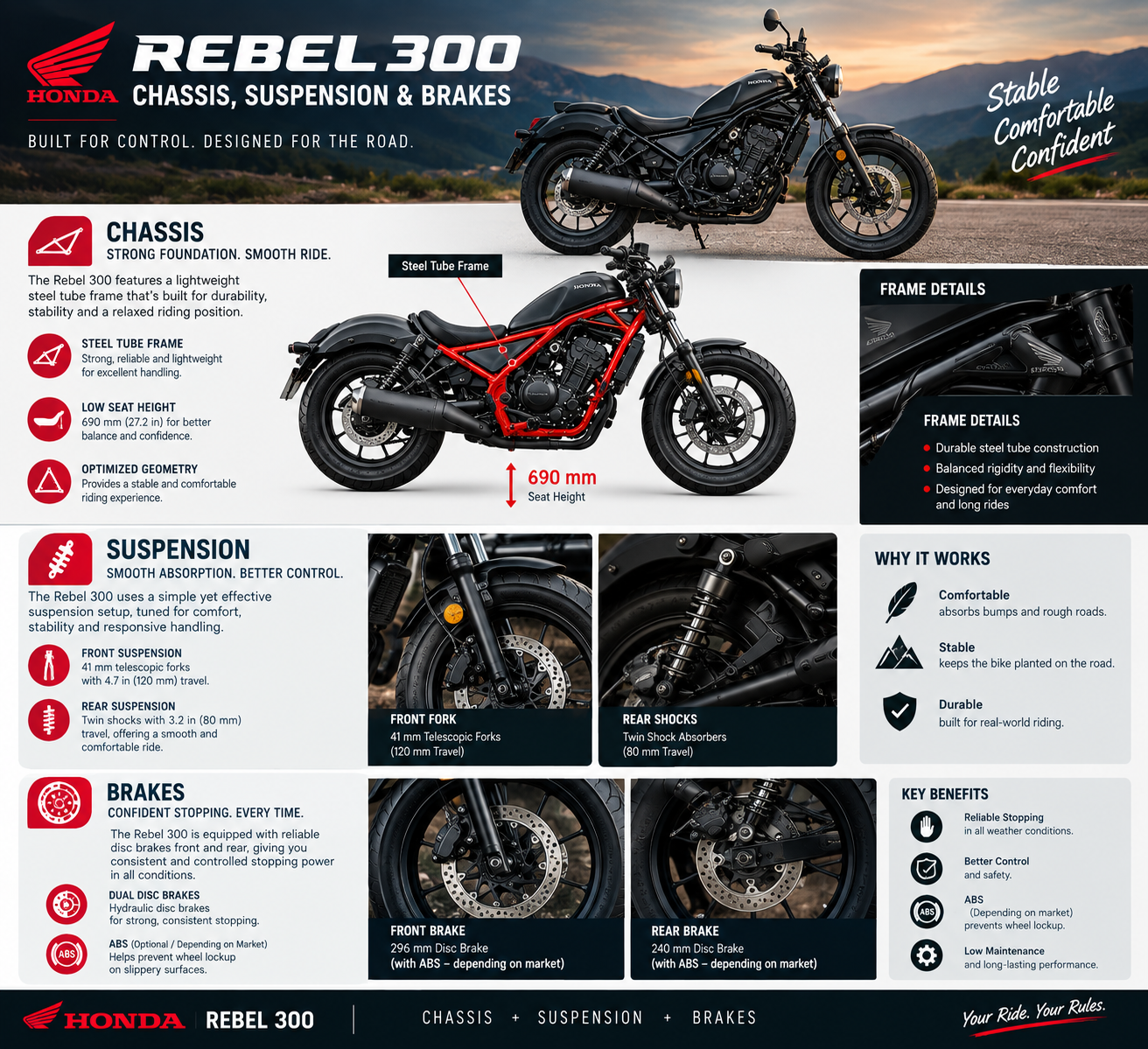
The Rebel 300 offers a 41mm fork with 4.8 inches of travel for front suspension, dual shocks with 5.5-inch travel for rear suspension, disc front brake, disc rear brake, and a 27.2-inch seat height. Single calipers front and rear pinch 296mm and 240mm discs respectively, and ABS is standard equipment, providing a nice safety net.
| Spec | Detail |
|---|---|
| Front Suspension | 41mm telescopic fork, 5.5″ travel |
| Rear Suspension | Dual shocks, 3.7″ travel |
| Front Brake | 296mm disc, single caliper |
| Rear Brake | 240mm disc, single caliper |
| ABS | Standard |
| Front Tire | 100/90-17 |
| Rear Tire | 130/90-16 |
Dimensions, Weight & Seat Height
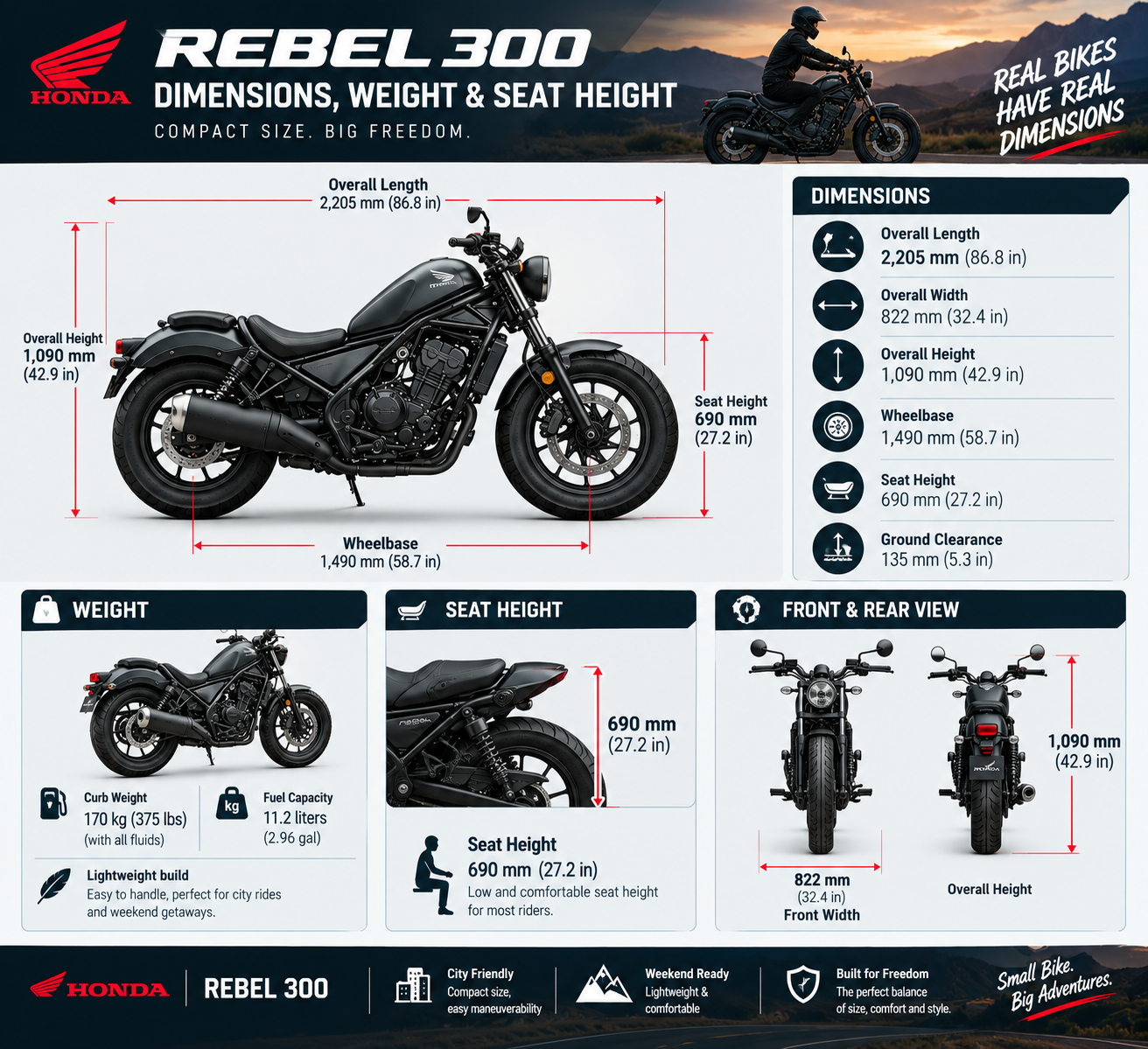
| Spec | Detail |
|---|---|
| Seat Height | 27.2 inches |
| Curb Weight | 379 lbs (wet) |
| Wheelbase | 57.3 inches |
| Overall Length | 83.3 inches |
| Fuel Economy | ~70–80 mpg (real-world) |
In the realm of cruiser seat heights, lower reigns supreme. This bike flaunts one of the lowest at 27.2 inches for maximum rider comfort and easy flat-footing at lights or in parking lots.
Colors & Variants Available (2026)
The Rebel 300 is only available in Matte Black Metallic or Pearl Smoky Gray for 2026.
| Variant | MSRP |
|---|---|
| Honda Rebel 300 (Standard) | $4,849 |
| Honda Rebel 300 E-Clutch | $5,349 |
How Does the Honda Rebel 300 Ride?
City & Urban Riding
In the city, the Rebel 300 is in its natural element. It’s light, narrow, and compact enough to thread through traffic with confidence. The low seat height means you’re flat-footed at every red light — no tippy-toeing, no anxiety.
From an engineering standpoint, the 300’s compact single keeps reciprocating mass low and combustion simple. One large cylinder, even pulses, and fuel injection deliver usable torque right off idle — which is exactly where newer riders spend most of their time. The ultra-low 27.2-inch seat and light curb weight make control feel intuitive rather than intimidating, from parking-lot U-turns to quick sweepers.
The throttle response is gentle and progressive. Throttle response is described as “super soft and predictable with zero snap.” This is the gentlest power delivery of any comparable bike. It’s intentional — new riders cannot accidentally throttle-out on a Rebel 300.
Highway Performance — Know the Limits
Let’s be real here: the Rebel 300 is not a highway bike. It can get there, but it’s not happy there for long.
Real-world highway riding at 70–75 mph puts the engine close to its comfort ceiling. It won’t refuse — it’ll cruise at interstate speeds — but you’ll feel it working. Passing maneuvers at 70+ mph require planning ahead rather than a confident twist of the wrist.
Most adults outgrow the 300’s highway performance quickly; if in doubt, buy the 500.
For riders whose routes stay below 65 mph — city streets, suburban roads, winding back roads — the Rebel 300 never runs out of fun. It’s when sustained 75 mph+ becomes a daily requirement that you should step up to the Rebel 500.
Handling & Maneuverability
The Rebel 300 handles beautifully at low and medium speeds. Its relatively low center of gravity, narrow profile, and light weight combine to make direction changes feel natural rather than forced. Tight parking lot turns and U-turns that intimidate new riders on heavier bikes are almost effortless here.
Suspension is non-adjustable and tuned for comfort over outright performance. Suspension includes a 41mm telescopic fork with 5.5 inches of travel and dual shocks offering 3.7 inches of travel. These components work well for typical urban riding, providing compliance and confidence while maintaining an attainable price point.
Comfort & Ergonomics
The Rebel 300’s riding position is relaxed and upright. Feet-forward pegs, a wide flat handlebar, and a well-padded seat make it comfortable for typical 45–90 minute rides. For very long days in the saddle (3+ hours), some riders add an aftermarket comfort seat — the stock unit becomes firm after extended time.
Wind protection is minimal — this is a naked cruiser, not a touring bike. At highway speeds, fatigue from wind blast accelerates. A small flyscreen or sport windshield is a worthwhile upgrade for regular highway stints.
Honda E-Clutch Explained — What It Means for New Riders
How the E-Clutch Works
Honda’s E-Clutch lets you shift with your left foot without needing the handlebar-mounted clutch lever — unless you want to.
The system works through sensors and an electronically controlled actuator. When you pull away from a stop, the E-Clutch manages clutch engagement automatically — no stalling, no jerky take-offs. When you shift up or down through gears, it momentarily disengages and re-engages the clutch for you, producing smooth gear changes without any manual clutch input.
It also acts as a quickshifter, enabling clutchless, full-throttle gear changes for riders who crave performance.
For a new rider, this means:
- No stalling at stop lights
- No jerky take-offs in front of traffic
- No hill-start anxiety — the system holds you smoothly
- Full manual override whenever you want it — the clutch lever still works as normal
Beyond new riders, it also appeals to experienced riders who understand the advantages of an automatic clutch on urban streets and while cruising through suburbia. You get all the engaged feels of manual shifting without the anxiety of stalling at stops or when creeping forward in traffic.
Standard vs. E-Clutch — Which Should You Choose?
| Factor | Standard Rebel 300 ($4,849) | E-Clutch Rebel 300 ($5,349) |
|---|---|---|
| Manual clutch required? | Yes | No (optional) |
| Best for | Riders who want to learn full manual | True beginners or city commuters |
| Price difference | — | +$500 |
| Quickshifter included? | No | Yes |
| Resale value | Slightly lower | Slightly higher (new tech) |
Our recommendation: If you are a true beginner with zero riding experience, the E-Clutch variant is worth every dollar of its $500 premium. If you’re committed to learning full manual clutch operation from day one — which is a valuable long-term skill — the standard model saves you $500 and teaches you a skill that transfers to any motorcycle.
Honda Rebel 300 Pros & Cons
What We Love
- Ultra-low 27.2″ seat height — accessible to riders of virtually any height
- Lightweight at 379 lbs — confidence-inspiring in parking lots and tight spaces
- Gentle, smooth power delivery — no surprises, no snap, perfectly matched to new riders
- Standard ABS — critical safety feature at no extra cost
- E-Clutch technology (2026) — removes the biggest learning barrier in motorcycling
- Iconic Rebel styling — looks like a custom bobber, costs like an entry-level bike
- Outstanding fuel economy — 70–80 mpg real-world
- Honda reliability — one of the most dependable brands in powersports
- MSF-approved — officially used in the Motorcycle Safety Foundation licensing course
- Strong accessory ecosystem — extensive aftermarket parts and customization options
What Could Be Better
- Highway limitations — not ideal for sustained riding above 70 mph
- Limited color options in 2026 — only Matte Black or Pearl Smoky Gray
- Non-adjustable suspension — no tuning for rider weight
- Small fuel tank (2.87 gallons) — frequent fill-ups on longer rides
- Single-cylinder vibration — noticeable above 65 mph; not painful but present
- No windscreen — fatigue on longer highway stints
- Riders may outgrow it quickly — some find themselves wanting more power within 1–2 years
Honda Rebel 300 vs. Honda Rebel 500 — Which Is Right for You?
The main differences between the Honda Rebel 300 and 500 lie in their performance figures, engine, and exhaust. The Honda Rebel 500 offers more grunt.
H3: Engine & Power Comparison
The Rebel 300 has a maximum output of approximately 26 horsepower and 18.6 lb-ft of torque, while the Rebel 500 has a maximum output of approximately 46 horsepower and 30.7 lb-ft of torque, making the Rebel 500 significantly more powerful than the Rebel 300.
| Spec | Rebel 300 | Rebel 500 |
|---|---|---|
| Engine | 286cc single-cylinder | 471cc parallel-twin |
| Horsepower | ~27 hp | ~46 hp |
| Torque | ~19 lb-ft | ~30.7 lb-ft |
| Weight | 379 lbs | 414 lbs |
| Seat Height | 27.2 inches | 27.2 inches |
| Gearbox | 6-speed | 6-speed |
Price Comparison
| Model | Standard MSRP | ABS/E-Clutch Variant |
|---|---|---|
| Rebel 300 | $4,849 | $5,349 (E-Clutch) |
| Rebel 500 | ~$6,799 | Included standard |
Who Should Choose the Rebel 300
- First-time riders with zero or minimal experience
- Shorter riders who prioritize flat-foot confidence
- Urban commuters who rarely need to exceed 65 mph
- Budget-conscious buyers who want a genuine Honda at the lowest entry point
- Riders who plan to take their MSF course on the bike
Who Should Choose the Rebel 500
- Riders with some experience who want more long-term headroom
- Commuters with regular interstate or highway segments
- Riders who plan to ride two-up occasionally
- Anyone who knows they’ll want more power within a year
- Taller riders who want a bit more presence between their knees
In the entry-level segment, 300cc and 500cc bikes are poles apart in terms of power and performance — it’s not a subtle difference on the road. If budget allows and you’re even slightly unsure about outgrowing the 300, move up to the 500.
2026 Honda Rebel 300 Price & Value
MSRP Breakdown
The Rebel 300 rides off the lot with an MSRP of $5,349 for the E-Clutch variant. With an MSRP of $5,349, the 2026 Honda Rebel 300 E-Clutch is a fantastic entry-level ride for newbies.
The standard (non-E-Clutch) Rebel 300 starts at $4,849 MSRP.
| Cost Item | Estimated Range |
|---|---|
| Base MSRP (Standard) | $4,849 |
| Base MSRP (E-Clutch) | $5,349 |
| Destination charge | ~$400–$500 |
| Dealer prep fee | ~$200–$400 |
| Sales tax (varies by state) | 6–10% |
| Registration & title | $50–$200 |
| Estimated out-the-door | $5,500–$6,500 |
Insurance Costs for New Riders
The Rebel 300’s small displacement and beginner-friendly profile make it one of the cheapest motorcycles to insure. Estimated annual premiums for a new rider:
| Coverage Type | Annual Estimate |
|---|---|
| Liability only | $200–$400/year |
| Full coverage (comprehensive + collision) | $600–$1,000/year |
Rates vary significantly by state, age, riding history, and coverage limits. Get at least three quotes before purchasing.
Financing Options
Honda Financial Services offers promotional financing on new Rebel models — terms vary by dealer and season. At $5,349, a 48-month loan at 7% APR works out to approximately $128/month. Many dealers also offer 0% promotional financing periods — always check Honda’s official offers page at time of purchase.
Best Honda Rebel 300 Accessories & Upgrades
The Rebel 300 has one of the best aftermarket ecosystems in the beginner motorcycle segment. Here are the most impactful upgrades:
Comfort Upgrades
| Upgrade | Purpose | Estimated Cost |
|---|---|---|
| Mustang or Saddlemen comfort seat | Longer ride comfort | $150–$300 |
| Passenger pillion seat kit | Two-up capability | $75–$150 |
| Bar-end mirrors | Style + visibility | $30–$80 |
| Flyscreen / mini windshield | Highway wind protection | $40–$120 |
| Handlebar risers | Taller rider ergonomics | $30–$60 |
Style & Customization
| Upgrade | Purpose | Estimated Cost |
|---|---|---|
| Slip-on exhaust (Vance & Hines, Two Brothers) | Sound + look | $200–$500 |
| Side bags / saddlebags | Storage capacity | $80–$200 |
| Crash bars / engine guards | Protection in tip-overs | $100–$200 |
| Custom grips | Feel + aesthetics | $20–$60 |
| LED accent lighting kit | Night-time presence | $30–$80 |
Protective Gear Recommendations for Rebel 300 Riders
Never buy the motorcycle without budgeting for proper gear. The minimum kit for a new Rebel 300 rider:
| Gear Item | Recommended Budget |
|---|---|
| Full-face helmet (ECE 22.06 or DOT/Snell) | $150–$400 |
| Motorcycle jacket with CE armor | $150–$350 |
| Riding gloves | $40–$100 |
| Riding boots (ankle protection) | $80–$200 |
| Riding pants with knee/hip armor | $100–$250 |
| Total gear budget | $520–$1,300 |
Is the Honda Rebel 300 Good for Beginners?
Yes — and it’s not even close.
The 2026 Rebel 300 E-Clutch is designed for literally one rider: the person who’s been afraid to learn clutch-and-shift.
But even the standard Rebel 300 has always been beginner-gold. The Rebel 300 is the Motorcycle Safety Foundation’s motorcycle of choice for new riders seeking to earn their motorcycle license. For many newcomers to motorcycling, the Rebel is often their first encounter with riding.
The combination of factors that make it work for beginners:
- 27.2″ seat height — flat-foot access for most riders
- 379 lb wet weight — light enough to rescue from a tip-over
- Smooth, soft throttle — zero snap means no accidental wheelies
- ABS standard — maximum braking safety without skill required
- E-Clutch (2026) — eliminates the #1 cause of new rider frustration
- Honda reliability — nothing breaks when you’re still learning
What New Riders Should Know Before Buying
Do take the MSF course first. Many states require it for licensing, and it’s the fastest way to develop real-world riding skills in a safe environment. The Rebel 300 is literally the bike they use.
Do budget for full gear. The bike is only as safe as the rider wearing proper protective equipment. Gear up before you ride.
Don’t skip insurance. Even a slow-speed tip-over can damage a motorcycle. Full coverage on a Rebel 300 is affordable relative to repair costs.
Don’t assume you’ll outgrow it. Some people are perfectly content with the 300 as their trusted tried-and-tested ride. Don’t let anyone pressure you into a bigger bike until you decide you want more.
Honda Rebel 300 Maintenance & Reliability
Service Intervals
Honda engines are legendary for their reliability when maintained properly. The Rebel 300 service schedule:
| Service Item | Interval |
|---|---|
| Engine oil change | Every 4,000 miles (or annually) |
| Air filter inspection | Every 8,000 miles |
| Spark plug replacement | Every 16,000 miles |
| Valve clearance check | Every 16,000 miles |
| Coolant change | Every 3 years |
| Brake fluid change | Every 2 years |
| Chain inspection/lube | Every 500–600 miles |
| Chain replacement | Every 15,000–20,000 miles |
Pro tip: Always use Honda Pro HP4 or an equivalent motorcycle-specific 10W-30 engine oil. Never use automotive oil — it lacks the friction modifiers required for a wet clutch system.
Common Issues & Long-Term Ownership
The Rebel 300 has a strong reliability record. Common owner-reported issues are minor:
- Chain wear — Accelerated by lack of lubrication; lube every 500 miles minimum
- Battery drain — Common if the bike sits for weeks unused; use a battery tender in storage
- Tire wear (rear) — The stock rear tire is adequate but not premium; an upgrade to Michelin Pilot Street or Dunlop Sportmax is a popular improvement
- Valve clearance — Check at 16,000 miles as per Honda’s schedule; often still in spec but worth verifying
- Corrosion on chrome — Minor surface corrosion can appear on exhaust heat shields in wet climates; treat with chrome polish and protectant
Long-term owners regularly report 30,000–50,000+ miles with nothing more than routine maintenance. This is a Honda. It will not let you down.
Frequently Asked Questions
Q: Is the Honda Rebel 300 good for beginners? A: Absolutely. It’s one of the most beginner-friendly motorcycles ever made. Its 27.2-inch seat height, 379 lb weight, gentle throttle, standard ABS, and 2026 E-Clutch option make it exceptionally approachable for new riders. It’s also the official motorcycle of the MSF licensing course.
Q: What is the price of the 2026 Honda Rebel 300? A: The standard Rebel 300 starts at $4,849 MSRP. The E-Clutch variant is $5,349 MSRP. Add destination, tax, and dealer fees for your total out-the-door cost.
Q: What is Honda E-Clutch and how does it work? A: The E-Clutch is an electronically controlled automatic clutch. It manages clutch engagement for you during take-off and gear changes — eliminating stalling and jerky take-offs. The manual clutch lever remains on the handlebar and still works if you want to use it. It also functions as a quickshifter for smooth upshifts.
Q: What is the Honda Rebel 300 top speed? A: Real-world top speed is approximately 85–95 mph. It’s most comfortable at 55–65 mph for everyday riding.
Q: Is the Honda Rebel 300 highway capable? A: Yes, but with limitations. It can maintain highway speeds, but it’s not optimized for sustained 70+ mph interstate riding. For primarily highway commuters, the Rebel 500 is a better fit.
Q: What’s the difference between the Honda Rebel 300 and Rebel 500? A: The 300 has a 286cc single-cylinder making ~27 hp; the 500 has a 471cc parallel-twin making ~46 hp. The 300 is lighter, cheaper, and easier for true beginners. The 500 offers significantly more highway confidence and long-term ridability.
Q: How fuel efficient is the Honda Rebel 300? A: Exceptionally efficient — approximately 70–80 mpg in real-world mixed riding. Its 2.87-gallon tank delivers roughly 200–230 miles per fill-up.
Q: What colors does the 2026 Honda Rebel 300 come in? A: Matte Black Metallic and Pearl Smoky Gray are the two options for 2026.
Q: Does the Honda Rebel 300 have ABS? A: Yes — ABS is standard on the 2026 Rebel 300 and Rebel 300 E-Clutch models.
Q: Should I buy the Rebel 300 or wait for a bigger bike? A: Buy the 300 if you’re a true beginner or primarily ride urban/suburban roads. Upgrade to the 500 if you know you’ll regularly need highway performance. Don’t skip beginner bikes to impress anyone — the Rebel 300 is a genuinely excellent motorcycle, not a stepping stone you should rush past.
Final Verdict — Should You Buy the 2026 Honda Rebel 300?
Here is the honest bottom line.
Whether you’re riding fast or slow, solo or with friends, in the city or on a winding country road, motorcycles should be about having fun. And now more than ever, there’s never been a better way to get started than on a Honda Rebel 300.
The 2026 Rebel 300 is the best version of this motorcycle Honda has ever made. 1Its small-displacement engine, E-Clutch, and affordable price point are all aimed squarely at beginner riders — and it delivers on every single one of those promises.
Buy the 2026 Honda Rebel 300 if you are:
- ✅ A first-time or returning rider
- ✅ Shorter in stature or prioritizing low seat height
- ✅ Primarily riding in city, suburban, or back-road environments
- ✅ Budget-conscious and want genuine Honda quality
- ✅ Wanting a stylish, approachable bike without sacrificing reliability
Look at the Rebel 500 instead if you are:
- ⚠️ Regularly commuting on interstates above 65 mph
- ⚠️ Carrying a passenger regularly
- ⚠️ Already have some riding experience and want long-term headroom
- ⚠️ Willing to spend an extra ~$2,000 for significantly more power
The Rebel 300 has one job: get you on two wheels safely, confidently, and with a smile on your face. In 2026, with the E-Clutch making it more accessible than ever, it does that job better than any other motorcycle at this price point.
Ready to Ride Your First Honda Rebel 300?
The Rebel 300 is your on-ramp to motorcycling. Approachable, reliable, stylish — and in 2026, easier to ride than ever.
[Check Current Honda Rebel 300 Dealer Inventory →] [Compare Rebel 300 vs. Rebel 500 Side-by-Side →] [Shop Honda Rebel 300 Accessories & Upgrades →] [Apply for Honda Financing →]