
Introduction
Getting a flat tire mid-ride used to mean one of two things: fumbling with a tiny manual pump for five sweaty minutes — or blasting a CO2 cartridge, hoping the seal held, and tossing a single-use canister into your pocket.
Both options are fine. Neither one is particularly enjoyable.
A good electric bike pump can fully replace a floor pump, hand pump, and CO₂ inflator — while being quicker, easier to use, and more precise than any of them.
That is a significant claim. But after testing and researching the latest crop of portable electric inflators, it is an accurate one — with some important caveats that most buying guides skim right past.
This guide covers everything: how electric bike pumps actually work, what separates a great one from a frustrating one, which models are genuinely worth your money in 2026, and a step-by-step breakdown of how to use one correctly. By the end, you will know exactly which pump belongs in your saddle bag.
Let’s get into it.
What Is an Electric Bike Pump?
An electric bike pump — also called a portable electric inflator or mini electric compressor — is a battery-powered device that inflates bicycle tires automatically. You set a target PSI on a digital display, attach it to your valve, press a button, and it stops inflating when the exact pressure is reached.
Electric pumps provide fast, consistent inflation at the touch of a button. They are portable, easy to use, and can be stored conveniently in a jersey pocket or saddlebag.
How Does an Electric Bike Pump Work?
The pump contains a small rechargeable battery (typically lithium-ion), a miniature air compressor motor, a digital pressure sensor, and either a direct-mount valve attachment or a short hose. When activated, the motor compresses air and forces it into the tire. The internal pressure sensor reads the PSI in real time and cuts the motor automatically when your target pressure is reached.
This auto shut-off feature is one of the biggest practical advantages over manual pumps — no guesswork, no overinflation.
Electric Pump vs. Manual Pump vs. CO2 Inflator
| Feature | Electric Pump | Manual Mini Pump | CO2 Inflator |
|---|---|---|---|
| Effort Required | None | High | None |
| Speed | Fast (1–2 min) | Slow (5–10 min) | Instant |
| Accuracy | Very High | Low | Low |
| Reusable | ✅ Yes | ✅ Yes | ❌ Single use |
| Weight | 97–430g | 60–180g | ~50g (+ cartridge) |
| Environmental Impact | Low | Low | High (cartridges) |
| Cost | $40–$130 | $10–$40 | $5–$15 (per use) |
| Battery Dependent | ✅ | ❌ | ❌ |
Traditional manual pumps can be time-consuming and physically demanding, while CO2 inflators are often unreliable and environmentally harmful. The electric pump sits in a sweet spot that neither of the traditional options can match.
Why Cyclists Are Switching to Electric Pumps in 2026
Early electric bike pumps were powerful but chunky. Since then, the best electric pumps have got smaller, smarter and, importantly, cheaper. Over the last year or so, what were once clunky, awkward devices have been transformed into sleek, compact designs that easily slip into a jersey pocket. Given how divisive the topic of electronics is among cyclists, their widespread adoption has been met with resounding acceptance.
Here’s why the category has genuinely crossed over from novelty to essential:
1. They eliminate physical effort entirely.
A good electric bike pump reduces effort. You’re not hand-pumping a tire while wearing work clothes.
2. They are accurate to within 1–2 PSI.
Electric bike pumps and electric mini pumps have come on in leaps and bounds over recent years. These fast, convenient and accurate tyre pumps make road- and trail-side repairs easier.
3. One pump handles multiple bikes.
One small pump can handle an e-bike, a hybrid, a kid’s bike, and often a scooter.
4. Real-world performance is now genuinely impressive.
Independent review testing found the best modern mini electric pumps could fully inflate a flat 700C x 28 mm road tyre to 70 psi or a 40 mm gravel tyre to 45 psi in about 1 minute, and most delivered 3 to 4 full inflations on one charge before the battery ran out.
What to Look for Before You Buy
This is where most buying guides let you down. They list specs without explaining what actually matters on the road or trail. Here is what you genuinely need to evaluate.
PSI Range & Pressure Accuracy
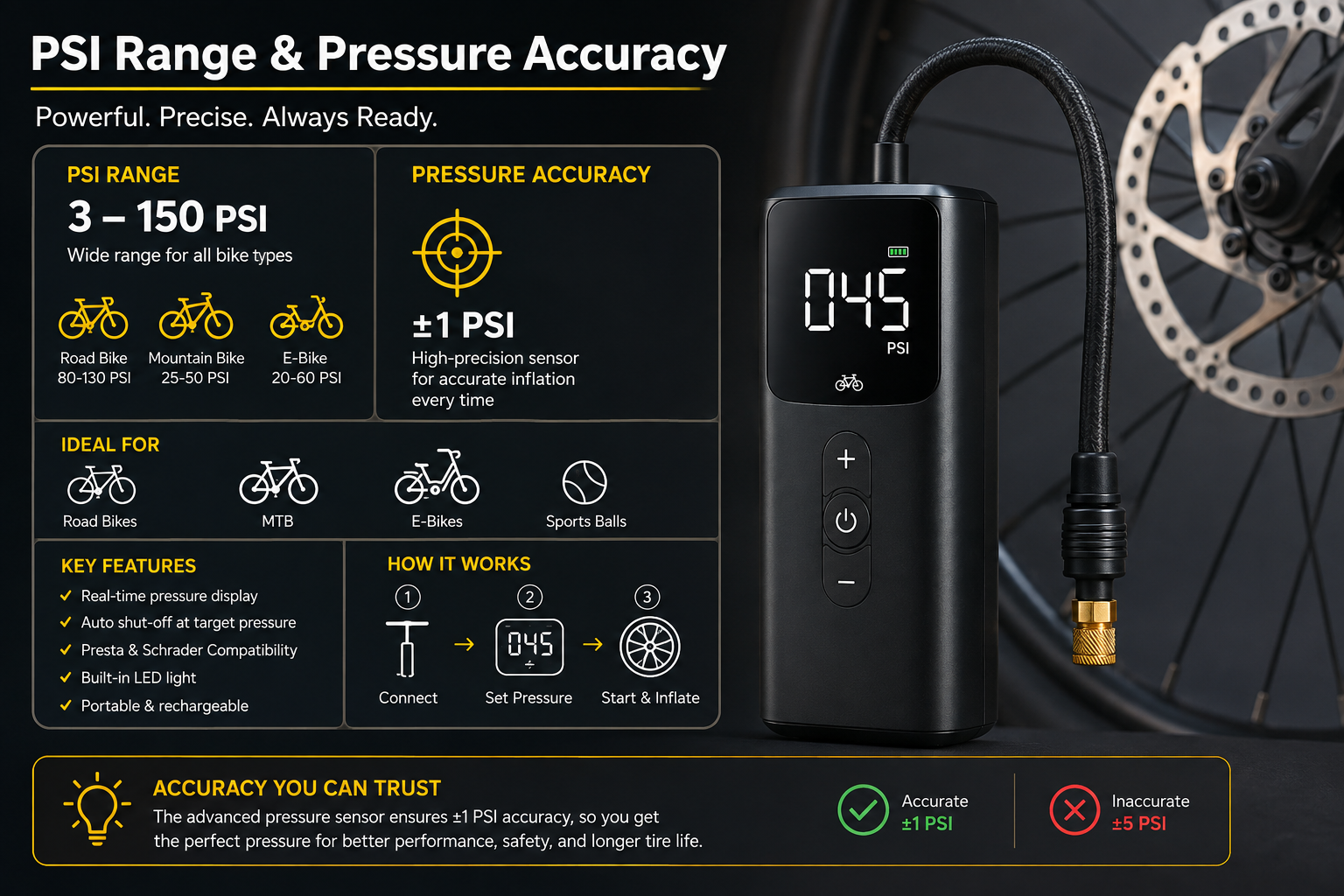
PSI (Pounds per Square Inch) measures pressure in your tire. You need high-pressure capability for bikes with narrow tires, like road bikes. If a pump can’t reach the PSI you need, it won’t help you.
Most portable electric pumps top out at 100–150 PSI. They all claim to reach a maximum of 100 psi, making them ideal for road use, especially for those on short rides or running a tubeless setup. For road bikes running 90–110 PSI, you need a pump that can reliably reach and hold that number — not just claim it on the box.
Quick PSI Reference:
- Road bike: 80–110 PSI
- Gravel bike: 35–60 PSI
- Mountain bike: 20–40 PSI
- E-bike: 40–65 PSI
Battery Life & Charge Cycles
The lightest “nano” pumps weighed about 97 to 130 g and typically used 300 mAh batteries, while larger mini or off-bike units reached 120 to 150 psi but weighed about 120 to 430 g.
A 300 mAh battery is often enough for 2–3 full inflations. A 600–800 mAh battery gives you 5–6. If you are a commuter who tops up tires daily, prioritize battery capacity over compactness.
Size, Weight & Portability
If your rides are short, predictable, and close to home, a tiny emergency-first pump makes sense. It disappears into your bag and gives you a fast rescue option for a straightforward puncture. If you ride a heavier e-bike, use larger tyres, commute longer distances, or want one pump for multiple bikes in the household, a slightly larger unit is usually the smarter buy.
Valve Compatibility (Presta vs Schrader)
Before buying any electric bike pump, check your valve type.
- Presta valves are narrow, have a locking nut, and are found on most road, gravel, and performance bikes
- Schrader valves are wider, look like car tire valves, and are found on mountain bikes, kids’ bikes, and e-bikes
Some pumps are Presta-only. Some are Schrader-only. The best ones handle both, either through a reversible chuck or interchangeable adapters. Always verify before purchasing.
Auto Shut-Off Feature
Auto shutoff matters when you’re inflating at the roadside and don’t want to hover over the display. This is not a luxury feature — it is the feature that makes electric pumps more accurate than any manual pump you have ever used.
Display Quality
A clear screen matters. Small screens become annoying fast in dim light or rain. Look for a backlit display with high contrast — not just a tiny LED number strip.
Charging Type
USB charging you already use matters. Fewer special cables means fewer excuses not to recharge it. USB-C is now the standard. Avoid pumps with proprietary charging cables.
Noise Level
Electric pumps are small compressors — they make noise. The Viair Recon Mini features a digital display and the ability to preset a desired PSI, allowing the pump to stop once it reaches that pressure automatically. The Recon Mini was on the louder side, at 55.6 decibels. Most pumps sit between 50–70 dB during operation. If you live in a flat and pump tires at 6am, this is worth checking.
Types of Electric Bike Pumps Explained
Nano / Pocket Pumps
Weight: 97–130g | Battery: ~300 mAh | Max PSI: ~100 PSI
These are the smallest electric pumps available — roughly the size of a lipstick case or a small power bank. They are designed to live in your jersey pocket or top-tube bag and serve as emergency inflators.
Nano pumps are best if carry weight and pocketability matter most. Good for solo commuting and occasional emergencies.
Best for: Road cyclists, minimalist packers, short-to-medium rides
Mid-Size Portable Pumps
Weight: 120–280g | Battery: 500–800 mAh | Max PSI: 120–150 PSI
The most versatile category. These fit in a handlebar bag or saddle bag, handle high-volume MTB and e-bike tires well, and offer longer battery life for multiple inflations.
Mid-size portable pumps are better if you want a stronger all-rounder for e-bike tyres, regular top-ups, and less anxiety about battery reserve.
Best for: Mountain bikers, e-bike riders, touring cyclists, commuters
Desktop / Home Electric Pumps
Weight: 300–600g | Battery: 1000+ mAh or plug-in | Max PSI: 150+ PSI
These are not designed to carry on a ride — they live in your garage or workshop and handle pre-ride inflation for the whole household. Think of them as electric floor pumps. Brands like Bosch make excellent options in this category.
Best for: Home use, families with multiple bikes, workshop setups
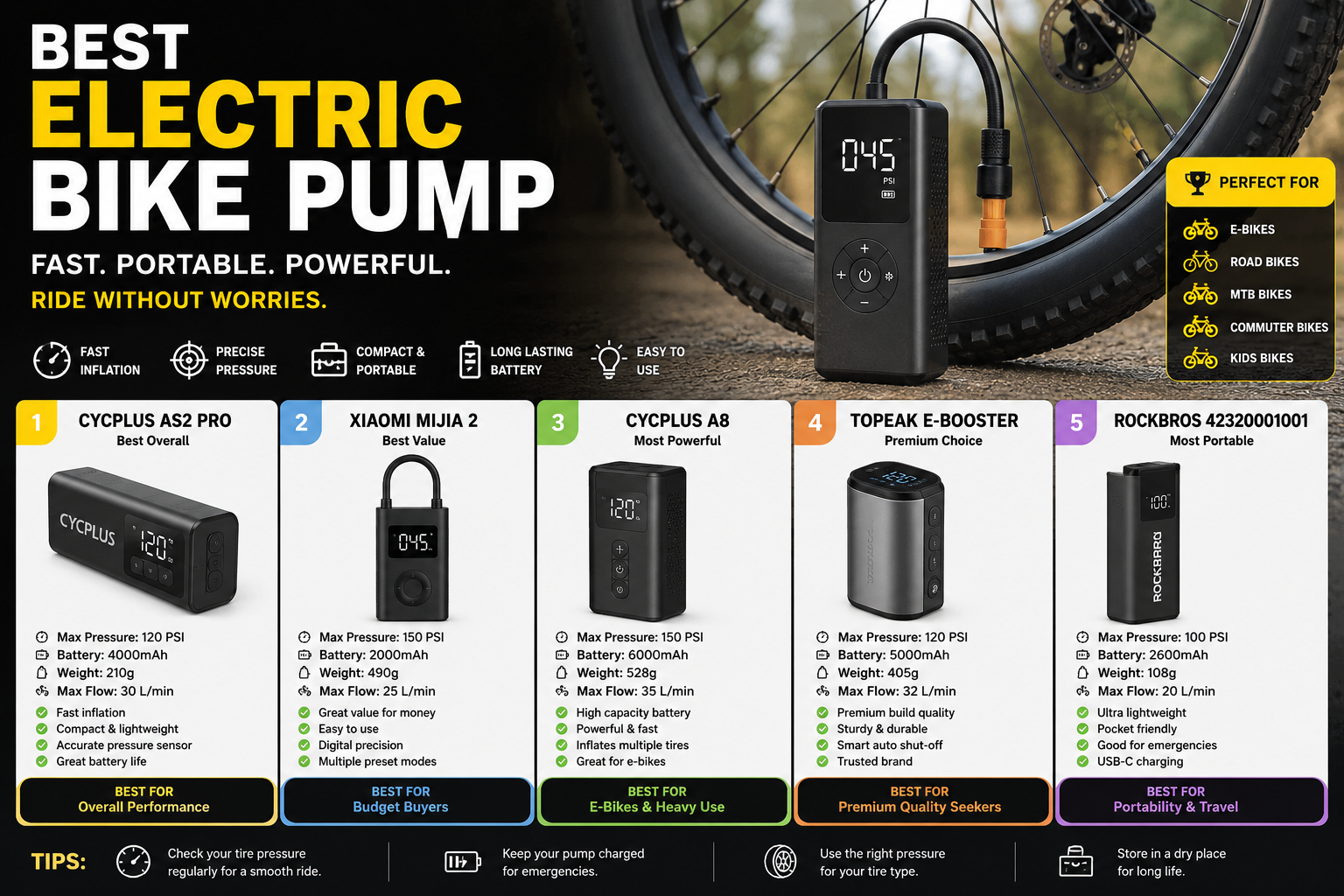
Best Electric Bike Pumps of 2026 — Our Top Picks
Cycplus AS2 Pro
Rated best overall by Cycling Weekly’s 2026 group test, the Cycplus AS2 Pro is programmable to an exact pressure.
Why it wins: The AS2 Pro sits in the sweet spot between nano portability and serious capability. It is accurate, genuinely compact, and — crucially — programmable to an exact PSI target. Set it, attach it, press start. Done.
| Spec | Detail |
|---|---|
| Weight | ~155g |
| Max PSI | 100 PSI |
| Valve | Presta + Schrader |
| Charging | USB-C |
| Auto Shut-Off | ✅ |
| Display | Digital LCD |
| Price (Approx.) | $60–$80 |
Best for: Road cyclists, gravel riders, and anyone who wants the most capable compact option
Best Budget — Cycplus AS2 (Standard)
The standard AS2 delivers nearly identical core performance to the Pro version at a lower price point. You lose some premium finish and the larger battery, but the inflation accuracy and convenience are still excellent for everyday use.
| Spec | Detail |
|---|---|
| Weight | ~130g |
| Max PSI | 100 PSI |
| Valve | Presta + Schrader |
| Charging | USB-C |
| Price (Approx.) | $40–$55 |
Best for: Newer cyclists, budget-conscious commuters, casual weekend riders
Best Nano Pump — Fumpa Nano
The Fumpa Nano is perhaps the most visually distinct and most feature-rich pump in its category. With its curved chassis and anodised aluminium finish, it has more in common with a high-end gadget than a bike pump. Beyond this sleek appearance lies some serious performance. In use, the Nano feels great in the hand. The curved edge sits naturally against the palm, and the raised button is easy to find, even in low light. Rather than tapping a sequence, you simply press and hold to start, then press again to stop. It’s intuitive and worked without a hitch in testing.
| Spec | Detail |
|---|---|
| Weight | ~97g |
| Max PSI | 100 PSI |
| Material | Anodised aluminium |
| Charging | USB-C |
| Auto Shut-Off | ✅ |
| Price (Approx.) | $70–$90 |
Best for: Road cyclists who want zero compromise on portability, tech-oriented riders
Best for Multiple Inflations — Topeak E-Booster Digital
Topeak’s E-Booster was the largest and heaviest mini compressor in most group tests. Despite its stout size, it can still easily fit into a hip pack, although in-frame storage may be out of the question.
What the E-Booster sacrifices in compactness, it makes up for in sheer endurance. This is the pump for riders who need to inflate multiple tires or who ride higher-volume tires that drain smaller batteries quickly.
| Spec | Detail |
|---|---|
| Weight | ~280g |
| Max PSI | 120 PSI |
| Battery | High-capacity |
| Valve | Presta + Schrader |
| Charging | USB-C |
| Price (Approx.) | $90–$120 |
Best for: MTB riders, e-bike owners, group rides, families with multiple bikes
Best Ergonomics — Muc-Off Airmach
The Muc-Off Airmach features a textured silicone cover that is great for cold hands or muddy gloves.
If you ride in wet conditions, this detail matters enormously. Most electric pumps have smooth plastic bodies that become slippery the moment your hands are cold or wet. The Airmach solves this with a practical, tactile silicone grip.
| Spec | Detail |
|---|---|
| Weight | ~180g |
| Max PSI | 100 PSI |
| Valve | Presta + Schrader |
| Charging | USB-C |
| Grip | Textured silicone |
| Price (Approx.) | $75–$95 |
Best for: Year-round commuters, winter riders, wet-weather cyclists
Best Premium — Prestacycle Prestaflator Go
The Prestacycle Prestaflator Go is BikeRadar’s top choice. It is a powerful, accurate inflator with a large battery, clear display and quiet operation. It’s slightly bulky and Presta-only, but fast, reliable, and compatible with spares and upgrades. Its feature set is a step above the average electric bike pump. The full-colour screen shows the current psi, BAR or kPa pressure, alongside a target pressure and current battery level that displays both four bars and colour indication.
| Spec | Detail |
|---|---|
| Weight | ~230g |
| Max PSI | 130 PSI |
| Display | Full-colour screen |
| Valve | Presta only |
| Charging | USB-C |
| Price (Approx.) | $100–$130 |
Best for: Serious road and gravel cyclists, riders who want the most premium experience
Electric Bike Pump Comparison Table (2026)
| Model | Best For | Weight | Max PSI | Valve | Auto Shut-Off | Price |
|---|---|---|---|---|---|---|
| Cycplus AS2 Pro | Best Overall | ~155g | 100 PSI | Both | $60–$80 | |
| Cycplus AS2 | Best Budget | ~130g | 100 PSI | Both | $40–$55 | |
| Fumpa Nano | Nano/Pocket | ~97g | 100 PSI | Both | $70–$90 | |
| Topeak E-Booster | Multiple Inflations | ~280g | 120 PSI | Both | $90–$120 | |
| Muc-Off Airmach | Best Ergonomics | ~180g | 100 PSI | Both | $75–$95 | |
| Prestacycle Prestaflator Go | Best Premium | ~230g | 130 PSI | Presta | $100–$130 |
PSI Guide: What Pressure Does Your Bike Actually Need?
PSI and volume are the two most important performance numbers for any air pump for bike and cycle, but people often don’t understand them. Here is a clear breakdown.
Road Bike Tires
- Clincher tires (23–25mm): 90–110 PSI
- Clincher tires (28–32mm): 70–90 PSI
- Tubeless road (28–32mm): 55–75 PSI
Mountain Bike Tires
- Trail / Enduro (2.3–2.5″): 22–30 PSI
- XC hardtail (2.0–2.2″): 28–35 PSI
- Plus tires (2.8–3.0″): 12–20 PSI
- Fat bike (4.0–5.0″): 5–12 PSI
Gravel & Hybrid Tires
- Gravel (38–45mm): 35–55 PSI
- Hybrid / Commuter (35–45mm): 50–70 PSI
E-Bike Tires
- Most e-bike tires (2.0–2.4″): 40–65 PSI
- Always check the sidewall of your specific tire — e-bike tires carry more load and often specify higher minimums.
Kids’ Bike Tires
- 16–20″ wheels: 30–50 PSI
- Balance bikes: 15–25 PSI
A high-PSI road pump takes forever to fill a mountain bike tire, while a high-volume MTB pump might not inflate a road tire to the right pressure. Match your pump’s range to your specific riding discipline.
How to Use an Electric Bike Pump — Step-by-Step
Step 1 — Charge Your Pump Before You Ride
A dead pump is just extra weight. Charge it after every use or at least before every long ride.
Step 2 — Identify Your Valve Type
Look at your tire’s valve stem:
- Presta: Narrow, long, with a metal locking nut at the tip
- Schrader: Wider, like a car tire valve, with a small pin inside
Before attaching any electric bike pump, check your valve type and confirm your pump or adapter is compatible.
Step 3 — Check Your Current Tire Pressure
Most electric pumps show current pressure when attached before inflation begins. Note the reading. If you are more than 5–10 PSI below target, you need to inflate. If only 2–3 PSI off, a quick top-up is all it takes.
Step 4 — Set Your Target PSI
Use the pump’s buttons or dial to set your target pressure. Reference the PSI guide above or the number printed on your tire sidewall.
Step 5 — Attach the Valve Connector
For Presta valves: unscrew the tiny locking nut first (turn counterclockwise), then attach the pump head firmly. For Schrader: simply push the connector onto the valve and lock it.
Step 6 — Start the Pump
Press the power or inflate button. Once charged, you set the pressure, attach it to your valve, and it inflates your tire to the desired pressure. The pump will stop automatically when your target PSI is reached.
Step 7 — Detach Carefully
Remove the pump connector quickly and smoothly. Some air loss on detachment is normal — usually 1–3 PSI. If accuracy is critical, set your target 2 PSI higher to account for this.
Step 8 — Store Dry & Recharged
Store it dry. Moisture and grit are bad for electronics and valve fittings.
Electric Bike Pump for Tubeless Tires — What You Need to Know
Tubeless tires are increasingly common on road, gravel, and mountain bikes — and they present a specific challenge: seating the tire bead.
Seating a tubeless bead requires a sudden burst of high-volume air, which most portable electric pumps cannot deliver on their own. For ongoing top-ups and maintaining pressure in an already-seated tubeless tire, portable electric pumps work perfectly. For initial tire installation and bead seating, a dedicated tubeless inflator or compressor is recommended.
Once your tubeless tires are set up:
- Top up pressure before every ride using your electric pump
- Set target PSI slightly higher to account for the micro air loss during valve removal
- If the tire has gone completely flat, use a CO2 cartridge or floor pump to reseat the bead first, then use the electric pump for fine-tuning
Electric Pump Maintenance & Care Tips
Your electric bike pump is a precision electronic device. Treat it accordingly.
Keep it charged. Leaving lithium-ion batteries fully discharged for extended periods shortens their lifespan.
Clean the valve connector after every use. Dirt and grit inside the connector cause poor seals and pressure leaks.
Store in a dry location. Never leave it in a wet saddle bag overnight.
Protect the display. Small screens crack under pressure. Many pumps come with a protective sleeve — use it.
Check for firmware updates. Some premium models (Cycplus, Fumpa) offer app connectivity and firmware updates that improve accuracy.
Don’t run it continuously for more than 3–4 minutes. If the pump gets warm during use, that’s not automatically a problem. Small motors and batteries build heat when compressing air. What matters is using the device within its intended range and letting it rest if needed.
Common Mistakes When Using an Electric Bike Pump
Mistake 1: Not checking valve compatibility before buying.
Direct-mount designs can be awkward on cramped wheel setups. A bad connection wastes air and tests your patience. Always verify Presta vs Schrader before purchasing.
Mistake 2: Setting the PSI target without checking the tire sidewall. Every tire has a recommended pressure range printed on its sidewall. Using a generic number is a common cause of both underinflation (slow, sluggish ride) and overinflation (increased puncture risk).
Mistake 3: Not accounting for air loss on valve removal. Most electric pumps lose 1–3 PSI when you remove the connector. If precision matters, set your target 2 PSI above your actual desired pressure.
Mistake 4: Buying the smallest pump regardless of tire volume.
Buyers often face tradeoffs between power, size, and features — more compact pumps may lack high PSI capacity, while electric models tend to be heavier and more expensive. Match the pump size to your actual tire volume.
Mistake 5: Ignoring the display in sunlight.
Small screens become annoying fast in dim light or rain. The same applies in direct sunlight. Test or check reviews for outdoor display visibility before buying.
Mistake 6: Never charging until it’s dead. Recharge your pump after every ride or use. A pump with 30% battery will behave differently than a fully charged one — especially on high-volume tires.
FAQ — Electric Bike Pump
Q1. How long does an electric bike pump take to inflate a tire?
A compact pump can take around 37 to 60 seconds to refill a road tire to 50 psi, which is a realistic benchmark for roadside use. Mountain bike tires with larger volume can take 90–120 seconds.
Q2. How many times can I inflate a tire on one charge?
Most modern mini electric pumps delivered 3 to 4 full inflations on one charge before the battery ran out. Higher-capacity models like the Topeak E-Booster or Prestacycle Prestaflator Go can manage 5–6.
Q3. How much does a good electric bike pump cost?
The typical electric bike tire pump cost $50 to $75 for a quality mid-range model. Budget options start around $35–$40. Premium models (Prestacycle, Fumpa Nano) reach $90–$130.
Q4. Are electric bike pumps accurate? Yes — significantly more accurate than manual pumps. Most digital electric pumps are accurate to within 1–2 PSI. Once charged, you set the pressure, attach it to your valve, and it inflates your tire to the desired pressure.
Q5. Can I use an electric bike pump on car tires?
If you’re looking for one electric pump that can handle more than just bikes — like car tires, soccer balls, or air mattresses — choose a model with multiple nozzles, built-in valve adapters, and at least 150 PSI capacity. Most bike-specific electric pumps top out at 100–130 PSI, which is insufficient for car tires (typically 32–40 PSI but requiring a high-volume unit).
Final Verdict: Which Electric Bike Pump Should You Buy?
Here is the short version:
| If you are… | Buy this |
|---|---|
| A road cyclist who wants the best value | Cycplus AS2 Pro |
| On a tight budget | Cycplus AS2 (Standard) |
| A minimalist who hates carrying weight | Fumpa Nano |
| An MTB or e-bike rider with big tires | Topeak E-Booster Digital |
| A year-round commuter in wet conditions | Muc-Off Airmach |
| A serious cyclist who wants the very best | Prestacycle Prestaflator Go |
The best electric bike pump is the one you’ll keep charged, keep with you, and trust when you’re late. That is the most honest buying advice anyone can give you. Electric bike pumps are so good that many experienced cyclists are now fully done with mini pumps altogether. After spending time with the current generation of models, that conclusion is easy to understand.