
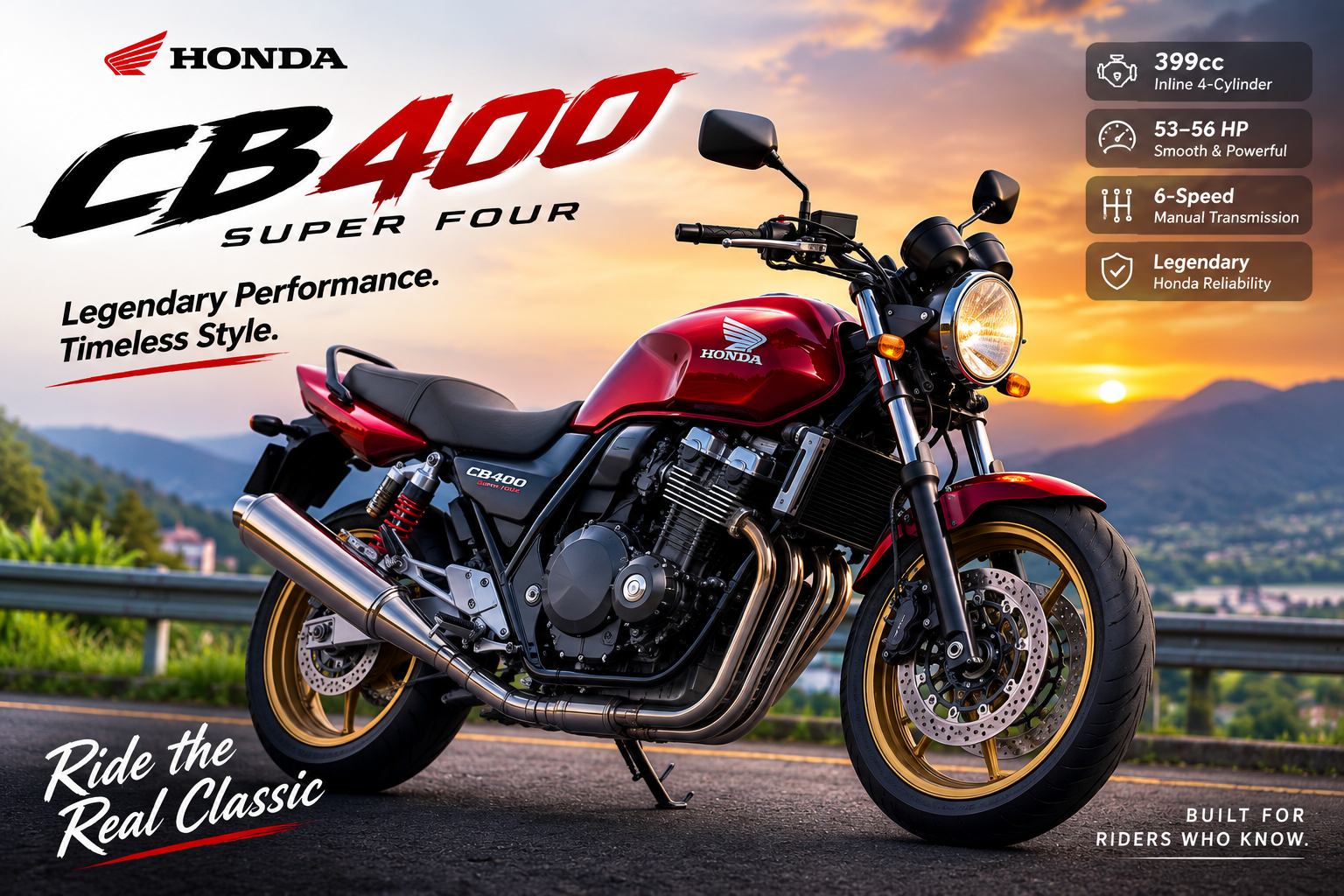
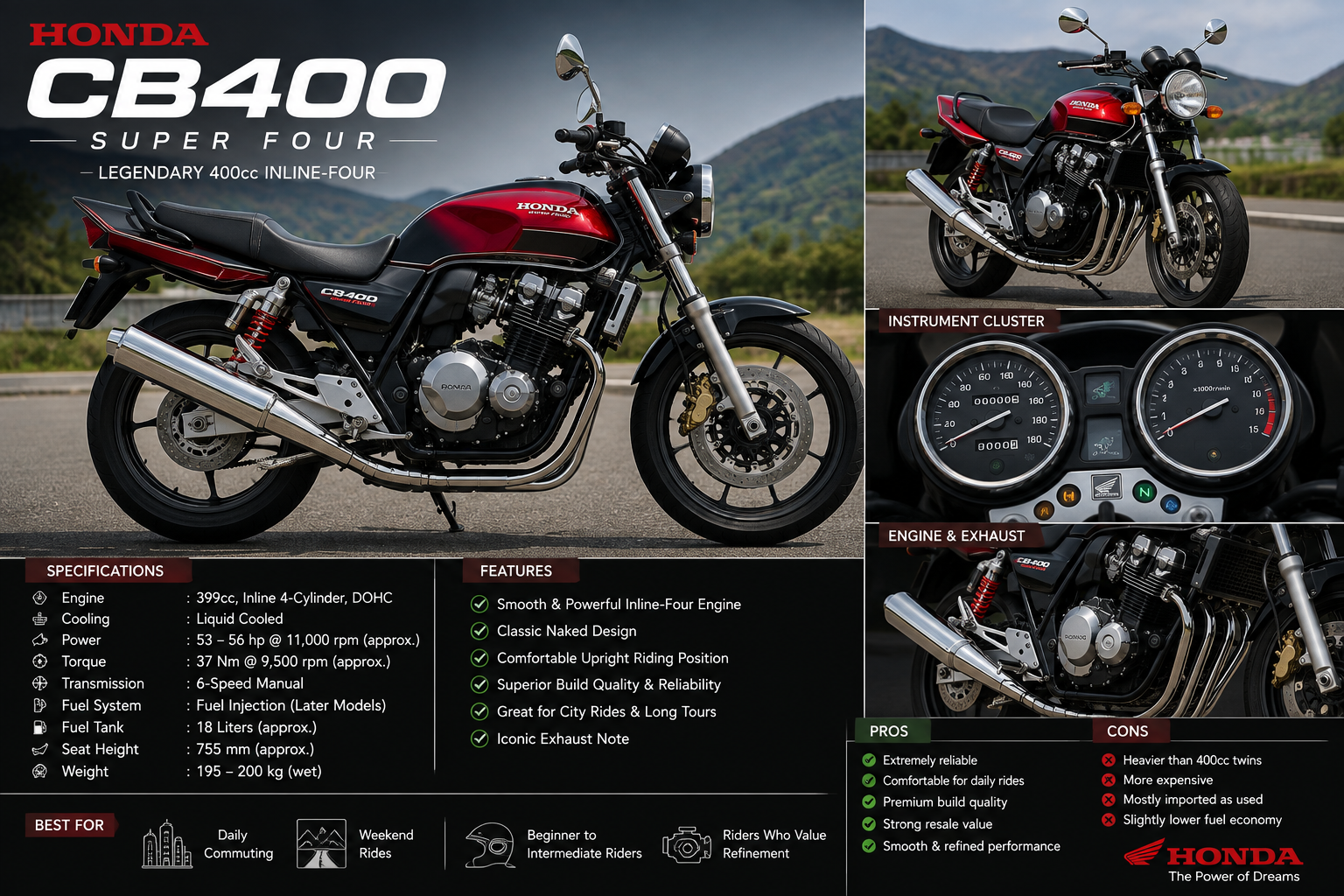
Some motorcycles are merely popular. The Honda CB400 Super Four is something else entirely — it is a benchmark. A machine that defined what a 400cc naked motorcycle should be for thirty consecutive years, and whose absence between 2022 and 2026 created a gap that no rival quite managed to fill.
Now it’s back.
Honda has confirmed production and delivery dates for two long-anticipated small-capacity motorcycles, the CB400 Super Four E-Clutch and the fully faired CBR400R Four E-Clutch, both of which will begin arriving at select Japanese dealerships later this summer, marking the revival of one of the company’s most iconic naked-bike platforms. This isn’t just a revival of the old model either, but a clean-sheet design — complete with the first all-new 400-class Honda four-cylinder engine in decades.
That’s the headline. A brand-new engine, Honda’s E-Clutch technology, throttle-by-wire, modern electronics — all in a bike that looks like a love letter to the CB400’s own history. If you’ve been waiting for this, the wait is over. If you’ve never heard of the CB400 before, you’re about to understand why so many riders care so deeply about it.
This is the most complete Honda CB400 guide available in 2026. Every spec, every feature, every rival, the full history — all in one place.
1. What Is the Honda CB400? Overview & Significance
The CB400 Super Four — A Legend Returns
The CB400 Super Four is something of a Honda legend. In production for 30 years, its demise in 2022 marked the brand’s exit from the 400cc four-cylinder class, which had been a staple part of the company’s output since the CB400F of 1974. The CB400 embodies the typical Universal Japanese Motorcycle produced through the 1970s, updated with modern technology. To this end, the bike has a naked retro design, paired with a smooth inline-four engine.
What that means in practice: the CB400 has always been the bike that lets you feel what a proper four-cylinder engine can do — the linear power delivery, the high-revving character, the sound — without the size, weight, or price of a litre-class machine. That has been its appeal since the beginning, and the 2026 model preserves it entirely while adding technology that the original engineers could only have dreamed of.
Who Is the CB400 Built For?
The automated clutch is aimed primarily at younger and less experienced riders. The CB400 Super Four launched in 1992 and was built for roughly three decades at the Kumamoto plant. It emerged from the CB-1 and became a fixture for younger and learner riders — in Japan, it even served as a riding school model.
But the CB400’s audience has always been broader than that. Yes, it’s a natural first serious bike. But it’s also the machine that experienced riders return to — for the city, for the back roads, for the pure enjoyment of a well-sorted 400cc four-cylinder that rewards smooth riding rather than demanding brute force.
CB400 vs CB400F — Understanding the Lineage
The CB400 name has appeared on more than one Honda over the decades. Here’s how to keep them straight:
| Model | Years | Engine |
|---|---|---|
| Honda CB400F | 1974–1977 | 408cc inline-four, 37 hp |
| Honda CB400 Super Four | 1992–2022 | 399cc inline-four, various states of tune |
| Honda CB400 Super Four E-Clutch | 2026–present | 399cc inline-four, 58 PS, E-Clutch |
The CB400F was the ancestor. The CB400 Super Four was the 30-year dynasty. The 2026 E-Clutch model is the next chapter.
2. Honda CB400 History — From 1974 to 2026
The Original CB400F (1974–1977) — Where It All Began
The story of the CB400 starts not in 1992 but in 1974, when Honda released the CB400F — a 408cc inline-four with a distinctive 4-into-1 exhaust that was considered one of the most beautiful production motorcycles of its era. It was small, rev-happy, and sounded magnificent.
The CB400F was a breakthrough machine. It proved that you didn’t need a large-displacement engine to deliver a genuinely exciting four-cylinder riding experience. That foundational idea would define the CB400 name for the next fifty years.
CB400 Super Four Era (1992–2022) — 30 Years of Dominance
The CB400 Super Four launched in 1992 and was built for roughly three decades at the Kumamoto plant. It emerged from the CB-1 and became a fixture for younger and learner riders — in Japan, it even served as a riding school model. The CB400 Super Four was only sold officially in Japan, Australasia, and some other Far East markets. Japanese market bikes are sometimes considered small compared to those built for Europe and the Americas, but Australian testers expressed surprise that compared to rivals, the new Honda fitted Aussie riders well. It was popular in Australia and New Zealand as it could be ridden by learner riders in those countries. It did not take long for rival manufacturers to cotton on to the demand for naked 400s among Japanese youth, Suzuki creating the original sporty Bandit, a 60bhp rocket ship which resulted in the birth of the whole long-running Bandit range. They raided their own heritage for the slightly less powerful 400 Katana, while Yamaha was a little more staid with the XJR400, and Kawasaki built the 62bhp ZRX400, a homage to the early 1980s KZ1000R Eddie Lawson replica.
Despite all that competition, the CB400 Super Four outlasted every single one of those rivals.
The VTEC Years — Hyper VTEC Spec I Through Revo
Over the years, Honda kept developing the engine further, including with the VTEC system, which adjusts valve timing to engine speed.
The Hyper VTEC system — Honda’s variable valve timing technology applied to the CB400 engine — was introduced in 1999. It gave the bike a split personality: mild and manageable at lower revs, then dramatically more alive when the VTEC system cut in above 6,000 rpm, opening all four valves per cylinder for a sudden surge of top-end power. It became one of the most talked-about engineering solutions on any small-capacity motorcycle.
The VTEC system evolved through multiple generations: Hyper VTEC (1999), Hyper VTEC Spec II (2002), Hyper VTEC Spec III (2004), and ultimately the Hyper VTEC Revo (2008), which refined the system further and remained in production through the model’s discontinuation in 2022.
Why Honda Discontinued the CB400 in 2022
Production continued until 2022, giving the model an impressive lifespan. The decision to end production was driven by tightening Euro 5 emissions regulations, which would have required costly engine redevelopment to keep the existing CB400 platform compliant. Rather than update the old engine, Honda made the strategically correct call: wait, design a clean-sheet replacement, and bring it back properly.
The 2026 Revival — Why It Matters
The four-cylinder 400 class appears to be making a big comeback in 2026, with these Honda concepts joining an existing Kawasaki ZX-4RR and newly announced Bimota KB399 duo. Add to this an incoming QJMotor SRK 421 RR from China, and it seems smaller-capacity high-revving machinery is back on the menu.
Honda’s timing is perfect. The appetite for compact inline-fours has been rekindled by the Kawasaki ZX-4RR and ZX-4R, and the CB400’s return adds the most storied nameplate in the segment back into the conversation — with modern technology that makes the new model far more than a nostalgia exercise.
3. Honda CB400 2026 Price & Availability
Japan Launch Price & Date
Honda Motor Co., Ltd. will release the new naked road sport model “CB400 SUPER FOUR E-Clutch” equipped with a newly designed water-cooled inline 4-cylinder 399cc engine on August 21. Pricing for the two models has also been confirmed, with the CB400 Super Four E-Clutch set at 998,800 Japanese yen, or roughly £4,600. At current exchange rates that also equates to approximately $6,100 USD — an extraordinary price point for an inline-four with E-Clutch, throttle-by-wire, and modern electronics as standard. According to Honda Japan, the naked CB400 Super Four E-Clutch will reach select “Dream” dealerships first, on August 21, with the sportier CBR400R Four E-Clutch following roughly one month later, on September 18. The sales target is 4,600 units per year — a deliberate, measured reintroduction rather than a mass-market flood.
Will the CB400 Come to the UK, Europe & US?
At this time, their arrival in the UK is unknown, with a spokesperson telling MCN: “We have no comment to make at the moment on possible future additions to our European line-up.” Although vague, the current increased appetite for smaller-capacity four-cylinder machinery in the market, spurred on by the likes of the Kawasaki ZX-4RR, and incoming QJMotor SRK421RR, is likely to drive plenty of UK customer interest in dealers. At this time, Honda has announced the CB400 Super Four E-Clutch for Japan, so there’s no telling if it will ever come to the US. When the CB400 Super Four launches on August 21st, it’s slated to retail from just 998,800 yen (~$6,100). Hopefully, then, Honda has the sense to bring this thing Stateside. How could something this approachable and retro not be a hit at that price?
The honest answer is that international availability is not confirmed but is widely anticipated if the Japanese launch sells strongly. Watch this space.
4. Honda CB400 Super Four 2026 Full Specifications
Engine & Performance
The 2026 Honda CB400 Super Four brings back the small inline-four: 399cc, around 58 hp at 11,500 rpm, E-Clutch and throttle-by-wire. At the heart of the 2026 CB400 is a refined 399 cc liquid-cooled engine designed to deliver smooth and predictable power. While many modern middleweight motorcycles rely on twins or singles, Honda continues embracing the multi-cylinder experience. This isn’t just a revival of the old model either, but a clean-sheet design — complete with the first all-new 400-class Honda four-cylinder engine in decades.
E-Clutch System Explained
As evidenced by the name, it touts Honda’s E-Clutch wizardry. Should you not already be familiar with the feature, it allows for optional clutch actuation and virtually stall-free riding, regardless of what gear is selected (though it does require some human engagement for shifts). The system is complemented by throttle-by-wire, an electronic throttle for direct throttle response. Honda first introduced the E-Clutch in 2024 on the CB650R and CBR650R before rolling it out across the range, including the Rebel 300 and the Transalp XL750.
Chassis, Frame & Suspension
The SF gets an extra litre in its fuel tank — taking it to 15 — with both machines wearing a set of blacked-out upside down forks, plus a mono shock tucked behind the dual-sided swingarm. Front brakes come courtesy of dual Nissin radial calipers, with both models also fitted with a USB-C output near the clocks.
Full Spec Sheet
| Specification | Detail |
|---|---|
| Engine | 399cc liquid-cooled DOHC 16-valve inline-four |
| Bore x Stroke | 55 mm × 42 mm |
| Compression Ratio | 11.3:1 |
| Power | ~58 PS @ 11,000 rpm |
| Torque | 39 N·m @ 9,500 rpm |
| Transmission | 6-speed, wet multi-plate |
| Clutch | Honda E-Clutch (automated) |
| Front Suspension | Blacked-out USD (inverted) forks |
| Rear Suspension | Monoshock |
| Front Brakes | Dual Nissin radial calipers, ABS |
| Rear Brake | Single disc, ABS |
| Front Tyre | 120/60 ZR17 |
| Rear Tyre | 160/60 ZR17 |
| Wheelbase | 1,410 mm |
| Seat Height | 755 mm (29.7 in) |
| Fuel Tank | 15 litres |
| Kerb Weight | ~187 kg |
| Display | 5-inch TFT colour screen |
| Connectivity | USB-C charging port |
5. Honda CB400 Key Features — What’s New in 2026
Honda E-Clutch — The Game Changer
The single biggest addition to the 2026 CB400 over any previous generation is the E-Clutch. This is not an automatic transmission — the CB400 retains its 6-speed manual gearbox and the rider still selects gears. What the E-Clutch does is automate the clutch lever operation itself.
It allows for optional clutch actuation and virtually stall-free riding, regardless of what gear is selected. In practice: pull away without touching the clutch lever. Stop at traffic lights without stalling. Concentrate entirely on throttle and steering inputs while the system handles clutch engagement and disengagement.
For new riders, this eliminates the most common source of anxiety in early riding. For experienced riders, it reduces fatigue in heavy city traffic and allows greater focus on the road ahead. It’s a win at both ends of the experience spectrum.
Throttle-By-Wire & Riding Modes
Throttle-by-wire replaces the mechanical cable connection between the twistgrip and the throttle bodies with an electronic signal, allowing the bike’s ECU to modulate power delivery intelligently. This enables riding modes — adjusting throttle response and power curve to suit different conditions.
At the heart of the 2026 CB400 is a refined 399 cc liquid-cooled engine designed to deliver smooth and predictable power. While many modern middleweight motorcycles rely on twins or singles, Honda continues embracing the multi-cylinder experience. The result is a motorcycle that revs freely, sounds engaging, and delivers power progressively throughout the range.
5-Inch TFT Display & USB-C Connectivity
Rev-happy inline-four, E-Clutch, modern electronics with 5-inch TFT, low seat height, affordable Japanese pricing. The full-colour TFT display brings the CB400’s instrumentation into 2026 proper — displaying riding mode, gear position, fuel level, trip information, and potentially smartphone connectivity. Both models are also fitted with a USB-C output near the clocks — allowing in-saddle device charging without any additional wiring.
Design — Styled After the CB1000F
This little 400 borrows its striking looks from the CB1000F that’s coming stateside, that bike also being a tribute to a historic Honda ridden by AMA legend “Fast” Freddie Spencer back in the 1970s. The upright retro Super Four potentially makes a better case for itself — acting as a stepping stone to the similarly styled CB1000F naked that arrives for 2026 powered by a de-tuned 2017 Honda Fireblade superbike engine.
The visual family resemblance is clear and deliberate — sharing the CB1000F’s round headlight, muscular tank, and compact tail section, but scaled down to 400cc proportions. It’s a bike that looks like it belongs in Honda’s premium naked lineup rather than in the budget commuter shelf.
USD Forks & Monoshock
Both machines wearing a set of blacked-out upside down forks, plus a mono shock tucked behind the dual-sided swingarm. Upside-down (USD) forks are a significant upgrade over the conventional telescopic units on the previous generation CB400 Super Four, offering greater rigidity and reduced unsprung weight for better handling response.
6. Honda CB400 Colour Options
The color variations include “Wolf Silver Metallic,” “Matte Ballistic Black Metallic,” “Ross White,” and “Candy Chromosphere Red,” for a total of four colors.
| Colour | Character |
|---|---|
| Wolf Silver Metallic | The launch hero colour — clean and premium |
| Candy Chromosphere Red | Honda’s signature red — a nod to the CB400’s heritage |
| Matte Ballistic Black Metallic | The understated street option |
| Ross White | Clean and modern |
The Candy Chromosphere Red will be the most popular choice for returning CB400 fans. The Wolf Silver Metallic best showcases the new bodywork details in daylight. Both are equally desirable — the choice largely comes down to whether you want to celebrate the heritage or start fresh.
7. Real-World Riding Experience
City Riding — How It Feels in Traffic
In city riding, the throttle response feels natural and unintimidating. The bike moves through traffic effortlessly, thanks to its balanced low-end torque.
The E-Clutch transforms the city riding experience. Stop-start traffic — historically the most tiring element of urban motorcycling — becomes genuinely relaxed. The system handles clutch engagement as you pull away, and disengages cleanly as you brake to a stop. You simply concentrate on where you’re going.
At 755mm seat height and approximately 187kg, the CB400 is also physically manageable in tight spaces. It’s narrow enough to filter confidently, light enough to maneuver at low speed, and short enough to feel planted at traffic lights.
Highway & Open Road Performance
On open roads, the engine becomes more expressive as the revs climb, offering a satisfying mid-range and a clean top-end pull that encourages enthusiastic riding. Gear shifts are crisp, and the six-speed gearbox performs reliably whether commuting or cruising at highway speeds.
At 58 PS, the CB400 has more than enough power for sustained highway cruising. The inline-four’s character is what makes it special — it doesn’t just deliver power, it delivers interest. The engine note rises through the rev range in a way that parallel-twins and singles simply cannot replicate.
Handling, Chassis & Suspension Feel
The USD forks are a significant upgrade over the previous generation. Combined with the rear monoshock and the dual-sided swingarm, the 2026 CB400 chassis provides a more confidence-inspiring platform through corners than its predecessor.
The 2026 Honda CB400 stays loyal to its naked roadster roots. Honda has kept the styling simple yet purposeful, with clean lines, a muscular tank, and a slightly modernized tail section. The overall design is not aggressively sporty, nor is it overly retro.
That applies equally to the handling character. It’s not a trackday machine. It doesn’t want to be. But it flows through a series of bends with a natural, rewarding rhythm that is entirely appropriate for a motorcycle in this class.
Is the CB400 Good for Beginners?
Yes — and it always has been. It emerged from the CB-1 and became a fixture for younger and learner riders — in Japan, it even served as a riding school model.
The 2026 model makes the learning curve even more accessible through the E-Clutch system. A new rider who has never managed a clutch lever can focus entirely on road awareness, throttle control, and braking — with the E-Clutch handling what is typically the most anxiety-inducing element of learning. It’s arguably the most beginner-friendly technology Honda has applied to this class of motorcycle.
8. Honda CB400 Pros and Cons
Pros
- All-new clean-sheet 399cc inline-four engine — the class benchmark
- Honda E-Clutch as standard — genuinely transformative for all skill levels
- Throttle-by-wire with riding mode selection
- 5-inch TFT full-colour display — class-leading electronics at this price
- USD (inverted) forks — a hardware upgrade over the previous generation
- Monoshock rear suspension — more sophisticated than twin-shock predecessors
- 755mm seat height — accessible for most rider heights
- Iconic CB400 heritage and brand trust
- ¥998,800 Japan pricing — outstanding value for the specification
- USB-C charging as standard
- Four colour choices including classic Candy Chromosphere Red
Cons
- Currently Japan-only — no confirmed UK, EU, or US availability
- 187kg kerb weight — heavier than direct rivals like Kawasaki Z400 (166kg)
- 43kW power output makes it non-A2-compliant for European licensing rules
- No official international pricing or dealer network outside Japan yet
- E-Clutch system is new to this platform — long-term reliability unproven on the CB400 specifically
- 15-litre fuel tank is modest for longer-distance riding
- No adjustable suspension as standard
9. Honda CB400 vs Competitors
CB400 vs Kawasaki Z400
| Feature | Honda CB400 (2026) | Kawasaki Z400 |
|---|---|---|
| Engine | 399cc inline-four | 399cc parallel-twin |
| Power | ~58 PS | ~45 PS |
| Clutch | E-Clutch (automated) | Conventional manual |
| Display | 5-inch TFT | LCD |
| Weight | ~187 kg | ~166 kg |
| Seat Height | 755 mm | 785 mm |
| Availability | Japan only (2026) | Worldwide |
Verdict: The CB400 wins on power, cylinder count, seat height, and technology. The Z400 wins on weight and global availability. If you can get your hands on a CB400, it is the more interesting machine by a significant margin.
CB400 vs Yamaha MT-03
| Feature | Honda CB400 (2026) | Yamaha MT-03 |
|---|---|---|
| Engine | 399cc inline-four | 321cc parallel-twin |
| Power | ~58 PS | ~42 PS |
| E-Clutch | Yes | No |
| TFT Display | Yes | No (standard) |
| Weight | ~187 kg | ~168 kg |
| Seat Height | 755 mm | 780 mm |
Verdict: The CB400 has a significant technology and power advantage. The MT-03 is lighter and globally available. For riding experience, the inline-four CB400 is in a different league of engagement.
CB400 vs KTM 390 Duke
| Feature | Honda CB400 (2026) | KTM 390 Duke |
|---|---|---|
| Engine | 399cc inline-four | 399cc single-cylinder |
| Power | ~58 PS | ~46 PS |
| E-Clutch | Yes | No |
| Character | Smooth inline-four | Aggressive single |
| Weight | ~187 kg | ~179 kg |
| Availability | Japan only | Worldwide |
Verdict: Completely different character. The KTM is aggressive, light, and worldwide-available. The CB400 is smooth, sophisticated, and inline-four. Different bikes for different riders — but the CB400’s technology package is superior.
CB400 vs Kawasaki ZX-4RR
The four-cylinder 400 class appears to be making a big comeback in 2026, with these Honda concepts joining an existing Kawasaki ZX-4RR.
| Feature | Honda CB400 (2026) | Kawasaki ZX-4RR |
|---|---|---|
| Engine | 399cc inline-four | 399cc inline-four |
| Power | ~58 PS | ~77 PS |
| Style | Naked retro | Fully-faired sportsbike |
| E-Clutch | Yes | No |
| Seat Height | 755 mm | 785 mm |
| Weight | ~187 kg | ~183 kg |
Verdict: Both share the inline-four format but are aimed at completely different riders. The ZX-4RR is a track-oriented sportsbike with significantly more power. The CB400 is the accessible, everyday machine with the better technology package for everyday use.
CB400 vs Honda CB500F
Japan is set to gain a brand-new CB400 Super Four while other markets could receive the identical looking, but more powerful, CB500 Super Four.
If you’re outside Japan and can choose between the CB400SF and the CB500SF when both become available, the CB500SF’s larger engine will offer more A2-license compliance potential for European markets and more highway capability. But the CB400SF is the historically significant nameplate — and for many riders, that matters.
10. Resale Value & Used Market Guide
The CB400 Super Four’s resale value has historically been exceptional in Japan. Production continued until 2022, giving the model an impressive lifespan — and even used examples from the final Hyper VTEC Revo generation hold their value remarkably well in the Japanese domestic market.
With the 2026 relaunch, used values for late-model previous-generation CB400s (2015–2022) are likely to increase further as buyers who cannot access the new model seek clean examples of the previous generation. If you find a well-maintained Hyper VTEC Revo example, it remains a highly desirable used purchase.
For the 2026 model, expect strong resale — the combination of Honda build quality, iconic nameplate, and limited Japan-only supply will support values for the foreseeable future.
11. Common Issues & Maintenance Tips
Previous Generation CB400 Known Issues
The previous-generation CB400 Super Four is one of the most reliable small-capacity motorcycles ever produced. Common maintenance items include:
| Item | Interval / Note |
|---|---|
| Engine oil change | Every 3,000–5,000 km |
| Spark plugs | Every 16,000 km |
| Valve clearance check | Every 16,000 km |
| Chain lubrication | Every 800–1,000 km |
| Brake fluid | Every 2 years |
| VTEC solenoid (older models) | Check at 40,000+ km |
| Cam chain tensioner | Monitor for noise at high mileage |
2026 Model — What to Watch
The 2026 CB400 E-Clutch is brand new. Until more long-term data accumulates, pay particular attention to:
- E-Clutch actuator wear — a new system with limited mileage data at this stage
- Throttle-by-wire sensors — keep the throttle body clean
- Engine oil specification — use only Honda-recommended grade for E-Clutch compatibility
Follow the service schedule in your owner’s manual strictly for the first 20,000 km to build a reliable service history and maintain warranty validity.
12. Is the Honda CB400 Worth Buying in 2026?
The Honda CB400 has always held a special place among motorcycle enthusiasts, blending practicality with a signature smooth inline-four character rarely found in the 400cc category. With the arrival of the 2026 Honda CB400, Honda attempts to preserve the spirit of the classic Super Four while updating it for modern expectations in performance, technology, and everyday usability.
The honest verdict: if you can buy one, yes — unreservedly.
Between the retro style, the approachable size, and the trick E-Clutch tech, there was a lot to be excited about. And the production model has delivered on every aspect of that excitement.
At ¥998,800 in Japan, the 2026 CB400 Super Four E-Clutch offers a specification level — inline-four engine, E-Clutch, throttle-by-wire, USD forks, monoshock, 5-inch TFT — that would command significantly higher prices on any rival motorcycle. How could something this approachable and retro not be a hit at that price?
The limitations are real: Japan-only for now, heavier than some rivals, not A2-compliant for European license rules. None of those things diminish what the bike is. They just limit who can easily access it — for the time being.
13. Frequently Asked Questions (FAQ)
Q1: What is the Honda CB400 Super Four? A: The Honda CB400 Super Four is a CB series 399cc standard motorcycle produced by Honda at the Kumamoto plant from 1992 to 2022, and then since 2026. It features a naked retro design and a smooth inline-four engine — one of the most iconic 400cc motorcycles ever built.
Q2: What is the 2026 Honda CB400 price? A: The CB400 Super Four is slated to retail from just 998,800 yen (~$6,100). In GBP, this equates to approximately £4,600 at current exchange rates.
Q3: Does the 2026 CB400 have E-Clutch? A: The CB400SF E-Clutch introduced Honda’s E-Clutch technology which automatically controls the clutch, and a throttle-by-wire system which contributes to direct throttle response.
Q4: Is the CB400 available in the UK, Europe, or US? A: Whether the rest of the world eventually gets a chance to buy either motorcycle remains an open question, one that will likely depend on how strongly the bikes perform in their home market and how much international demand continues to build.
Q5: What engine does the 2026 CB400 Super Four use? A: The 2026 Honda CB400 Super Four brings back the small inline-four: 399cc, around 58 hp at 11,500 rpm, E-Clutch and throttle-by-wire.
Q6: Is the Honda CB400 good for beginners? A: Yes. It emerged from the CB-1 and became a fixture for younger and learner riders — in Japan, it even served as a riding school model. The 2026 E-Clutch makes it even more accessible for new riders.
Q7: What colours does the 2026 CB400 come in? A: The color variations include “Wolf Silver Metallic,” “Matte Ballistic Black Metallic,” “Ross White,” and “Candy Chromosphere Red,” for a total of four colors.
Q8: How does the CB400 compare to the previous VTEC model? A: The 2026 model is a complete clean-sheet redesign. The new generation replaces the previous CB400 Super Four V-TEC II and the sportier CBR400RR, nicknamed Baby Blade. Key upgrades include the E-Clutch, throttle-by-wire, USD forks, a monoshock rear, a 5-inch TFT display, and an entirely new engine producing more power than any previous production CB400.
14. Final Verdict & Conclusion
The return of the Honda CB400 Super Four is not just another model launch. It is the return of a philosophical statement: that a four-cylinder motorcycle doesn’t have to be large, expensive, or intimidating to be genuinely rewarding.
The Honda CB400 has always held a special place among motorcycle enthusiasts, blending practicality with a signature smooth inline-four character rarely found in the 400cc category. The 2026 model preserves everything that made that reputation — and adds a technology package that makes the case for the CB400 stronger than it has ever been. The upright retro Super Four potentially makes a better case for itself — acting as a stepping stone to the similarly styled CB1000F naked. It is the ideal starting point for riders moving toward larger machinery, and simultaneously a genuinely enjoyable endpoint for those who simply want a brilliant, characterful 400cc machine without complication.
Whether you’re a returning CB400 fan, a new rider looking for the best way into serious motorcycling, or an experienced rider who appreciates what an inline-four can do in a compact, well-sorted package — the 2026 Honda CB400 Super Four E-Clutch is the answer to the question the 400cc class has been waiting four years for someone to ask again.